ACE Conference 2026

Ethanol and Motorcycles Mix it Up

Cindy Zimmerman

Ethanol Report PodcastThe Renewable Fuels Association (RFA) proved once again this year that ethanol and motorcycles do mix well together.

This edition of “The Ethanol Report” features the 71st Annual Sturgis Motorcycle Rally held August 8-14 in Sturgis, SD.

RFA at SturgisRFA Director of Market Development Robert White and his father Jere White, Executive Director of the Kansas Corn Growers, talk about the importance of reaching motorcycle lovers with information about ethanol. You’ll also hear comments about ethanol from Buffalo Chip Campground owner Rod “Woody” Woodruff, Mrs. South Dakota Lori Visker, Survivor star Rupert and a biker from Australia.

Pictured here giving away ethanol “Fueled with Pride” tee shirts at Sturgis are – from right to left – are Robert White, his fiancee Denita Elliss, and Doug Brandmahl, a biker from Virginia. Lots more photos from Sturgis can be viewed in the 2011 Sturgis Motorcycle Rally Photo Album.

Listen to or download the Ethanol Report here: Ethanol Report on 2011 Sturgis Motorcycle Rally

Audio, Ethanol, Ethanol News, Ethanol Report, Sturgis

Gator Fat Could Make Biodiesel

Cindy Zimmerman

Once upon a time, an oil company used the slogan “Put a Tiger in Your Tank.” Someday, it could be “Put a Gator in Your Tank.”

Scientists have identified a new and unlikely raw material for biodiesel in alligator fat, according to a research published in the American Chemical Society’s Journal Industrial & Engineering Chemistry Research.

Researchers at the University of Louisiana showed in laboratory experiments that oil extracted from alligator fat can easily be converted into biodiesel. They say the oil is actually more suitable for biodiesel production than oil produced from some other animal fats. The gator biodiesel is similar in composition to biodiesel from soybeans, and meets nearly all of the official standards for high quality biodiesel.

Alligator fat is a byproduct from the alligator meat processing industry, which each year disposes of about 15 million pounds of alligator fat in landfills. The alligators are harvested from the wild and from alligator farms for their skin and meat. Louisiana and Florida account for the highest populations of alligators in the United States.

Read more about the research here.

advanced biofuels, Biodiesel, feedstocks

Farm Broadcast Content Favorites

Chuck Zimmerman

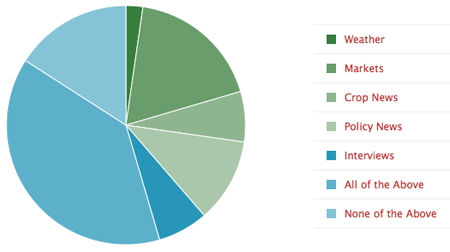
Our latest ZimmPoll asked the question, “What do you like best about farm radio?” You know that biofuels are certainly part of farm broadcast programming! You see farm broadcasters at many biofuel industry events.

So here’s what the results are in order of most responses. 39% said All of the Above, 18% said Markets, 16% said None of the Above, 11% said Policy News, 7% said Crop News and same for Interviews and only 2% said Weather. We also had a comment posted on AgWired that said, “The localization and attachment to the farm broadcaster who is most familiar with the area ag news beat.” So what do you think about these results?

Our new ZimmPoll is now live. We’re asking the question, “Which of these Fall Farm Shows Will You Attend?” I’m sure we’ll be seeing more new technology related to biofuels feedstock production at these shows. Thanks.

ZimmPoll is sponsored by Rhea+Kaiser, a full-service advertising/public relations agency.

ZimmPoll

Navy, Energy and USDA Partner for Advanced Biofuels

Cindy Zimmerman

The Obama Administration today announced a partnership between the private sector and the U.S. Departments of Agriculture, Energy and Navy to produce advanced drop-in aviation and marine biofuels to power military and commercial transportation.

President Obama made the announcement during a stop in Iowa, at the same time the three department secretaries held a telephone conference call with the press. Secretary of Agriculture Tom Vilsack, Secretary of Energy Steven Chu, and Secretary of the Navy Ray Mabus announced that they have developed a plan to jointly construct or retrofit several drop-in biofuel plants and refineries.

“America’s long-term national security depends upon a commercially viable domestic biofuels market that will benefit taxpayers while simultaneously giving Sailors and Marines tactical and strategic advantages,” said Navy Secretary Ray Mabus. “Today’s announcement not only leverages our home grown fuel sources to support our national security, but it also helps advance the biofuels market, which ultimately brings down the cost of biofuels for everyone.”

“By building a national biofuels industry, we are creating construction jobs, refinery jobs and economic opportunity in rural communities throughout the country,” said Agriculture Secretary Vilsack. “As importantly, every gallon of biofuel consumed near where it is produced cuts transportation costs and, for the military, improves energy security.”

“These pioneer plants will demonstrate advanced technologies to produce infrastructure-compatible, drop-in renewable fuels from America’s abundant biomass resources,” said Energy Secretary Chu. “It will support development of a new, rural-focused industry that will replace imported crude oil with secure, renewable fuels made here in the U.S.”

The joint plan calls for the three Departments to invest a total of up to $510 million with at least a one to one match from private industry in an effort to reduce U.S. reliance on foreign oil and create jobs while positioning American companies and farmers to be global leaders in advanced biofuels production.

Listen to the entire press conference here: Navy, DOE, USDA Press Conference

advanced biofuels, Audio, biofuels, biojet fuel, Ethanol, Ethanol News, Government

President Visiting Three of Top Four Ethanol States

Cindy Zimmerman

During his Midwest bus tour this week, President Barack Obama is visiting three of the nation’s top four ethanol producing states, accounting for more than 42 percent of the country’s ethanol production.

The president’s first audience question today in Minnesota, the number four ethanol state, was “How are you going to use renewable energy to create jobs in the future?”

“One, obviously, is biofuels,” Obama responded. “And a lot of folks here are familiar with corn-based ethanol, but the fact of the matter is the technology is moving where we need to start taking advantage of a whole range of biofuels, using refuse, using stuff that we don’t use for food to create energy. And we are seeing incredible progress on that front, but it’s key to make sure that we continue to make the research and that we also use the incredible purchasing power of the federal government to encourage it.”

The president also noted progress in alternative fuels for aviation, as well as wind, solar and the next generation of electric vehicles. Read the entire transcript of his remarks and audience questions here on the White House website.

Renewable Fuels Association
(RFA) president and CEO Bob Dinneen posted an open letter to President Obama on the E-xchange Blog, encouraging him to embrace his “record of support for ethanol and other domestic renewable fuels” as he travels through the ethanol producing countryside. “Ethanol production is offering jobs that provide a good wage, good benefits, and the opportunity for rural Americans to stay in rural America or move back home,” wrote Dinneen. “Ethanol and the policies that have helped support it are providing benefits to Americans all across the country. American ethanol production is the most successful, efficient, and cost-effective renewable fuel source the world has ever known.”

After his stop in Minnesota Monday morning, Obama visited a farm in the number one ethanol producing state, Iowa. On Tuesday, the president is scheduled to visit Peosta, Iowa and he will travel to number three state Illinois for two stops in the northwest corner of the state on Wednesday.

By the way – the number two ethanol producing state is Nebraska. No stops are scheduled there.

Ethanol, Ethanol News, Government, RFA

Fagen Joins Growth Energy

Cindy Zimmerman

fagenGrowth Energy has added green energy design-builder Fagen, Inc. of Minnesota as an associate member.

“Fagen has worked on construction and design projects for a number of our plant members, so adding them to the team makes perfect sense,” said Growth Energy CEO Tom Buis.

Fagen has been a pioneer in the ethanol industry and is also heavily involved in local, agricultural grassroots initiatives.

“We look forward to working with the Growth Energy team to help educate Americans across the country about the benefits of ethanol,” said Ron Fagen, President and CEO of Fagen Inc.

Ethanol, Growth Energy

ICM to Sponsor Ethanol Fuel for US Auto Club Racing

Cindy Zimmerman

Ethanol plant design-builder ICM, Inc. is partnering with National Biofuels Distribution (NBD) to supply and support the United States Auto Club (USAC) with the high-performance ethanol racing fuel called Ignite. The switch to Ignite was announced just recently by USAC.

The USAC includes more than 600 race teams and 250 annual USAC-sanctioned races, including the Silver Crown Series, National Sprint Car Series, National Midget Series, and Traxxas TORC Series. USAC racers are expected to use about 2.5 million gallons of the ethanol racing fuel annually. According to ICM, research this year on Ignite E90 ethanol fuel will provide performance data for a consistent ethanol blend, a standard expected by racing industry experts. ICM anticipates the expansion of Ignite Racing Fuel into additional racing series in 2012 and 2013.

Dan Schwartzkopf of ICM, former owner of Renova Racing’s six-car team, will be offering his past experiences, knowledge, and contacts to the effort. “ICM views the Ignite Fuel/USAC agreement as a valuable platform to provide education about the superior performance and low emissions of ethanol, both on track and off,” Schwartzkopf said.

Schwartzkopf has a 20-year, six-series racing background, including helping other racing series adopt the use ethanol, and he will lend his experience to the ICM team providing technical data and expertise to Ignite Fuel.

Domestic Fuel interviewed Schwartzkopf a couple of times in the early years of the Indy series switch to ethanol. You can listen to them here and here.

Ethanol, Ethanol News, Racing

Chrysler and ZeaChem Team Up for Cellulosic Ethanol

Cindy Zimmerman

A leading advanced biofuels company has teamed up with a major automobile maker to speed up the production and use of cellulosic ethanol made from non-food feedstocks.

ZeachemChrysler Group and ZeaChem today announced the formation of a strategic alliance to “strengthen the credibility among regulators and American consumers of cellulosic ethanol as a cost-effective green transportation alternative; move away from the “food for fuel debate;” provide a leadership role to bring cellulosic ethanol through the production value chain to the consumer market; and build awareness of the potential environmental advantages of high yield, low carbon cellulosic ethanol.”

“Chrysler Group has long been committed to promoting the consumption of alternative fuels and to delivering flex-fuel vehicles to our customers,” said Reg Modlin, director, regulatory affairs, Chrysler Group LLC.

“ZeaChem is at the forefront of advanced cellulosic ethanol production,” said Jim Imbler, president and chief executive officer of ZeaChem. “Our process delivers a 40 percent higher yield in ethanol from non-food cellulosic feedstocks. Through strategic alliances we can fast-track the large-scale production of cellulosic ethanol. We look forward to collaborating with Chrysler Group to achieve our mutual goals and bring sustainable advanced cellulosic ethanol to consumers’ vehicles.”

advanced biofuels, Car Makers, Cellulosic, Ethanol, Ethanol News

Wrapping Things Up At Sturgis Motorcycle Rally

Chuck Zimmerman

The 2011 Sturgis Motorcycle Rally is over and that means a lot of bikers went home more aware of ethanol and hopefully better informed about how it performs in their bikes and what it does for our economy. To get a wrap up on how it went for the ethanol promotion sponsored by the Renewable Fuels Association I spoke with Robert White. Here’s Robert with a guitar that was given away during one of our t-shirt distribution sessions.

Robert has been on duty at Sturgis the past two years. He’s seen interest in ethanol grow each year. Bikers are very patriotic people and the fact that ethanol is an American made fuel resonates well with them. He also says, “We’re simply highlighting that fact that ethanol works well not only in these vehicles but all the ones they have back home.” That’s a lot of people back home to spread the word to since there are over a half million people who come to the rally!

You can listen to my interview with Robert here: Robert White Interview

2011 Sturgis Motorcycle Rally Photo Album

Domestic Fuel coverage of the Sturgis Motorcycle Rally is sponsored by The Renewable Fuels Association
Audio, Ethanol, Ethanol News, Promotion, Sturgis

Book Review – Climate Capitalism

Joanna Schroeder

Can we clean up the environment and make money at the same time? The answer is yes according to L. Hunter Lovins and Boyd Cohen, the authors of “Climate Capitalism.” They write, “Two words define the current era: ‘climate’ and ‘capitalism.’ ” The authors begin by talking about America’s economic collapse and then reframe the argument around the environment from one of a moral or environmental issue to one of a “crisis of capitalism.”

The authors write, “What is little recognized is that the twin threats, to the climate and to the economy, are linked in both cause and cure. Unless nations move aggressively to implement energy efficiency and renewable energy, key elements of the transition away from fossil fuels and necessary to save the climate, it is difficult to see how our economy can lift itself from recession or avoid further crises. Solving the climate crisis IS THE WAY OUT of the economic crisis,” (authors’ emphasis).

Now that the stage is set, Lovins and Cohen begin providing case studies of sorts of different companies that have improved their bottom line by investing in energy efficiency and sustainable technologies. For example, Toyota became the largest auto maker in the world through the production of hybrid vehicles and fuel efficient cars while U.S. automakers continued to churn out oversized SUVs when a consumer green shift was taking place.

Conventional thinking around the issue of reducing green house gas emissions has held that averting climate catastrophe will cost the world trillions of dollars during a time countries can’t afford to invest due to the financial crisis. However, the authors argue that climate capitalists will seek out economic opportunities in the context of averting runaway climate chaos that will both mitigate climate change as well as offer profits.

Climate capitalists will be successful, the authors write, because they follow the principles of natural capitalism. The first principle is buying time by using all resources as efficiently as possible. The second principle is redesigning how we make and deliver all products and services using approaches such as cradle-to-cradle concepts, Biomimicry, the circular economy, Design for the Environment, and others.

While the information was interesting, and arguably relevant to supporting the authors’ argument, I found it to be a bit difficult to digest – the cause appeared to be information overload. But I still managed to grasp hold of the big takeaway – if you believe that the world is in fact threatened by climate crisis, then can you afford to not do anything? Lovins and Cohen say no. Those who choose not to plan and invest in a future based on sustainable practices will fail miserably.


book reviews, Environment