Butamax Advanced Biofuels has entered into an agreement on commercialization principles with Highwater Ethanol, a leading ethanol producer based in Lamberton, Minn.
Butamax, a leading global biobutanol technology development company, is working to offer current ethanal producers proprietary biobutanol technology to permit improved biofuels growth and plant profitability.
“We are developing relationships with a group of early adopters. These facilities are among the most efficient, well managed facilities in the United States. Their knowledge and expertise are a complement to the commercialization of Butamax technology,” said Peter Matrai, COO of Butamax.
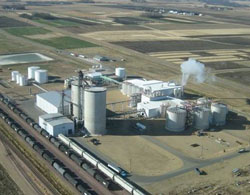
Highwater Ethanol is the first entrant to the Butamax Early Adopters Group. Their ICM-designed facility was constructed by Fagen with a nameplate capacity of 50 million gallons per year.
Biobutanol is a high performing drop-in biofuel that can be blended at higher concentrations than ethanol, without the need for infrastructure changes. At 16 percent volume, biobutanol delivers twice the renewable energy content of 10 percent ethanol blends.
Last year, Butamax announced the addition of a technology laboratory in Paulinia, Brazil to accelerate process development efforts for producing biobutanol from sugarcane. In addition, the Butamax technology demonstration facility in Hull, England is producing biobutanol to support design of commercial facilities.

 By the end of 2011,
 “Voilà has been a very strong part of POET’s business this year, and I’m excited to see more plants getting this technology,” POET founder and CEO Jeff Broin said. “The more we can diversify into new profitable products, the more successful our plants will be.”
 Earlier this week,

 Back in August, the Green Scissors Project identified ways the federal government could shave $380 billion from the federal budget over five years. But their $380 billion in proposed cuts included a major error that accounts for more that 10 percent of their suggested cuts – $38.8 billion that they argued the Volumetric Ethanol Excise Tax Credit would otherwise cost between 2012 and 2016. They conveniently ignored the important fact that there will be no VEETC between those years. VEETC expires about a month from now, and corn growers and the ethanol industry have long agreed to let it expire and have since stopped fighting for its renewal.
 The U.S. Department of Agriculture has announced a new pilot program of insurance for camelina beginning with the 2012 crop year.
 Camelina, an oilseed, is a rotation crop for wheat that can be established on marginally productive land. It is an annual, short season plant. Biofuel from camelina is an ideal jet fuel substitute. USDA’s Agricultural Research Service (ARS) scientists have long-term studies underway to examine ways to use camelina as a bioenergy crop for producing jet fuel for the military and the aviation industry. In addition, earlier this year USDA announced two Biomass Crop Assistance Program (BCAP) project areas devoted to developing camelina as biofuel in several states, including Montana. USDA is also part of several partnerships to develop oilseeds and native and perennial grasses as a biofuels.


 The
 French energy company