 The Chicago Farmers, an agriculture and agribusiness organization, will discuss, “Alternative Energy’s Impact on Farm Income,” at its December meeting, Mon., Dec. 12 at the Illini Center in Chicago.
Fred Iutzi, of the Illinois Institute for Rural Affairs, will provide a strategic overview and update on renewable energy trends and a status of the industry in Illinois. Corn ethanol and soy biodiesel, advanced biofuels from cellulosic biomas, biomass heat and power, and wind and solar power all will be discussed. The presentation will highlight policy and development issues for both large-and small-scale renewable energy projects and connections between Illinois and the wider national energy economy. It will be followed by a question and answer session.
Reservations are due by Fri., Dec. 9. Participants are encouraged to
register early.
 By the end of 2011,
  “Voilà has been a very strong part of POET’s business this year, and I’m excited to see more plants getting this technology,” POET founder and CEO Jeff Broin said. “The more we can diversify into new profitable products, the more successful our plants will be.”
  Earlier this week,
 Back in August, the Green Scissors Project identified ways the federal government could shave $380 billion from the federal budget over five years. But their $380 billion in proposed cuts included a major error that accounts for more that 10 percent of their suggested cuts – $38.8 billion that they argued the Volumetric Ethanol Excise Tax Credit would otherwise cost between 2012 and 2016. They conveniently ignored the important fact that there will be no VEETC between those years. VEETC expires about a month from now, and corn growers and the ethanol industry have long agreed to let it expire and have since stopped fighting for its renewal.
 The U.S. Department of Agriculture has announced a new pilot program of insurance for camelina beginning with the 2012 crop year.
 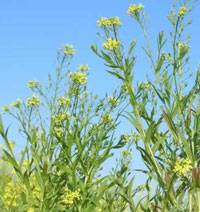 Camelina, an oilseed, is a rotation crop for wheat that can be established on marginally productive land. It is an annual, short season plant. Biofuel from camelina is an ideal jet fuel substitute. USDA’s Agricultural Research Service (ARS) scientists have long-term studies underway to examine ways to use camelina as a bioenergy crop for producing jet fuel for the military and the aviation industry. In addition, earlier this year USDA announced two Biomass Crop Assistance Program (BCAP) project areas devoted to developing camelina as biofuel in several states, including Montana. USDA is also part of several partnerships to develop oilseeds and native and perennial grasses as a biofuels.

 The
The  French energy company