The largest government purchase of biofuels for military application was announced today.
 U.S. Navy Secretary Ray Mabus and U.S. Department of Agriculture Secretary Tom Vilsack jointly announced that the Defense Logistics Agency (DLA) signed a contract to purchase 450,000 gallons of advanced drop-in biofuel.
The biofuel to be purchased is made from a blend of non-food waste (used cooking oil) from the Louisiana-based Dynamic Fuels, LLC, a joint-venture of Tyson Foods, Inc., and Syntroleum Corporation, and algae, produced by Solazyme. The fuel will be used in the U.S. Navy’s demonstration of a Green Strike Group in the summer of 2012 during the Rim of the Pacific Exercise (RIMPAC), the world’s largest international maritime exercise.
“The Navy has always led the nation in transforming the way we use energy, not because it is popular, but because it makes us better war fighters,” stated Secretary Mabus. “This unprecedented fuel purchase demonstrates the Obama Administration’s commitment to seeking energy security and energy independence by diversifying our energy supply.”
“In March, the President challenged me, Secretary Mabus, and Secretary Steven Chu to work with the private sector to cultivate a competitively-priced—and domestically produced—drop-in biofuel industry that can power not just fighter jets, but also trucks and commercial airliners,” said Secretary Vilsack, “Today’s announcement continues our efforts to meet that challenge. This is not work we can afford to put off for another day.”
The biofuel will be mixed with aviation gas or marine diesel fuel for use in the Green Strike Group demonstration.
Read more from USDA and listen to press conference of the announcement.

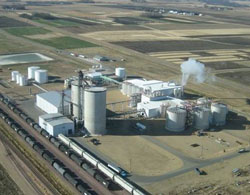

 By the end of 2011,
  “Voilà has been a very strong part of POET’s business this year, and I’m excited to see more plants getting this technology,” POET founder and CEO Jeff Broin said. “The more we can diversify into new profitable products, the more successful our plants will be.”
  Earlier this week,
 Back in August, the Green Scissors Project identified ways the federal government could shave $380 billion from the federal budget over five years. But their $380 billion in proposed cuts included a major error that accounts for more that 10 percent of their suggested cuts – $38.8 billion that they argued the Volumetric Ethanol Excise Tax Credit would otherwise cost between 2012 and 2016. They conveniently ignored the important fact that there will be no VEETC between those years. VEETC expires about a month from now, and corn growers and the ethanol industry have long agreed to let it expire and have since stopped fighting for its renewal.
 The U.S. Department of Agriculture has announced a new pilot program of insurance for camelina beginning with the 2012 crop year.
 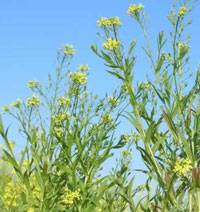 Camelina, an oilseed, is a rotation crop for wheat that can be established on marginally productive land. It is an annual, short season plant. Biofuel from camelina is an ideal jet fuel substitute. USDA’s Agricultural Research Service (ARS) scientists have long-term studies underway to examine ways to use camelina as a bioenergy crop for producing jet fuel for the military and the aviation industry. In addition, earlier this year USDA announced two Biomass Crop Assistance Program (BCAP) project areas devoted to developing camelina as biofuel in several states, including Montana. USDA is also part of several partnerships to develop oilseeds and native and perennial grasses as a biofuels.

 The
The  French energy company