Cobalt Technologies has announced a milestone in the commercial conversion of biomass to sugars with the successful demonstration of its biomass pretreatment process.
 The company, which is developing next generation n-butanol, made the achievement in cooperation with ANDRITZ, a globally leading supplier of technologies, equipment and plants for the pulp and paper industry.
Cobalt conducted the testing in the ANDRITZ pulp and paper mill demonstration facility in Springfield, OH, which is specifically designed to validate new processes before commercial-scale implementation. Cobalt’s dilute acid hydrolysis pretreatment process, which extracts sugars from ligno-cellulosic biomass, was validated on woody biomass, bagasse and agricultural residues.
Cobalt tested its pre-treatment process on both a batch and continuous basis and reports that these runs, while processing up to 20 bone-dry tons of biomass per day, successfully extracted sugars from the biomass without the use of enzymes to produce the desired liquid hydrolysate – a liquid-based sugar that is then converted into n-butanol.
“The hydrolysates produced at ANDRITZ’s demonstration facility have been fermented successfully at our facility in Mountain View, California without the need of any conditioning to remove inhibitory compounds,” Bob Mayer, CEO of Cobalt Technologies. “By proving we can meet, and in some areas, exceed our commercial targets and cost metrics at this scale, we are now well positioned to leverage this critical milestone to support our on-going commercialization efforts.”
This milestone also marks the first phase of Cobalt’s partnership with specialty chemical company, Rhodia in Brazil to develop bio n-butanol refineries throughout Latin America utilizing bagasse as a feedstock.


 The Nebraska Ethanol Board 2012 Emerging Issues Forum will be held next month in Omaha.





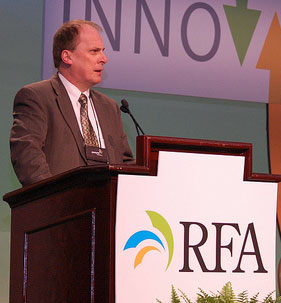 Speaking at the 17th annual
  It was the main topic of the president’s press conference today and Congress will be holding hearings on it this week. From the president to the people at the pump, everyone is talking about higher gasoline prices these days, but ethanol is actually helping to keep them lower than they could be.
 This “Ethanol Report” features an interview with Renewable Fuels Association (RFA) Vice President for Research and Analysis Geoff Cooper on just how ethanol does it. From ethanol’s lower cost at the wholesale level to how it reduces oil demand and prices and provides a cost-effective source of octane, Cooper says “there’s no argument that ethanol is playing a significant role in holding gasoline prices lower than they would be otherwise.”

 Virdia today officially announced the closing of $30 million in private financing and a $75 million loan package from the Mississippi Development Authority to build manufacturing plants in the state.