In a collaborative partnership to promote the use of renewable diesel in its current and next-generation clean diesel passenger vehicles, Volkswagen of America Inc. is partnering with Amyris Inc. and Solazyme Inc., two of the world’s leaders in renewable fuels, to evaluate emissions reductions and demonstrate the performance of Volkswagen’s TDI Clean Diesel technology.

Under the agreements, Volkswagen will provide each company with two products—a new 2012 Passat TDI and a 2012 Jetta TDI—in order to closely examine the effects that the fuels produced by Amyris and Solazyme will have on Volkswagen clean diesel technology and the environment.
“Partnering with two leaders in advanced biofuel technology supports Volkswagen’s goal of offering a competitive suite of technologies that help reduce greenhouse gas emissions, improve fuel efficiency and fit the diverse needs of our customers,” said Jurgen Leohold, head of Volkswagen Group Research. “In order to achieve our long-term desire of bringing CO2-neutral mobility to the market, advanced gasoline and diesel engines like TDI Clean Diesel technology must play a major role; and renewable energies to power these advanced powertrains are needed on a large scale.”
During the year-long evaluation, Volkswagen will measure the environmental impacts from the use of cleaner burning renewable diesel formulas. Initial analysis indicates that while advanced biofuels are comparable to standard diesel blends in terms of performance, there are tremendous opportunities to reduce vehicle emissions.
“Amyris’ renewable diesel’s proven superior cold weather performance, high cetane and comparable energy density to petroleum diesel have enabled us to obtain one of the highest blending registrations certified by the U.S. Environmental Protection Agency,” said Mario Portela, Chief Operating Officer, Amyris. “Our partnership with Volkswagen, like our work in Brazil, where nearly 200 buses are running on various blends of Amyris diesel, is another important milestone in expanding OEM acceptance by showing our fuels eliminate the performance challenges of first generation biofuels while still enabling significant reductions in greenhouse gas and tailpipe emissions.”
“Volkswagen has continually been at the forefront of automotive innovation providing safe, quality, and environmentally sound vehicles to consumers,” said Rogerio Manso, Chief Commercialization Officer, Solazyme. “Solazyme’s 100 percent drop-in renewable diesel is compatible with existing infrastructure and vehicles, and provides the world-class engine manufacturer with an advanced diesel replacement that drives significant Greenhouse Gases (GHG) as well as ground-level emission reductions.”


 April 25-26, 2012 is the date for the new All-Florida Ag Show sponsored by Florida Grower and the Highland County Farm Bureau. The event will take place at the Highlands County Fair Convention Center in Sebring, Florida and will bring together a diverse group of agribusiness leaders ranging from fruits to vegetables to livestock to biofuels. There will also be a wide array of topics discussed during the show including labor, water, alternative energy, crop opportunities and more.
 The
The 

 According to the latest figures from the

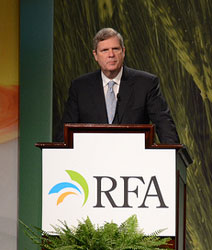 The best way to help the U.S. ethanol industry right now is to encourage the adoption of E15 by fuel retailers, according to Agriculture Secretary Tom Vilsack.