

How do we make the biofuels and bioproduct industry sustainable? This question is answered in the lastest “quick brief” published by Advanced Biofuels USA. According to the paper, the key is the development of low cost, decentralized biomass to biofuel production systems that can economically increase the travel distance of biomass. It is also important to make biomass available year round. Subsequently the industry could become a seamless system ready to meet market supply and demand and bioenergy producers would no longer have to rely on single crops grown close to home.
 The quick brief was authored by Robert Kozak and in the paper he describes the sustainable system as able to “efficiently convert harvested field crops, slash timber, and agricultural residues at their point of production into biofuel and bioproduct precursors [oils or sugars] with sufficient value so they may be economically transported in excess of 500 miles.”
Upon completion of the journey, the paper continues, the biomass arrives at a large-scale biorefinery designed to produce bioproducts from multiple sources of biomass. In many cases, the biorefinery would be co-located with existing petroleum refineries.
Joanne Ivancic, Executive Director of Advanced Biofuels USA noted, “This paper makes clear the importance of committing to decentralized/centralized research in the 2012 Farm Bill. Turning these innovative ideas into realities will allow agricultural communities to remain viable and will bring badly needed jobs to depressed industrial areas. A commitment to this exciting future makes it clear that the Farm Bill benefits all Americans; not only farmers and farming communities.”
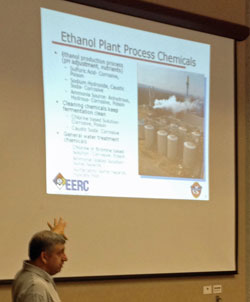 Nearly 160 emergency personnel, first responders, hazmat teams, safety managers, and local emergency planning committee members attended an ethanol safety seminar in Forsyth, Georgia this week.
 Under a joint energy project,
  Virdia’s CASE™ (Cold Acid Solvent Extraction) process uses low temperature, low pressure hydrolysis coupled with its closed loops of acid recovery and solvent extraction to produce high purity fractions of sugars and lignin. Virent’s BioForming platform utilizes a combination of catalytic processes to convert water-soluble oxygenated hydrocarbons derived from biomass to non-oxygenated hydrocarbons that can be used as drop-in compounds in gasoline, jet fuel and diesel fuel. Virent’s BioForming platform catalysts and reactor systems are similar to those found in today’s petroleum oil refineries and petrochemical complexes.
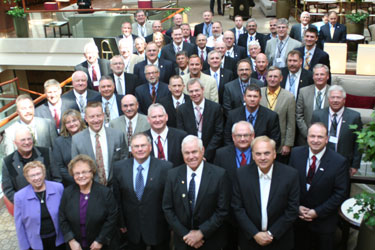 More than 60 grassroots members of the
 The letter addressed to Senate Majority Leader Harry Reid (D-NV), Senator Minority Leader Mitch McConnell (R-KY), House Speaker John Boehner(R-OH) and House Minority Leader Nancy Pelosi (D-CA) highlighted “ethanol’s proven ability to lower gas prices and reduce this country’s dependence upon foreign oil” and pointed out that any changes to the RFS “could dampen investment in the development of next generation biofuels.”
 It may seem like only yesterday the last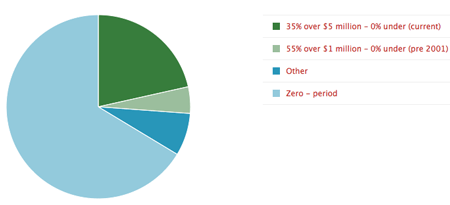

 With the Senate Finance Subcommittee on Energy, Natural Resources, and Infrastructure holding a hearing this week on expired and expiring energy tax incentives, the
  The study,