HCL CleanTech has changed its name to Virdia and announced new funding for the development of cellulosic sugars for biofuels and other uses.
 Virdia today officially announced the closing of $30 million in private financing and a $75 million loan package from the Mississippi Development Authority to build manufacturing plants in the state.
Founded in 2007 as HCL CleanTech, Virdia has developed the CASE™ process, which converts cellulosic biomass to high quality fermentable sugars and lignin, and is based on a series of patented and patent-pending technologies. Cellulosic sugars and lignin are important feedstock for the renewable chemicals industry and the second generation biofuels sector. The company plans to establish its cellulosic refineries close to sustainable sources of biomass.
Virdia also announced a new Chief Executive Officer will be taking the reins of the newly-branded company. Philippe Lavielle replaces co-founder Eran Baniel, who will now serve as vice president of business development. Before joining Virdia, Lavielle was a member of the executive management at Genencor, a $1 billion world leader in industrial enzymes recently acquired by DuPont, where his responsibilities included global business development in the fields of renewable energy and biochemicals.
“This is an exciting and pivotal time for Virdia, and I am pleased to bring my experience to bear in leading the company through its next stage of commercialization,” said Lavielle. “The momentum we are experiencing in funding and our plans to scale up manufacturing move us that much closer to realizing our mission on a large scale. Virdia is well positioned to be the frontrunner in the race to make cellulosic sugars a reality – an indispensable step for the success of the bioeconomy.”
To fund its piloting activities and engineering plans, Virdia recently closed its latest round of financing, raising over $20 million from insiders, Khosla Ventures, Burrill & Company and Tamar Ventures. In addition, the company closed a $10 million in a venture debt deal with Triple Point Capital. The company agreement with the Mississippi Development Authority to build manufacturing facilities includes an incentive package with $75 million in low-interest loans, as well as up to $155 million in various tax incentives over a 10-year period during which Virdia’s cellulosic sugar plants are expected to create hundreds of new jobs in the state.

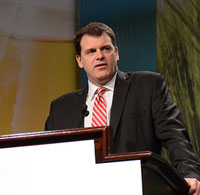 Following on the heels of a rousing speech of Agriculture Secretary Tom Vilsack, Dr. Ostheimer thanked ethanol producers for their contributions to America’s energy portfolio and noted that the energy policy for development of biofuels was deliberately set up to grow slowly. “We understood that increasing this demand would have an effect on global markets and price and so we chose to do so, not in a shocking way, but in a steady, clear and transparent way and the result has been phenomenal.”
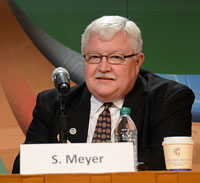 Dr. Meyer opened his remarks by stressing that he is “not opposed to ethanol…expensive oil and gasoline clearly provide an opportunity for ethanol and are a reason that we should continue to make biofuels.”
 At issue is California’s request for a stay of the injunction issued by District Court Judge Lawrence J. O’Neill when he ruled in December that the new fuel regulation issued by the California Air Resource Board (CARB) violated the Commerce Clause and was therefore unconstitutional.
 Rabobank first points out significant changes in U.S. ethanol policy starting in 2012. The VEETC blending credit and a tax on ethanol imports both expired in December 2011 and U.S. ethanol industry groups have shifted their political weight toward initiatives like E15 and advanced biofuels.