RFA E-15 Ad

More Planting This Year

Chuck Zimmerman

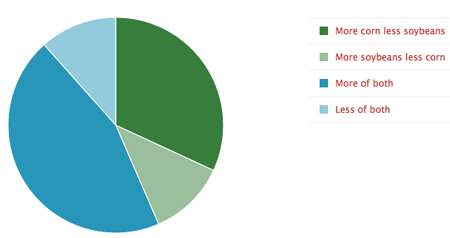
In our latest ZimmPoll we asked, “What will be planted this year?” It’s that time and everyone seems to have their own idea about what it will be. 45% of respondents said More of both, 32% said More corn less soybeans and 12% each said More soybeans less corn and Less of both. USDA is estimating corn acreage will be higher this year and the highest since 1944 with soybean acres nearly the same as last year. What do you think?
Our new ZimmPoll is now live and asks the question, “Is our food system broken?” During the Bayer CropScience Ag Issues Forum one of our speakers was Gawain Kritke, Oxfam America. He told us “our food system is broken.” I think the statement was made out of frustration that we produce more food than we can eat in this country and a huge amount goes to waste. Since we don’t have a system to get waste food to those who need it they seem to believe the food system is broken. I think it’s a provacative statement and would love your thoughts.

ZimmPoll is sponsored by Rhea+Kaiser, a full-service advertising/public relations agency.

ZimmPoll

NBB Raises Money for Industry Advancement

The National Biodiesel Foundation raised nearly $22,000 at its 4th Annual Silent Auction and raffle. Funding benefits outreach, education, research and demonstration activities for the advancement of biodiesel.

“The event not only provides us the opportunity to generate funding but offers a forum to promote the Foundation and showcase current activities and goals,” said Tom Verry, executive director of The Foundation. “We are pleased to see participation of donors and bidders expand over the past years. This is a further indication of the events overall success. We thank all the companies and individuals who donated or participated in the event.”

Additional accomplishments for the National Biodiesel Foundation during 2011 included:

  • • Conducted biodiesel education and training as a participant in the Alternative Fuel Trade Alliance. Specifically, this project (1) increased the number of states that enforce ASTM standards and biodiesel fuel quality; (2) achieved Automotive Service Excellence (ASE) certification for the National Biodiesel Board’s biodiesel technician training curriculum; and (3) trained Clean Cities Coordinators around the country on how to generate and capitalize on media to increase awareness of biodiesel sustainability;
  • • Coordinated and administered the Department of Energy Clean Cities grant which established biodiesel terminals and stations across the US. The primary objective of this project is to displace approximately 86 million gallons of petroleum-based diesel;
  • • Helped promote Bioheat® awareness campaign in New York City achieving significant inroads into a billion gallon heating oil market;
  • • Co-hosted the 3rd Annual Biofuels Science and Sustainability Tour, designed to educate congressional members and their staff on the Iowa renewable fuels industry.
Biodiesel, Education, NBB

Analyst Expects New Biofuels Policy in 2013

Cindy Zimmerman

A global economic analyst expects that Washington may be taking another look at biofuels policy in 2013.

bayer bill lapp“I think more of that will happen when we know more about who controls the Senate and the House, and who’s the president and where the EPA is on all this after November,” said Bill Lapp of Advanced Economic Solutions during an Ag Issues Forum sponsored by Bayer CropScience this week in Nashville who notes that the biofuels industry is facing a number of challenges. “Not only is the corn-based ethanol mandate going from 13.2 billion gallons to 15 billion, gasoline consumption has continued to decrease in the past couple of years, and we have failed miserably in meeting the goals of cellulosic production.”
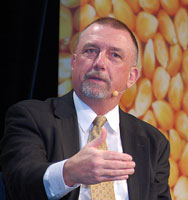
Lapp suggests there may be another incarnation of the Renewable Fuel Standard. “Whether you call it RFS-2A, or whatever you want to call it, I think there has to be thought to what are we going to make those ultimate mandates,” he said. “So Congress is going to have a tremendous challenge.”

Lapp also has concerns about biodiesel production, whether the tax credit will be re-instated, and what the mandate will be for 2013.

Listen to interview with Bill Lapp here: Bill Lapp Interview

Audio, Biodiesel, biofuels, Ethanol, Ethanol News

RFS May Top Farm Bill in Importance to Corn Growers

Cindy Zimmerman

Maintaining the Renewable Fuel Standard (RFS) may be more important to corn growers than a new farm bill.

“If you took a poll of our members, and we may well do that at our Commodity Classic next week, I would say that they view the RFS as more important than the farm bill,” said National Corn Growers Association (NCGA) Vice President of Public Policy Jon Doggett during last week’s National Ethanol Conference.
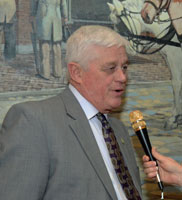
Doggett says it is interesting that even other crop producers besides corn consider the RFS to be very important. “We’ve got to work together on these things, we’ve got to quit trying to figure out who’s the winner and who’s the loser because once we devolve into that kind of discussion, we all lose.”

Listen to or download Doggett’s comments here: Jon Doggett at NEC

garry niemeyerCorn growers are now gathering this week in Nashville for the Commodity Classic, and NCGA president Garry Niemeyer of Illinois says there is a lot of truth in the idea that the RFS is more important to them than the farm bill. “The Renewable Fuel Standard is really what sets the basis for where we are with ethanol,” said Niemeyer. “We’ve worked very hard to make sure that we have a very good Renewable Fuel Standard bill and it is a road map for our future with ethanol.”


At the same time, Niemeyer says they do have recommendations for farm legislation that would cost less taxpayer dollars yet still provide a safety net for growers. “We have adopted the Aggregate Risk and Revenue Management program that has been put forth by Senators Brown, Thune, Durbin and Dick Lugar. Hopefully, we’re going to move that policy forward because that makes the most sense to us,” he said.

Listen to or download an interview with Garry Niemeyer here: Garry Niemeyer Interview

Audio, Commodity Classic, corn, Ethanol, Ethanol News, National Ethanol Conference

ZeaChem to Develop “Drop-In” Advanced Biofuels

ZeachemZeaChem, a developer of biorefineries for the conversion of renewable biomass into sustainable fuels and chemicals, will receive a portion of a $40m grant from USDA’s National Institute of Food and Agriculture (NIFA) through the Agriculture and Food Research Initiative (AFRI) Regional Coordinated Agricultural Project (CAP). The USDA project will establish regional systems for the sustainable production of bioenergy and bio-based products.

ZeaChem will secure $12m of the total $40m grant, and will implement the AFRI project at its existing 250,000 gallon-per-year integrated demonstration biorefinery, located at the Port of Morrow, near Boardman, Ore. The company is creating integrated cellulosic biorefineries, capable of producing a broad portfolio of fuel and chemical products from renewable biomass.

ZeaChem’s role in the USDA project is the logical progression of the company’s phased development strategy, in which it researches and develops potential products at each step toward commercialization. Design of the AFRI project is underway and the equipment modules are expected to be installed in 2013.

“ZeaChem is pleased with the USDA’s support to establish a bioenergy economy in the Pacific Northwest,” said Jim Imbler, president and chief executive officer of ZeaChem. “The grant allows ZeaChem to use our existing integrated demonstration facility to develop advanced biofuels beyond cellulosic ethanol, including bio-based jet, diesel and gasoline. The project highlights one of our unique strengths, which is that we can utilize a variety of biomass feedstocks and proven processes to develop a wide range of economical and sustainable fuel and chemical products.”

Production of bio-based jet and diesel is expected to begin in 2013 and production of bio-based gasoline, part of the C3 product platform, will follow in 2015.

The USDA AFRI Regional CAP is led by the University of Washington and includes GreenWood Resources, Oregon State University, Washington State University, the University of California, Davis, University of Idaho, and the Agricultural Center for Excellence.

advanced biofuels, bioenergy, Cellulosic

Brazil to Invest $38 Billion in Pumping Up Ethanol

Cindy Zimmerman

Brazil is reportedly planning to pump $38 billion into its ethanol sector to help increase production.

A statement from Brazil’s Ministry of Agriculture said the purpose of the government plan is to “meet growing national demand and the potential of the foreign market for ethanol” by stimulating private sector investments in the production of ethanol, which have declined due to market conditions.

In response, Growth Energy CEO Tom Buis noted that since both the Volumetric Ethanol Excise Tax Credit (VEETC) and the tariff on ethanol imports from Brazil expired at the end of 2011, Brazil’s action puts U.S. ethanol at a disadvantage.

“The American ethanol industry voluntarily gave up its tax incentives and the import tariff against Brazil, even though Brazil continues to have a tariff on the books and is pumping $38 billion toward propping up their industry. This shows the danger of unilaterally disarming, because it means that American ethanol producers are not competing just against Brazilian ethanol producers – but against the Brazilian government as well,” said Buis. “The U.S. unilateral disarmed at a time when Brazil is not just continuing to subsidize its industry, but is increasing its investment in a plan to undermine our domestic ethanol industry.”

Brazil’s ethanol output has been dropping in recent years, while U.S. ethanol exports to Brazil have been increasing. The government plan would raise the percentage of anhydrous ethanol to gasoline to 25% and provide incentives for increasing both sugarcane acreage and ethanol processing plants.

Brazil, Ethanol, Growth Energy

Ethanol Report Wraps Up NEC

Cindy Zimmerman

The The 17th annual National Ethanol Conference (NEC) of the Renewable Fuels Association (RFA) was one of the best ever, with a good crowd and headline speakers.

Over 1200 ethanol industry leaders from around the country and the world attended the conference in Orlando and were treated to yet another first class event that provided the most up-to-date information on issues important to the industry as well as lots of time to network.

Ethanol Report PodcastThis edition of “The Ethanol Report” offers a wrap-up with some of the highlights from the conference, featuring comments from keynote speakers Agriculture Secretary Tom Vilsack, futurist Dr. James Canton, political commentators Karl Rove and Robert Gibbs, and RFA president and CEO Bob Dinneen.
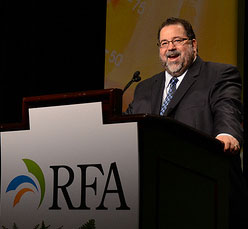

Listen to or download the Ethanol Report here: Ethanol Report Wrap-Up of 17th NEC

Subscribe to the Ethanol Report here.

2012 National Ethanol Conference Photo Album

Audio, Ethanol, Ethanol News, Ethanol Report, National Ethanol Conference, RFA

RFA CEO Pleased with Ethanol Conference

Cindy Zimmerman

Renewable Fuels Association President and CEO Bob Dinneen was very happy with the 17th annual National Ethanol Conference held last week in Orlando, Florida.

“I actually think this was our best conference ever,” Dinneen said at the conclusion of the event on Friday which drew 1200 attendees and headline speakers. “I just thought the vibe in the room was very, very constructive. People are sober about the marketplace, but they are very hopeful about the future.”

Dinneen was especially pleased with Secretary Vilsack’s address and the luncheon with Karl Rove and Robert Gibbs, as well as some of the great panel discussions that included some ethanol opponents. “I think there’s just benefit to everybody being informed. I respect other people’s opinions,” he said.

Now that the conference is over, it’s back to work for RFA on issues like getting E15 to consumers and protecting the RFS.

Listen to or download Dinneen’s wrap up interview here: Bob Dinneen Interview

2012 National Ethanol Conference Photo Album

Audio, Ethanol, Ethanol News, National Ethanol Conference, RFA

President Stresses All of the Above Energy Policy

Cindy Zimmerman

As the ethanol industry was meeting in Orlando last week, President Obama was talking energy just a few hundred miles to the south at the University of Miami.
“If we’re going to take control of our energy future and can start avoiding these annual gas price spikes that happen every year — when the economy starts getting better, world demand starts increasing, turmoil in the Middle East or some other parts of the world — if we’re going to avoid being at the mercy of these world events, we’ve got to have a sustained, all-of-the-above strategy that develops every available source of American energy,” the president said. “Yes, oil and gas, but also wind and solar and nuclear and biofuels, and more.”

President Obama spoke strongly about the need to end oil industry tax benefits. “I said this at the State of the Union — a century of subsidies to the oil companies is long enough. It’s time to end taxpayer giveaways to an industry that has never been more profitable; double down on clean energy industries that have never been more promising — that’s what we need to do. This Congress needs to renew the clean energy tax credits that will lead to more jobs and less dependence on foreign oil.”

The president talked about a variety of renewable energy sources, including algae. “We’re making new investments in the development of gasoline and diesel and jet fuel that’s actually made from a plant-like substance — algae,” he said. “If we can figure out how to make energy out of that, we’ll be doing all right.”

Read the full text of the president’s remarks here.

advanced biofuels, algae, biofuels, Ethanol, Ethanol News, Government, Oil, Solar, Wind

Views from the Political Right and Left at NEC

Cindy Zimmerman

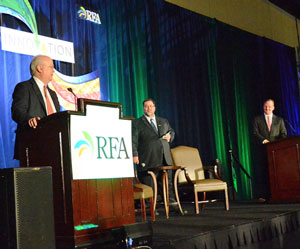
Positioned on opposite sides of the stage to their political leanings, two former presidential advisors took on a range of questions related to the 2012 election year and important policy issues in front of 1200 attendees at the 17th annual National Ethanol Conference (NEC) last week.

On the left, was senior advisor to President George W. Bush, Karl Rove, while on the right was the former White House Press Secretary for President Obama, Robert Gibbs. Serving as referee and moderator in the center was Renewable Fuels Association President and CEO Bob Dinneen. The two political insiders took on a variety of hot button topics, such as the contraceptive mandate and who will win the Republican nomination. While they disagreed on most matters, especially the contraceptive mandate, both seemed to agree that Mitt Romney will ultimately be the Republican nominee.

Energy policy was the main topic of interest for the NEC crowd and the mini-debate between Gibbs and Rove took place on the day that President Obama made a major speech about energy in Miami, just hours from where the ethanol conference was being held in Orlando. Gibbs stressed the president’s “all of the above” energy strategy. “We used less foreign oil last year than we have in 16 years. We have to re-double our commitment to renewable energy, be it wind, be it solar, be it renewable fuels – and I’m not just saying that because I happen to be talking to you all,” said Gibbs, adding that we also need to be utilizing more domestic oil, nuclear, natural gas and coal. “All this has to go into what we do to solve our energy crisis. There’s not a magic bullet.”

Rove did agree with Gibbs on the “all of the above” approach, but argued that the Obama administration was not doing as much as it could. “Robert’s right, we’re using less oil today, in part because you’re putting something into the oil so we don’t need to use as much of it. We peaked out, ironically enough, in our use of oil in this country in 2005 – the year of the RFS,” said Rove, who noted that he was disappointed that the ambitious schedule for getting cellulosic ethanol production on-line under the RFS has not been realized. “And that’s why what you’re doing in innovation is so important. If we’re going to realize the promise of the RFS, it’s going to take exactly that.”

2012 National Ethanol Conference Photo Album

advanced biofuels, Audio, Energy, Ethanol, Ethanol News, National Ethanol Conference, RFA