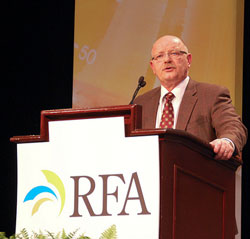
 The president of one of the world’s largest ethanol plant engineering and construction firms is pleased with the progress made by the industry in the last 30 years, but frustrated by the barriers to higher ethanol blends.
At the recent National Ethanol Conference, where ICM, Inc. founder Dave Vander Griend was honored with the Renewable Fuels Association 2012 Membership Award, he talked about how ethanol could replace some of the additives currently found in gasoline – called aromatics – which are used to help boost octane in gas. “We’re looking just to go from 10% ethanol to 15% ethanol with a clean, non-toxic product,” he explained. “The petroleum industry can go from 10 to 40% aromatic additions to their gasoline anytime they choose.”
He noted that Henry Ford’s Model T engine was originally designed to run on either gasoline or ethanol. “Actually, the first FFV was a Model T,” said Vander Griend. “That wasn’t something that set well with Rockefeller – he wanted everything to be gasoline, but at that time there was no octane additive to put into the gas so it wasn’t very good and cars would ping and knock. Taking that fuel they made then, if they would have added 20-30% ethanol, both parties would have won.” Instead, they got rid of ethanol through prohibition and used lead to increase octane. The creation of the EPA got the lead out of gasoline, which led to MTBE being used as a replacement until that was determined to be carcinogenic.
Vander Griend believes that ethanol could reduce tailpipe emissions by up to 50% with just a 30% blend. “Ethanol can replace aromatics on a 1-to-1 (basis) and actually give them more octane than they had from the aromatics,” he said.
Listen to interview with Dave Vander Griend here: Dave Vander Griend Interview
 Biofuels organizations are strongly urging lawmakers to approve an


 The
The 
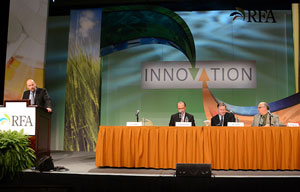 The debate over ethanol, greenhouse gases and land use continues – and that was the topic of a panel discussion at the recent 17th annual
 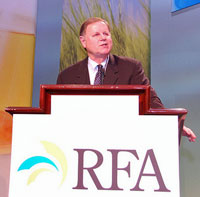 “The new thing is that we now have real world data,” Dr. Tyner said. He presented actual data from the U.S. Department of Agriculture showing that in the last six years the world has added 105 million of crop land – mostly corn, soybeans, rice, rapeseed and wheat. “So, markets work – that’s basically the bottom line,” said Tyner.
  The Nebraska Ethanol Board