According to a new report, the biofuels industry contributed $277.3 billion to the global economy in 2010. “Contribution of Biofuels to the Global Economy” was commissioned by the Global Renewable Fuels Alliance (GFRA) and outlines the economic footprint of the biofuels industry. The actual research was conducted by Cardno Entrix.
Global biofuel production produced 110 billion litres in 2010 and supported nearly 1.4 million jobs in all sectors of the global economy according to GFRA. By 2020 the industry is forecasted to produce over 196 billion litres and support over 2.2 million jobs across all sectors worldwide. It is expected that the majority of future growth will come from developing nations in Asia and Africa.
“It is promising to see the global biofuels industry growing during these difficult economic times,” said Bliss Baker, spokesperson for GFRA. “The global biofuels industry is a bright spot in the current world economy and is contributing billions of dollars to output and creating hundreds of thousands of jobs all while reducing our reliance on crude oil.”
Baker added that a growing biofuels industry in developing nations will help bring wealth, jobs and prosperity while reducing reliance on oil. He concluded by noting that the report truly demonstrates the how far the biofuels industry has come in the past decade and showcases continued growth of the industry.

 President Obama made up a “to-do list” for Congress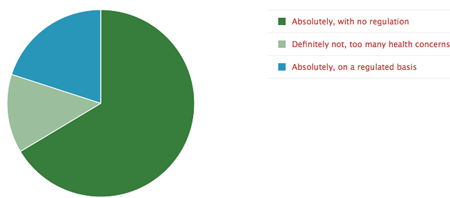

 The 2012 CUTC agenda features cutting-edge technologies and new uses that are positioned change the corn industry. Among the session topics is Advance Biofuels, which will highlight some of the most recent research on advanced biofuels. Speakers will cover thermochemical and biochemical and biomimetic routes to the pretreatment and hydrolysis of lignocellulosics (such as corn fiber hulls, corn stover, etc.) to produce sugar and phenolic monomers that can be further upgraded to synthetic fuels, bioethanol, and/or chemicals.
 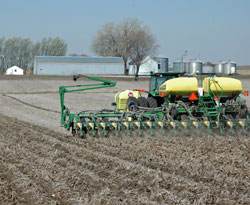 “In spite of the wettest weather of the spring, producers in the Midwest still managed to plant a significant acreage of corn and soybeans” last week, says USDA Meteorologist Brad Rippey. “Corn emergence was greatly benefited by the rain and continuing warm weather.” Nearly a third of the crop is emerged nationwide, compared to the average of 13%. Last year, just six percent was emerged by this time.
  While the industry is moving steadily toward the 15 billion gallon corn ethanol cap under the Renewable Fuel Standard (RFS2), Glauber says right now the market is steady at about 10 percent of ethanol blended fuel and getting E15 in the marketplace is moving slowly toward reality. “But you still have the underlying economics of whether or not a gas station is going to change over equipment to be able to sell E15,” he said. “The likely thing would be so-called blender pumps, which are expensive propositions.”