RFA E-15 Ad

Free Biodiesel Workshops

Joanna Schroeder

The American Lung Association in Minnesota is hosting two free workshops on biodiesel, a renewable fuel alternative to diesel. The workgroups will take place Thursday, June 21 from 2:00 pm to 4:30 pm and Friday, June 22nd from 9:00 am to 11:30 am at the AmericInn at 1500 Highway 71, International Falls.

National fuel expert Hoon Ge of MEG Corporation will be the key speaker and he will cover recent refining changes in diesel fuels, how to prevent, identify and respond to issues with diesel and the growing role of biodiesel in the transportation industry.

The United Soybean Board, Minnesota Soybean Research & Promotion Council and Twin Cities Clean Cities Coalition are sponsoring the workshop. The workshops are free but space is limited to so Lisa Thurstin to secure you spot.

advanced biofuels, Biodiesel

IRFA to Celebrate 10th Anniversary

Joanna Schroeder

Although ethanol has been used in Iowa for many decades, an Iowa-focused organization dedicated to the use of renewable fuels didn’t begin until 2002 – The Iowa Renewable Fuels Association (IRFA). To celebrate the 10 year milestone,  IRFA is hosting an event coinciding with the 34th anniversary of the first retail sale of E10, which just so happened to take place in Iowa. Today, through its educational and promotional efforts, IRFA has helped the state more than double its use of biodiesel and ethanol.

Tomorrow, along with Iowa Gov. Terry Brandstad, IRFA is releasing a new study detailing the positive impact renewable fuels has had on Iowa’s economy. In addition, Gov. Brandstad has declared June 15th “Iowa Ethanol Day” to mark 34 years of ethanol sales across the state.

Also on hand for the event will be Iowa Lt. Governor Kim Reynolds; IRFA President Brad Albin (who works for REG, Inc.); and IRFA founding member Bill Couser (who works for Lincolnway Energy).  DomesticFuel will be on hand to cover the event, being held at the Iowa State Capitol at 9:00 am on June 15, 2012.

advanced biofuels, Biodiesel, biofuels, Ethanol, Iowa RFA

$1.8 Mil Grant to Fund New Tech at Cal Biodiesel Plant

John Davis

A California biodiesel maker receives a $1.8 million state grant to fund some new technologies at an existing refinery at a military base.

A press release from its parent corporation, Biodico, says Biodiesel Industries of Ventura, LLC got the grant to use at Biodico’s 10 million gallon per year facility at the National Environmental Technology Demonstration Site, at Naval Base Ventura County in Port Hueneme, California:

“We create subsidiaries for each of our facilities so that local investors can become involved in what we are doing in their communities,” explained JJ Rothgery, chairman of the Biodico’s board of directors, “and so that national investors with interests in environmentally sustainable energy can become involved in our new projects. Currently we are working on two projects in California, one at Naval Base Ventura, and the other at Red Rock Ranch in California’s Central Valley. Both projects will benefit from the technology developed under the new Energy Commission grant.” Each 10 million gallon per year facility costs approximately $12.5 million from inception to completion.

The research from this money will be focused on using new non-food crops for biodiesel and will be done in cooperation with Dr. Stephen Kaffka, Director of the California Biomass Collaborative at the University of California Davis, and John Diener, president of Red Rock Ranch. In addition, the Biodico production facility will be able to produce all its own heat and power, and Biodico will use it as a blueprint for making its other facilities self-sustaining.

Biodiesel, Government

Power of Propane Continues Demos Through Southeast

John Davis

Propane continues to show its versatility and ability to step up as a mainline automobile fuel during the Southeast Propane Autogas Development Program‘s latest stop during this year’s roadshow appearance at the Maryland International Speedway in Mechanicsville.

During the visit, attendees got to see a variety of autogas-powered fleet vehicles, as well as meet Susan Roush-McClenaghan, driver for the ROUSH Drag Team, who talked about her propane-powered Ford Mustang race car and her experience racing the high-performance vehicle.

For those who missed the stop in Maryland, your next opportunity comes next week when the roadshow series stops in Birmingham, Alabama on June 21, 2012. Check out the Southeast Propane Autogas Development Program roadshow series website for more information.

Propane

9,000 Acres to be Dedicated to Non-Food Energy Crops

John Davis

An additional 9,000 acres in New York and North Carolina, and the expansion of an area in Arkansas, is being set aside as part of the Biomass Crop Assistance Program (BCAP) project. USDA announced $9.6 million will be spent to fund this latest effort to use more non-food crops for the production of biofuels, such as biodiesel and ethanol:

“Increasing the production of renewable, home-grown fuels is vital to reducing our country’s reliance on foreign oil, while creating good-paying jobs and diversifying the agriculture economy,” said [Agriculture Secretary Tom] Vilsack. “These projects are the foundation for an even stronger energy future in rural America. Because most energy crops are perennial and take time to mature before harvest, BCAP is designed so that sufficient quantities of feedstock will be available to meet future demand. Most importantly: these crops can grow where other crops cannot, providing farmers with new opportunities to diversify into more markets.”

In North Carolina, 4,000 acres is being put into Freedom® Giant Miscanthus and switch grass to support Chemtex International Inc.’s Project Alpha, a cellulosic biorefinery expected to produce 20 million gallons of ethanol and sustainable chemicals. Upstate New York will be seeing up to 3,500 acres in fast growing shrub willow to generate more than 100 megawatts of electricity for ReEnergy Holdings LLC. Finally, BCAP Project Area 2 in northeast Arkansas is expanding its enrollment up to nearly 8,000 acres of Giant Miscanthus, sponsored Missouri-based MFA Oil Biomass.

Under BCAP, producers get reimbursed up to 75 percent of what it costs to establish these perennial energy crops, plus five years of maintenance payments for herbaceous crops and up to 11 years for woody crops.

USDA officials point out that this program helps the Renewable Fuels Standard, which calls for 20 billion gallons more in just 10 years of non-corn based biofuels.


Biodiesel, biofuels, Ethanol, USDA

LS9 Opens Biodiesel Demo Plant in Florida

John Davis

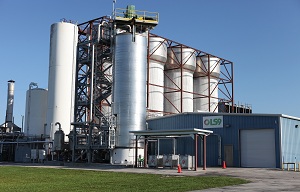
Renewable energy and chemical producer LS9 has opened it’s demonstration plant in Okeechobee, Florida and is expected to be producing 75,000 gallons of biodiesel and biochemicals from local feedstocks in the coming months. This company press release says the retrofit of the plant was completed last month:

“The opening of our demonstration plant in Florida moves LS9 from a development company towards becoming a fully integrated commercial organization,” said Ed Dineen, LS9 President and CEO. “Florida’s strong agricultural resources will allow us to source locally grown feedstocks for testing and processing into renewable biofuels and biochemicals. We are grateful to those who attended our event today, and recognize that this would not have been possible without the support from Enterprise Florida, the Florida Opportunity Fund’s Clean Energy Investment Program, and the community of Okeechobee that has gone above and beyond to welcome LS9 to the state.”

LS9 officials highlighted the company’s single-step fermentation technology that allows the plant to move easily from one type of product to another. The retrofit of the facility was helped with $4.5 million of Florida Opportunity Fund (FOF) Clean Energy Investment Program money.

Biodiesel

New Energy Farms Announces Development of CEEDS

New Energy Farms (NEF) has developed a revolutionary new method of propagating energy grasses that will reduce farmer establishment costs by 50 percent or more.

Cost effective scaling of perennial energy grasses such as Miscanthus, Arundo donax and energy cane has previously inhibited expansion. NEF has developed a new planting product for vegetative energy crops called CEEDS. These are small capsules that are established using automatic min till or no-till planters, like seed. The process applies to a number of energy grasses and is currently being evaluated by companies in the U.S. and Canada. The existing range of NEF energy crops will be available in the CEEDS format commencing from 2013 to 2014 depending on the cultivar and region.

“The focus was to make establishing vegetative energy crops as easy as other arable crops, to do this we started to look how to reverse engineer a seed, and the result was CEEDS,” says Dean Tiessen, president of New Energy Farms.

“CEEDS represents a step forward in energy crop establishment; that has been many years in the development, but solves all the issues that have previously made scaling energy crops difficult,” adds Dr. Paul Carver, CEO New Energy Farms.

The CEEDS planting system works alongside the NEF energy crop plantation management system, Biomass Direct to provide a farm to end user service for our customers.

The main advantages of CEEDS are
• New cultivars can be bulked up to market volumes 3 times faster.
• Establishment cost for crops like Miscanthus can be reduced by over 50 percent.
• Min / No till, fully automatic precision planting (no planting staff required).
• Substantially lower cost of planting, less ground cultivation.
• Reduction by up to 80% in transport logistics for planting material.
• Greater vigor after planting, more shoots produced.
• This system delivers the maximum yield from a cultivar.
• Makes planting energy grasses as simple as drilling conventional arable crops.

advanced biofuels, bioenergy, biomass

Has Your Business Considered Using Pinterest

Chuck Zimmerman

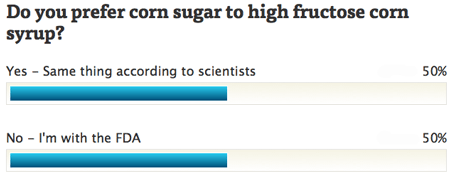
Our latest ZimmPoll asked the question, “Do you prefer corn sugar to high fructose corn syrup?” In what is a first for our poll, the response was split evenly! See the chart below.

Recently the FDA denied a request from the Corn Refiners Association to allow food labels to use the term corn sugar instead of high fructose corn syrup. Nutritionally, there is no difference in regular table sugar and HFCS so I don’t see why FDA ruled like they did. Their reasoning had to do with their definition of sugar as a crystalline solid. This is basically a public relations war over words since the “problem” with either cane or corn sugar is how much someone consumes. Nothing wrong with cane sugar or corn sugar, regardless what you call it, in my opinion. I like them both. Apparently consumers like HFCS better according to this story. What do you think? We like all uses of corn and sweetener is one of them as well as ethanol!

Our new ZimmPoll is now live and asks the question, “Does your business have an interest in Pinterest?” This online pinboard is now being used by political campaigns to target key demographics. Even President Obama’s wife is using it! Seems like there might be some good reason for agribusinesses, farm and food groups to start pinning away. How about it biofuels groups? Are you using it to help educate the public?

ZimmPoll is sponsored by Rhea+Kaiser, a full-service advertising/public relations agency.

ZimmPoll

Making the Deserts Bloom with Biofuels

John Davis

After spending the past year in the desert myself, I can tell you personally that the prospect of seeing ANYTHING growing, whether it is a plant or animal, is quite a highly anticipated event. And being in that desert far from home really helped bring home how much this country needs domestically produced fuels. That’s why this story from the U.S. Geological Survey’s blog caught my eye. Researchers, such as the USGS’s Sasha Reed (pictured below), are looking at how to get the most out of biofuel production in the arid regions of the American Southwest, while preserving the fragile environment…

“Even renewable energy has consequences, and we want decision makers to have the data available to make informed decisions about incorporating a variety of energy sources into our national energy portfolio,” Reed says…

…Reed and her colleagues are using a two-pronged approach to unravel the biofuel potential of the American Southwest. First, they are using remote sensing and modeling to help determine the amount of energy that could be added to our national energy portfolio by biofuel production. Second, they are using biogeochemistry to assess how different approaches to biofuel development will affect greenhouse gas emissions, water availability and quality, air quality, and soil fertility and stability.

Obviously, in the desert, water is a big concern. Trying to find ways to reduce the amount of water taken away from helping hold soil in place (which, without that water creates a whole new problem… DUST!) is a large part of the focus of Reed’s work. She says more dust has a compounding effect, such as making snow melt faster, which leads to water shortages in areas of the Southwest. The hope is this USGS work will give land managers and policy makers more information to make better decisions about when, where and how to produce biofuels in those desert areas.

algae, Biodiesel, biofuels

Biodiesel Board’s Weber on Biomass R&D Committee

John Davis

A man well-known to the biodiesel community will be taking his seat on a top-level, federal government committee looking at helping the rural economy, while making the country more energy secure.

Alan Weber, who has served as a consultant on new resources for biodiesel for the National Biodiesel Board and vice president of Missouri-based MARC-IV Consulting, has been tapped to serve on the USDA’s and U.S. Department of Energy’s Biomass Research and Development Technical Advisory Committee.

The prestigious committee helps USDA and DOE in meeting important goals of a healthier rural economy and improved national energy security. Weber will advise the agencies on overcoming technical challenges through research and development that will lead to a greatly expanded biobased industry.

Weber has been involved with biodiesel for more than 20 years, helping establish the NBB’s Washington, DC office. He’s a master’s graduate of the Agricultural Economics program at the University of Missouri, where he served as a program director for industrial uses from renewable resources.

Biodiesel, NBB