EWEA to New Commissioner: Rein in Energy Future

Joanna Schroeder

Alenka Bratusek has been named Vice President- and Commissioner-designate for Energy Union and Miguel Arias Canete has been named as European Commissioner-designate for Energy and Climate Action. In response to the news, the European Wind Energy Association (EWEA) is calling on the new commissioner to take the reigns of the Europe’s energy future.

ewea-logo“We look forward to working with Vice President Bratusek and Commissioner Canete on building a new treaty-busting energy union in Europe, which is underpinned by renewables,” said EWEA Chief Executive Officer Thomas Becker. “For a true single energy market to flourish in Europe, energy policy must become the domain of EU lawmakers and should not be shackled to 28 diverging ministries, regulators and agencies at national level.”

Becker said added, “The announcement of Vice President-designate Bratusek, with responsibility for energy union, shows a commitment by the Juncker presidency to make strides toward a single electricity market that places renewable energies, such as wind power, at the heart of European energy security.”

Parliamentary hearings for the new College of Commissioners are expected to commence on the week beginning Monday September 29, 2014.

Energy, International, Renewable Energy, water

Polar Bears to Warm Up Elephants at Oregon Zoo

Joanna Schroeder

H_slinky-infographic-3What in the world do polar bears and elephants have to do with renewable energy? Lots with a creative use of geothermal energy at the Oregon Zoo where an underground heating-cooling system will improve energy efficiency. Polar bears like it cool and elephants like it hot and with the help of “Slinky” or a geothermal loop, the two endangered species will keep each other comfy. The innovative high-tech system will be buried 12 feet underground.

“Essentially, this system works the same way as your household refrigerator,” explained Jim Mitchell, zoo construction manager. “The condenser that cools the coils in your refrigerator produces heat, which is expelled away from the coils with a fan. Our system has just added another step: capturing that heat for use elsewhere rather than blowing it all away.”

According to Mitchell, heat is created as a byproduct of cooling the polar bear swimming pools at the zoo. And rather than just expel that heat, the geothermal system will direct it through rows of Slinky-like coiled pipes buried deep in the northern section of Elephant Lands.

The ground maintains a constant temperature, insulating the pipes. Then, when it’s time to crank the thermostat, pumps connected to the system will deliver heat to Forest Hall, the 32,000-square-foot indoor portion of Elephant Lands.

The geothermal loop and other energy-efficient design systems are expected to cut Elephant Lands’ energy requirements in half, reduce greenhouse gas emissions by 40 percent and serve as the primary heat source for what will be one of the country’s largest indoor elephant facilities.

Eventually, other renewable sources of heat will be fed into the geothermal system. While it won’t be readily apparent to visitors, the roof at Forest Hall will feature a huge array of solar panels.

“Gradually, we may eliminate the need for fossil fuels at the majority of buildings and exhibits at the zoo,” Mitchell said.

Curator Bob Lee, who oversees the zoo’s elephant program said of the project, “The beauty of this system is in how it gives elephants choice. Most of the time, the elephant family will be able to move freely indoors and out, and we’ll be able to sustainably maintain a comfortable temperature for them.”

Energy, energy efficiency, Geothermal, Renewable Energy, Solar

Wind Turbines Outperforming Expectations at Honda

Joanna Schroeder

Wind turbine energy output is exceeding expectations just six months after installation at the Honda Transmission Mfg of America plant located in Russells Point, Ohio. The two wind turbines have exceeded the projected power output figures by 6.3 percent. The turbines, standing 260 feet tall with 160-foot blades, were initially projected to produce upwards of 10,000 megawatt hours (MWH) of electricity per year, accounting for approximately 10 percent of the plant’s annual power needs. The turbines have outperformed company projections in four of the six months since operation began. At their highest output, the turbines provided 16.26 percent of the plant’s power requirements for the month of April.

“We are extremely pleased with the performance of the wind turbines’ production over their first six months,” said Gary Hand, Vice President of Honda Transmission Mfg. of America. “The turbines’ operation has exceeded the projections established during the project development.”

The wind turbines have also contributed toward reducing the CO2 emissions of power production, helping HHondaturbinesSMrevonda reach its voluntary goals to reduce the environmental impact of its products and manufacturing operations by 2020. This includes a 30 percent reduction in CO2 emissions from Honda products, and significant CO2 reductions from the company’s plants and other operations, compared with year 2000 levels.

We are pleased to observe the performance of the two on-site wind turbines are achieving results over and above what Honda had anticipated. From the outset, we were confident that the site location selected would allow the GE turbines to produce a significant amount of the facility’s’ energy requirements,” said Tyler Juhl, vice president of operations for Juhl Energy who developed and installed the turbines.

The installation of the turbines makes the plant the first major automotive facility in the United States to receive a substantial amount of its power from on-site wind turbines. The two turbines are owned by ConEdison Solutions.

Michael W. Gibson, vice president of energy services at ConEdison Solutions, added of the wind power achievement, “ConEdison Solutions takes tremendous pride in our commitment to customers, and we are proud to be helping Honda implement its innovative energy program at Russells Point. With this initiative, Honda has set an excellent example for the American manufacturing sector, and we are gratified that they have been pleased with its success.”

automotive, Electricity, Renewable Energy, Wind

BioEnergy Bytes

Joanna Schroeder

  • BioEnergyBytesDFBroadwind Energy, Inc. has announced $14 million in new tower orders from a U.S. wind turbine manufacturer. Broadwind will produce these towers in its Manitowoc, Wisconsin and Abilene, Texas facilities.
  • The 14th Annual Renewable Energy Roundup & Sustainable Living Expo starts on Friday, September 26th with the Grand Opening & “Save The Planet? – Kids Are The Answer,” a free educational opportunity for Middle and High School age youth to participate in special environmental educational activities. The Roundup is September 26 – 28 and takes place in Belton at the Bell County Expo Center, 301 W Loop 121 (at IH-35), Belton, TX 76513.
  • Toshiba has been selected as the battery supplier for the next generation, all-electric, zero-emission bus from Proterra Inc., the leading electric vehicle (EV) transit bus manufacturer. The new fleet will use Toshiba’s Rechargeable Batteries (SCiB™), a safe rechargeable battery solution with high-rate performance and long-life capabilities that is used in a wide range of applications, from EVs to grid energy storage.
  • SunEdison, Inc. announced that Google Inc. has agreed to provide $145 million in equity financing for the Regulus solar plant. When completed, the Regulus solar project will be SunEdison’s largest developed and constructed project in North America. Located in Kern County, Calif., the Regulus plant will begin operation later this year, and will supply power to Southern California Edison through a 20-year power purchase agreement.
Bioenergy Bytes

Introducing Cellulosic Technology Cellerate

Joanna Schroeder

During the cellulosic ethanol celebration event at Quad County Corn Processors ethanol plant in Galva, Iowa yesterday, Syngenta unveiled the new brand for the cellulosic ethanol technology: Cellerate™. Enhanced by Enogen® corn enzyme technology, Cellerate is a collaboration between Syngenta and Cellulosic Ethanol Technologies, LLC.

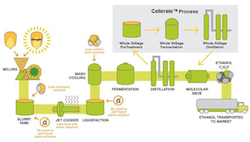
Cellerate is unique in that it is designed to increase an ethanol plant’s production by Cellerate cellulosic ethanol technologyallowing the corn kernel fiber to be converted into cellulosic ethanol. Ethanol plants can easily integrate Cellerate process technology into their existing production process. Cellerate, in conjunction with Enogen corn, will deliver notable benefits to ethanol plants beyond what can be achieved through either technology alone.

“The combination of Cellerate and Enogen represents the next leap forward in ethanol production,” said Jack Bernens, head of marketing and stakeholder relations for Enogen corn enzyme technology at Syngenta. “Ethanol is helping America reduce its dependence on foreign oil, lower prices at the pump, improve the environment with lower emissions, and grow the economy with jobs that can’t be outsourced. Together, these technologies will make ethanol more sustainable.”

In July 2014, collaboration between Syngenta and Cellulosic Ethanol Technologies, LLC, a wholly owned subsidiary of Quad County Corn Processors (QCCP), produced the first commercial-scale cellulosic ethanol in Iowa.

“The synergy of Cellerate and Enogen will decrease natural gas usage and increase ethanol throughput, while reducing a plant’s carbon footprint,” said Delayne Johnson, chief executive officer of QCCP. “These advantages, combined with higher protein DDGs and increased corn oil production, make the technology package appealing for ethanol plants looking to improve their bottom line.”

Cellulosic, corn, Enogen, Ethanol, Syngenta

New Calif. Law to Crack Down on Biodiesel Grease Thieves

John Davis

california_state_flagThe State of California will be cracking down on thieves of a popular biodiesel feedstock – used cooking grease. This article from the San Diego Union-Tribune says the new law is expected to be signed into effect soon and will have tougher penalties, including starting at $1,000 for first-time offenders.

Backers of the legislation hope harsher penalties, along with new provisions for roadside inspections and record keeping, will translate into more action by law enforcement and prosecutors. Individual oil thefts often qualify as petty theft but cumulatively cost biofuel companies and restaurants millions of dollars each year…

Restaurants, from fast-food to four-star, share in the profits by setting their waste oil aside in liquid containers ranging from 55 gallon drums to 15,000 gallon vats.

Imperial Western Products, which operates in California, Nevada and Arizona and collects oil from hundreds of restaurants in San Diego County, estimates 25 percent or more of its contracted oil gets taken before its trucks arrive.

David Isen, asset protection manager for the Coachella-based company, said thieves have used heavy equipment to haul away locked containers entirely. Motion sensors have helped him document oil theft in the early morning hours. Perpetrators responded, he said, by showing up later and blending into the morning bustle, or posing as cardboard collectors.

“Nobody is afraid of the enforcement,” he said. “We’re losing millions of dollars a year, our company alone.”

California actually has some pretty strict regulations on kitchen grease hauling but not many enforcers. The new law hopes to close some of the loopholes thieves have been exploiting.

Biodiesel

Algae & Safflower Biodiesel Flies Across Salt Flats

John Davis

Bonneville_BiodieselRacetruck_ustA truck running on biodiesel made from algae and safflower seed oil was tearing up the salt flats known for their speed records. This story from KSL in Salt Lake City, Utah says the Utah State University truck first set a record of nearly 135 miles per hour… about 30 miles faster than a small-engine diesel truck has ever gone before… using regular diesel. Then it was time to put the biodiesel blend to the test at the Bonneville Salt Flats.

Michael Morgan, a research assistant at Utah State University, was out to prove something.

“Not only can we run it in our everyday cars, but when we want to, come here and run it as fast as we possibly can,” he said.

The diesel fuel his team made with algae and safflower seeds can stack up to the real thing, he said.

“I know that the world only has so many resources. We’re using them up quickly,” he said.

The 20 percent biodiesel blend pushed the truck over 100 miles per hour, but since the salt flats does not take records made using biodiesel, it was just for exhibition.

The group from Utah State dedicated the run to former colleague Dallas Hanks, a great biodiesel advocate from the school who died of cancer this past June.

“We want people to know about the work that he did,” Morgan said.

Biodiesel

Quad County Processors Host Grand Opening

Cindy Zimmerman

The first refinery to produce cellulosic ethanol with a bolt-on process officially opened its doors today.

quad-open-group“This is a historic day not just for the ethanol plant, but for the entire region,” said Delayne Johnson, CEO of Quad County Corn Processors in Galva, Iowa. “This is a perfect example of cutting edge technology, right here in our backyard and we are thrilled to have our plant using this ingenuity.” The Adding Cellulosic Ethanol (ACE) project, newly re-named “Cellerate,” allows QCCP to produce 2 million gallons of cellulosic ethanol each year from corn kernel fiber at their plant in Galva, Iowa.

“Today’s grand opening is a direct result of the ingenuity and hard work of the employees and shareholders of QCCP, but it’s also a direct result of the kind of innovation that occurs when a policy like the Renewable Fuel Standard (RFS) is in place,” said American Coalition for Ethanol (ACE) Executive Vice President Brian Jennings. “More than any other policy enacted by Congress, the RFS has been a catalyst for innovation, including the kind of technology advancement developed at QCCP to make cellulosic ethanol from corn kernel fiber.”

quad-open-bob-brianRenewable Fuels Association president and CEO Bob Dinneen participated in the grand opening ceremony and praised QCCP, noting, “To the management, staff and investors of Quad County Corn Processors I say a hearty congratulations on your vision and your commitment to seeing it through. To EPA I say get out of Washington and see what is happening in places like Galva, Iowa.”

Dinneen tweeted from the event, “Quad Co cellulosic plant can tell Big Oil “we told you so” and make them eat their words!”

ACE, advanced biofuels, Cellulosic, Ethanol, RFA, RFS

Nat Gas, Solar and Wind Lead Power Capacity Adds

John Davis

During the first half of this year, natural gas, solar and wind lead all sources when it comes to new utility-scale generating capacity to come online. This report from the Energy Information Administration (EIA) says that 4,350 megawatts (MW) of new utility-scale generating capacity came online, with natural gas making up the lion’s share of those additions but solar and wind made bigger proportional gains compared to the first six months of 2013.
eiaaddsjanjune2014
Utility-scale capacity additions in the first half of 2014 were 40% less than the capacity additions in the same period last year. Natural gas additions were down by about half, while solar additions were up by nearly 70%. Wind additions in the first half of 2014 were more than double the level in the first half of 2013.

Of the states, Florida added the most capacity (1,210 MW), all of it natural gas combined-cycle capacity. California, with the second-largest level of additions, added just under 1,100 MW, of which about 77% was solar and 21% was wind, with the remaining additions from natural gas and other sources. Utah and Texas combined for another 1,000 MW, nearly all of it natural gas combined-cycle capacity with some solar and wind capacity in Texas.

In addition to the large additions by natural gas, solar saw strong year-on-year growth, adding 1,146 MW. Wind basically more than doubled the amount added in the same period last year, putting 675 MW generating capacity online.

Government, Natural Gas, Solar, Wind

Symposium Examines Critical Energy Infrastructure

Joanna Schroeder

The Midwest Energy International Symposium will look at how the U.S. will confront a host of energy environment and infrastructure challenges over the next two years. The event will take place on Thursday, October 9, 2014 at the Quad-Cities Waterfront Convention Center located in Bettendorf, Iowa.

Speakers and panelists will provide valuable information and insights regarding energy Midwest Energy Natl Symposiumexports including ethanol, biodiesel, biojet fuels and the supply chains and logistics for fuel transport systems including the trucking, railroad and water transport industries.

The featured keynote speaker is Dr. Gong Ping Yeh, Fermilab with the United States Department of Energy (DOE). His research and interests in sustainable energy include wind, solar, biofuels, electric vehicles and improving energy efficiencies. In recent years, he has focused on Accelerator Driven System and Thorium energy as a new source of energy. Dr. Yeh has been serving internationally as an advisor for sustainable energy in many countries.

Other keynote speakers include:

  • Lt. General Wallace “Chip” Gregson, Jr. (Ret.) will address United States Department of Defense Sustainable Energy Projects.
  • The Rock Island Arsenal, United States Army, will present energy program models for hydroelectricity.
  • Mexico: Creating an Energy Self Sufficient Region in NAFTA, Mexico Energy Ministry
  • Korea: Korea’s Energy Future, Global America Business Institute
  • Germany: Germany’s Current Energy Transition and Use of Biogas as a Fuel, German American Chamber of Commerce, Chicago.

More information about the event along with registration information can be found here.

advanced biofuels, Alternative Vehicles, aviation biofuels, bioenergy, conferences, Renewable Energy