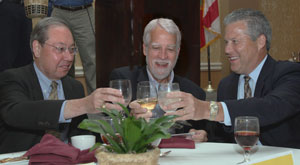
 There was reason for a cellulosic ethanol celebration at the second annual Farm to Fuel Summit held in St. Petersburg last week.
In this photo released from the University of Florida’s Institute of Food and Agricultural Sciences, UF Senior Vice President for Agriculture and Natural Resources Jimmy Cheek (left), UF Distinguished Professor of Microbiology Lonnie Ingram (center) and Verenium Vice President for Business Development Tim Eves (right) raise a toast to celebrate the first payment from Verenium to UF for use of cellulosic ethanol technology developed by Ingram. (AP photo/University of Florida/IFAS/Thomas Wright)
 The check, representing the beginning of profitability of this technology, was presented at the second annual Farm to Fuel Summit.
Verenium Corporation, a leading developer of biofuels derived from low-cost, abundant biomass and a developer of specialty enzyme products, presented the University of Florida a $66,000 royalty check for its patented cellulosic ethanol technology.
BioEthanol Japan — a joint venture of Marubeni Corp. and Tsukishima Kikai Co., LTD — is using the technology under license from Verenium in their 1.4 million liter-per-year cellulosic ethanol plant in Osaka, Japan. It is the world’s first commercial plant to produce cellulosic ethanol from wood construction waste.
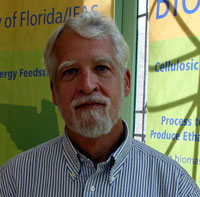 DomesticFuel did a story and telephone interview with Dr. Ingram in April 2006, so it was a pleasure to meet him at Farm to Fuel to do a follow-up. He has been working on production of cellulosic ethanol for about 20 years. “The breakthroughs we have had in the past year are successes in scaling this up and actually having the first commercial plant operational,” said Ingram. He says it is fully commercialized at this point, with that first royalty check being paid by Verenium, and a small plant in Japan is converting wood waste to ethanol. “The first wood-to-ethanol plant in the world,” says Ingram.
As for the big question, how long before cellulosic ethanol production will really be commercially viable, Ingram avoids a direct answer, but notes that there is another demonstration plant being built in Jennings, Louisiana using sugarcane bagasse. “In addition, the University of Florida has received a grant to set up a research demonstration plant in Florida to specifically address Florida biomass sources.”
He believes the potential is there for “Florida to produce all of its automotive fuel needs as ethanol from renewable biomass. There’s also a potential that Florida could produce much of its power from biomass.”
Listen to the 5:00 interview with Dr. Ingram here: [audio:http://www.zimmcomm.biz/audio/f2f-ingraham.mp3]


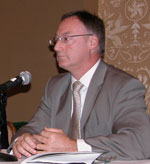 The main focus of the Florida Farm to Fuel Summit in St. Petersburg last week was getting biofuels production going in the Sunshine State.
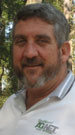 “We have the only existing fuel ethanol plant in Florida,” said Banks. “With an aim of being up and running by the summer of 2008. For that, we need about four million bushels of something.”
 “In the longer term, in my judgment, the fuel of the future is going to be hydrogen,” Dorgan said. “I’m a big fan of the biofuels, I’m a big fan of ethanol, I believe it’s enormously important that we’ve invested in wind energy. But I believe —especially in the longer term — our grandkids need to be driving vehicles that put water vapor out the tailpipe and have twice the efficiency of power to the wheel. That comes with hydrogen fuel cells. It allows us to say to the Saudis and the Kuwaitis and others, ‘We don’t need your oil.’”
 Marathon Oil Company is now pumping biodiesel at two of its terminals in Illinois.
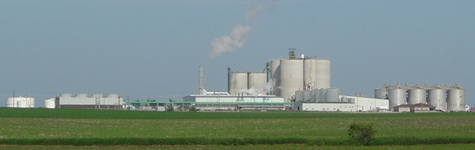
 VeraSun Energy will hold a grand opening ceremony for its 110 million-gallon-a-year ethanol plant at Charles City, Iowa on August 17th, 2007.

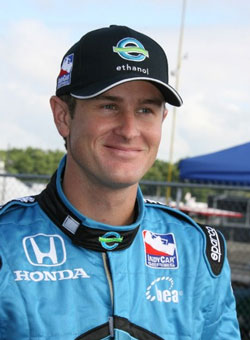 Ryan Hunter-Reay said he would be happy if his first IndyCar Series race ended with a “top 6 or 7” finish and he got his wish. He finished seventh, overcoming some mechanical problems in practice.
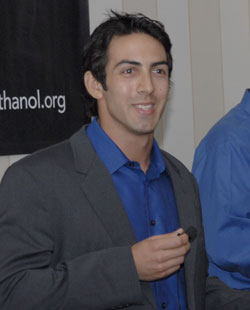 Now former Team Ethanol car driver Jeff Simmons
 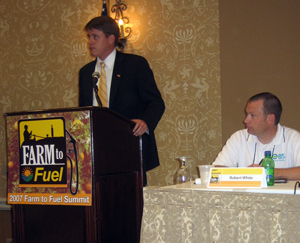 The
The  Republican presidential candidate Rudy Giuliani says he can lead America to energy independence, and of course, tells Iowans during a campaign stop in the Hawkeye State that ethanol is one of the keys.