 Dakota Wind Energy, LLC, has announced plans to form South Dakota’s first utility scale community-owned wind project. The project has the potential of generating 750 megawatts of energy and will spread over 700 square miles of farmland in Roberts, Marshall, and Day counties.
This press release from the company says it will take advantage of the under-used wind power South Dakota offers:
According to the American Wind Energy Association (AWEA), South Dakota ranks 4th in the nation with the greatest wind potential. However, when compared to other states, South Dakota‟s current installed wind power capacity is very low.
The Dakota Wind Energy LLC was conceptualized by South Dakota landowner, Gerry Fisher. National Wind, the project’s manager, local landowners and community leaders have capitalized the company. Dakota Wind Energy, LLC has formed a members advisory board which includes nine of the South Dakota landowners/co-founders. These board members are, Donald Erickson, Dennis Fagerland, Gerry Fisher, Blair Healy, Tim Hofer, Walt Johnson, Bob Metz, Don Ogren, and Curt Sampson. Additional landowners and local community members will become owners as the project develops.
“For community-wind projects, such as Dakota Wind Energy, size does matter. Utilities and institutional investors prefer large community-owned wind projects because they have the local support needed to move smoothly through permitting, site control, and power line siting,” says Patrick Pelstring, co-chair of National Wind. “This increases their likelihood of completion and gives projects such as Dakota Wind Energy, a competitive advantage. Large community wind projects also have the capital available to afford the high costs related to wind developments of any size, including building a private transmission line, which can cost millions of dollars,” says Pelstring.
The project could produce enough energy to power more than 200,000 homes.


 A documentary about biofuels makes its world premiere at the Sundance Film Festival in Utah this week.
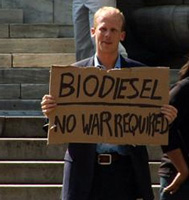 “Fields of Fuel” is directed by Josh Tickell, who also wrote “Biodiesel America,” which was introduced at the 2006 Biodiesel Conference. Tickell is a long-time advocate of biodiesel who became known for his “Veggie Van” tours in the late 1990’s. While his main focus is on biodiesel, he is also a fan of ethanol – especially the cellulosic variety.
 Keynote speakers for the Washington International Renewable Energy Conference, or


 Minnesota might already be the home of the NFL’s Vikings, but lawmakers in that state are trying to lure some modern-day descendants of the marauders to set up a wind energy research center.
 House Speaker Margaret Anderson Kelliher and several other Democrats said they’re considering a package of unspecified incentives – possibly bonding dollars, or tax breaks – to draw Denmark’s Vestas Wind Systems to the state. Vestas, the world’s largest maker of wind turbines, plans to build a U.S. research center, but hasn’t picked a location.
 A new biodiesel blending facility located at a petroleum terminal in Aurora, Colorado is seen as key to improving the availability of biodiesel in the area while helping integrate the green fuel into the nation’s petroleum infrastructure.
 “Today we are witnessing a renewable energy revolution in our state and in our nation,” said U.S. Senator Ken Salazar (D-CO), who spoke at the opening ceremony. “This revolution is fueled by innovative firms like Magellan and CHS who understand that the production of clean, renewable biofuels not only strengthens America’s national and environmental security, but offers an unprecedented opportunity to spur economic growth and job creation in our rural communities as well. I commend them for their work and urge other firms to follow suit.”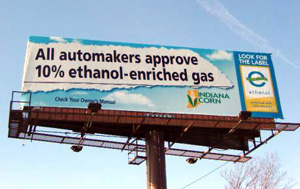
 Indiana Corn and Soybean is also working to gain support for a Biofuels special recognition license plate to be made available through the Indiana Bureau of Motor Vehicles.
 According to Greentech (Media), venture firms also continue to invest in biofuels such as cellulosic ethanol and biodiesel, with more than $750 Million directed towards these new feedstocks and technologies. Notable alternative energy VC funding rounds in 2007 included HelioVolt’s $101M for thin film photovoltaics, Great Point’s $100M for coal gasification, Amyris’ $70M for synthetic biology and biofuels, and A123’s $70M for innovative battery technology.