
 Avantha Group Company, CG was awarded the certification from Germanischer Lloyd Renewables Certification (GL RC), for its liquid immersed SLIM® and Bio-SLIM® distribution transformers. The testing for adherence to certification norms was carried out according to GL’s Guidelines for the Certification of Offshore Wind Turbines, Edition 2012. The transformers are hermetically sealed with bio-degradable fluid which reduces the risk of pollution at environmentally sensitive locations, such as offshore wind farms.
- Join key federal, state, and local officials; top military leaders; and leading business executives at the 2014 American Energy Summit January 27-28, 2014 in Arlington, Virgina. Attendees will learn about new opportunities to participate in thousands of new energy programs and contracts being created by state agencies throughout the U.S.; local energy mega projects; how to win new government and private sector energy contracts; how to obtain financing for new energy projects and more.
- JinkoSolar Holding Co., Ltd. has announced that it has signed a strategic cooperation agreement with the local government of Lingwu City, Ningxia Hui Autonomous Region, to develop a 200 MW ground-mounted PV power plant. Under the terms of the agreement, JinkoSolar will invest and build PV industrial base in Lingwu, build a 200MW ground-mounted PV power plant and invest in a number of PV related supporting facilities in Lingwu. The project will begin contraction according to the approval status of the local Development and Reform Commission, allowing for the power generated from the plant to be connected to the State Grid. The investment related to the project is expected to be approximately RMB 4.6 billion.
- Alliance AutoGas has announced that it has recently received new EPA certifications covering 10 of the widely popular 2012 and 2013 Ford vehicle platforms. Alliance AutoGas is a U.S. authorized distributor for PRINS autogas technologies that converts conventional gasoline vehicles to run on propane autogas and installs on-site and public fueling stations.

EPA Opens Comment Period for RFS
 The Environmental Protection Agency (EPA) has officially published the proposed 2014 renewable fuel standard in the Federal Register that starts a 60-day public comment period that runs until January 28, 2014. EPA’s proposal significantly lowers the levels of ethanol and biodiesel that must be blended in the nation’s fuel supply.
“It is unfortunate that the Obama administration has caved in to Big Oil rather than stand up for rural America and the environment,” said Iowa Secretary of Agriculture Bill Northey who participated in a Protect the RFS rally on November 22, 2013. “The renewable fuels standard needs to be protected as it has helped hold down prices at the pump, created thousands of jobs in rural Iowa, and benefited the environment. The President should be focused on jobs and the economy rather than looking for ways to hurt rural America.”
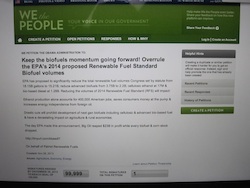 While comments to the EPA are an important part to restoring the RFS they don’t require President Obama to review them personally. Therefore, Patriot Renewable Fuels launched an online petition last week that needs 100,000 signatures by the end of December 26, 2013 for the President to review the 2014 RFS proposal. Take the time now to sign by clicking here.
Individuals interested in submitting comments to the EPA should reference Docket ID No. EPA-HQ-OAR-2013-0479. Comments can be submitted by any of the following methods:
- www.regulations.gov: Follow the on-line instructions for submitting comments.
- Email: a-and-r-docket@epa.gov
- Mail: Air and Radiation Docket and Information Center, Environmental Protection Agency, Mailcode: 2822T, 1200 Pennsylvania Ave., NW., Washington, DC 20460.
- Hand Delivery: EPA Docket Center, EPA West Building, Room 3334, 1301 Constitution Ave., NW., Washington, DC 20460. Such deliveries are only accepted during the Docket’s normal hours of operation, and special arrangements should be made for deliveries of boxed information.
Biodiesel Feedstock’s Proteins Mapped
 Researchers in Europe and South America have mapped the protein of a biodiesel feedstock, castor beans, in hopes of reducing the poisons in the leftover pulp. This article from The Almagest says researchers from the University of Southern Denmark and hope to be able to get more out of the bean.
Countries like Brazil and India grow large quantities of the castor oil beans, which can be refined into bio-diesel. Unfortunately, the beans contain allergens and also the extremely potent poison ricin, and therefore the bean pulp after extraction of the oil cannot be used for animal feed. The animals might become sick or even die from eating castor pulp.
“Therefore we are interested in finding out if it in some way could be possible to eliminate the allergenic proteins and the ricin from the beans, so that the pulp can be used for animal feed”, explains professor Peter Roepstorff, Department of Biochemistry and Molecular Biology at University of Southern Denmark.
The first step towards this has now been taken. Roepstorff and a team of Danish/Brazilian colleagues have used proteomics to map 1875 castor bean proteins.
“Now we know where the proteins are, and we know when during bean development they are produced. Especially the protein ricin and the allergen 2S Albumin are interesting in this context. Unfortunately our research shows that it does not seem to be easy to get rid of them”, says Peter Roepstorff.
The researchers found that the allergens and the deadly ricin poison are low when the beans are young, but as the beans mature and produce desirable oil levels, the ricin and allergen levels increase. The goal is to figure out how to manipulate the proteins to get the high oil levels without all the poisons.
Abengoa Announces Sustainable Business Prize
International renewable energy company Abengoa has launched the second edition of the Focus-Abengoa Sustainable Business Prize that seeks to recognize suppliers that have demonstrated their commitment and made a contribution to sustainable development.
 The company presents this award to highlight outstanding actions by its suppliers. It is open to all companies that have been suppliers to Abengoa, or any of its subsidiaries in any country during the last 24 months, and that are implementing or have completed initiatives in the last two years that have contributed to social development and reducing environmental impact. The prize will be awarded in two categories – one for small and medium size companies with less than 50 employees, and another for large companies with 50 or more employees.
The jury for the Focus-Abengoa Sustainable Business Prize will be comprised of Jose Borrell Fontelles, vice-chairman of the Focus-Abengoa Foundation and Abengoa’s International Board, and chairman of the jury; Cristina Garcia Orcoyen, managing director of the Entorno Foundation; German Granda, general manager of Foretica; Jose Luis Blasco, managing partner for climate change and sustainability services at KPMG; and Maria Mendiluce, director of the World Business Council for Sustainable Development (WBCSD).
The committee is looking for projects or initiatives that promote responsible business management and stand out for their originality, innovative nature, impact and leadership.
Companies that wish to participate should complete the form on the competition website (http://sustainability.abengoa.com) and return it before December 11, 2013 to the e-mail address rsc@abengoa.com. When returning the form, please include in the subject line of the email “2nd edition of the Focus-Abengoa Sustainable Business Prize”.
In the 1st edition of the Prize, the jury chose Novozymes in the large company category for its “Life Cycle Studies (ACV)” project, while in the small and medium sized company category no first prize was awarded, although the jury decided to present a runners-up prize to Aislamientos Desmontables S.L. for its initiative, “Environmental control, quality, health and safety in the workplace”.
Biodiesel Popular as Vancouver’s New Micro-Brew
 Vancouver Island is knows for its beer micro-breweries, with 17 places cooking up liquid gold. But a new kind of micro-brew is gaining popularity there: biodiesel. This story from Beacon News says a biodiesel cooperative at a farmer’s market is selling about 40,000-50,000 gallons of the green fuel each year.
As you walk into the Cowichan Biodiesel Cooperative’s processing facility in Duncan B.C., it really does look like a microbrewery. Tanks, pumps, hoses and other assorted machinery are all reminiscent of the brew master’s trade. But unlike the yeasty, worty smell that you get at a brewery the biodiesel processing facility has the faint hint of French fries.
And when you ask a long-time customer about why they spend the extra-money for their home-made diesel she’s got a quick answer.
“I got involved because I wanted to get off fossil fuels,” says Lynn Wytenbroek, a founding member.
The cooperative credits dedicated customers and a source of used vegetable oil from cruise ships and restaurants for a lot of its success. Plus, you gotta love the coop’s URL: www.smellbetter.org.
Turkey Fryer Oil Gets New Green Life as Biodiesel
 Many a turkey met a delectable fate yesterday as they were dipped in hot oil and fried up GBD – golden, brown and delicious. Well, you might want to add green to that equation, as the leftover fryer oil can be turned into biodiesel. Many cities and communities across the country are offering to take that used fryer oil off your hands and make it into the green fuel. In Chicago, that city’s newspaper, the Tribune, had this article about the recycling efforts there, which also keeps that unwanted grease out of the sewer system.
On Saturday, 19 suburbs in DuPage and Cook counties will collect used cooking oil to convert it to clean-burning biofuel. School & Community Assistance for Recycling & Composting Education, or SCARCE, a Glen Ellyn-based environmental education nonprofit, organized the collection with oil recyclers Green Grease Environmental and Chicago Biofuels…
Green Grease Environmental and Chicago Biofuels will turn the used oil into biofuel and reimburse cities 50 cents for every gallon if they collect enough to cover expenses, said Mark Donahue, owner of Green Grease Environmental…
When oil gets into sewers, it sticks to pipe walls, creating clogs and backups that are expensive for cities and homeowners to fix, said Jim Holzapfel, public utilities director for water and wastewater for of Naperville, which will have two used cooking oil collection sites.
Sometimes the buildup gets out of control, like when a 16-ton lump of congealed grease and oil was discovered in London’s sewers in July. According to a statement from Thames Water, the utility company that manages the sewers, the bus-sized lard blob, or “fatberg,” reduced the pipe to 5 percent of its normal capacity and could have flooded streets and homes with sewage.
While your town might not experience its own 16-ton “fatberg,” you’ve got a chance to give your waste grease new life as biodiesel. Check your local area to see who will be collecting or where you can drop it off.

Most Think RFS Cut is Bad
 Our latest ZimmPoll asked the question, ”What is your opinion on the EPA lowering biofuels requirements?”
Our poll results:
· Bad for the country – 26%
· Guts the RFS and hurts ag – 26%
· Windfall for oil industry – 19%
· Other – 13%
· Industry can overcome – 7%
· Doesn’t go far enough – 5%
· Better for livestock producer – 4%
Looks like it’s a strong majority that feels the new requirements are bad all around – for the country and for the farmers – unless you’re in the oil industry. Our new ZimmPoll is now live and asks the question, “What are you thankful for?” ‘Tis the season to be thankful for so many things – we want to know what tops your list! Let us know.
100th Anniversary of the Gas Station

Makeshift gas station in 1900’s. Image courtesy of John Jakle.
December 1, 2013 is the 100th anniversary of the modern gas station. As Americans pull up to the pump this holiday season, the Renewable Fuels Association (RFA) is encouraging consumers to fill up with ethanol-blended fuel.
“For 100 years drivers have been paying too much for transportation fuel. This can be seen today more than ever,” said Bob Dinneen, President and CEO of RFA. “The price of gasoline is the first thing people see as they drive into a gas station. With the excitement of seeing loved ones comes the reality of the cost of a tank of gasoline, but ethanol reduces the cost of gasoline by on average $1.00/gallon in 2012 and 2013. In addition to cost savings it offers consumers choice at the pump. Now that is truly something to be thankful for.”
According to RFA, a popular cost saving fuel choice is E85 (85 percent ethanol, 15 percent gasoline) for flex fuel vehicles. There are approximately 3,200 stations offering E85 today and over 15.5 million flex fuel vehicles on the road. According to E85Prices.com, E85 prices in Michigan today average $2.62, compared to the average gas price of $3.27. In Lake Odessa, Michigan E85 prices even reached as low as $2.19. Click here to located E85 stations.
RFA also notes consumers increasingly have the option of a new fuel blend, E15 (15 percent ethanol, 85 percent gasoline) for cars 2001 and newer. E15 is the most tested fuel in the history of the Environmental Protection Agency (EPA) and has already been driven over 45 million miles with no known instances of engine damage or misfueling. Approximately 75 percent of vehicles currently on the road are approved for E15 use.
E15 is currently available in 10 states including Kansas, Iowa, Nebraska, South Dakota, North Dakota, Minnesota, Wisconsin, Michigan, North Carolina, and Illinois.
Offshore Wind Needs EUR123 Billion to Meet Goals
 According to new research, the offshore wind energy sector needs up to EUR123 billion in investment between now and 2020 if it is to meet its target of 40 GW of installed capacity. Equity and debt provides are willing to invest; however, they are holding back due to regulatory instability.
What’s blocking the investment is the uncertainty caused by changing regulatory frameworks, not least in the two largest markets, the UK and Germany, the independent survey of the financial community shows.
“By undermining investment stability, governments are putting green growth, jobs and a world-leading European industry at risk,” said CEO of the European Wind Energy Association (EWEA), Thomas Becker, at the report launch in Frankfurt at EWEA OFFSHORE 2013. “Stable national frameworks and a binding EU renewable energy target for 2030 will be a green light to investors and ensure the industry continues to flourish.”
The report, ‘Where’s the money coming from? Financing offshore wind farms‘ comes from EWEA with research from Ernst and Young.