ACE Conference 2026

Invateus Solar Starts Solar Farm on Superfund Site

Joanna Schroeder

Inovateus Solar and participated in the development of a 43-acre ground-based solar array project sited on an existing Superfund Site with previous ground contamination. The Maywood Solar farm is located near Vertellus Specialties headquartered in Indianapolis, Indiana and was supported by Indianapolis Power & Light’s (IPL) Rate Renewable Energy Production (REP) Program. The 10.82 MW project is part of a renewal energy production program administered by the Indianapolis Power and Light Company (IPL).

Maywood Solar FarmThe Maywood land is a Superfund project site that was remediated in 1992 under the supervision of the United States Environmental Protection Agency EPA) and Indiana Department of Environmental Management (IDEM), and is now in a monitoring-only status. The solar array was constructed by Hanwha Q CELLS USA along with the EPA, IDEM, IPL, and Vertellus Specialties Incorporated.

“We were excited to start the development of this project with Vertellus Specialties, and hand it over to Hanwha Q CELLS for completion,” said Inovateus Solar President T.J. Kanczuzewski. “This is another example of how public utilities and private companies can work together to achieve the goal of introducing more renewable energy in the state of Indiana. Our company is looking forward to making other announcements on projects built in the IPL Rate REP program soon.”

Under the voluntary feed-in tariff program, IPL will pay Hanwha Q CELLS 20 cents per kW hour for the project. A total of 100 MW of renewable energy projects are allowed under the IPL Rate REP program, of which Inovateus is involved with approximately 24 MW of qualified solar energy generation through the Maywood Solar Farm and other projects.

Renewable Energy, Solar

BioEnergy Bytes

Joanna Schroeder

  • BioEnergyBytesDFYingli Green Energy Holding Company Limited has announced that its wholly-owned subsidiary, Yingli Green Energy International AG, has entered into a strategic alliance with AMB Energia Wytwarzanie , a subsidiary of AMB Energia S.A. to co-develop 30 MW of solar projects in Poland. Within the framework of the agreement, AMB Energia as a local partner will fully develop the projects with the support from Yingli throughout all project stages.
  • Finavera Wind Energy Inc. has announced it has received a final $16.5 million of consideration, primarily in the form of debt forgiveness, from Pattern Renewable Holdings Canada ULC, a subsidiary of Pattern Energy Group LP as the final amount payable under the Purchase and Sale Agreement for 184 megawatts (MW) of wind projects, previously announced on April 29, 2013. The final consideration has been received earlier than the anticipated date in Q1 2015, based in part on the successful development of the Meikle Project.
  • Boralex Inc., through its subsidiary Boralex Europe S.A., has acquired Calmont 14 MW wind power project in the Midi-Pyrénées region in France. With a 15-year power sales contract with EDF France, construction work on the Calmont wind farm will begin during the first quarter of 2015 with commissioning scheduled for year end 2015. In all, Boralex will invest approximately €25 million to complete this project. Calmont is located a few kilometers from Boralex’s Avignonet-Lauragais hybrid solar/wind site offering attractive operating synergy opportunities.
  • Amicus Solar Cooperative, a purchasing cooperative that is 100% owned and managed by its member companies, has obtained an initial allocation of $50 million for qualifying businesses desiring solar through LFC Capital’s Solar Ownership Program. This Amicus/LFC Capital collaboration represents the first round of a multi-stage rollout of program funds planned for future solar photovoltaic (PV) projects.
Bioenergy Bytes

Amyris & GOL Take to the Skies with Biojet Fuel

Joanna Schroeder

Amyris along with Brazilian airline GOL have flown the industry’s first commercial flight with farnesane, a recently approved jet fuel. Flight 7725 left from Orlando, Florida July 30 at 5:15 pm ET and landed in Sao Paulo, Brazil.

GOL committed to fly its Boeing 737 fleet with up to a 10 percent blend of the renewable farnesane fuel starting with this initial flight on July 30, 2014. According to Amyris, Farnesane can reduce greenhouse gas (GHG) emissions by up to 80 percent compared to petroleum fuels. When blended with Jet A/A1 fuel at 10 percent, farnesane can also reduce particulate matter emissions, decreasing pollution near airports and major metropolitan areas.

The global aviation industry has committed to aggressive goals to reduce its GHG emissions, including achieving carbon neutral growth by 2020 and reducing emissions by 50 percent by 2050 compared to 2005. In addition to improving the efficiency of airplanes and flight operations, this renewable biofuel represents a major opportunity for commercial aviation to reduce emissions. The approved renewable jet fuel is drop-in and can be blended directly with petroleum jet fuel without any changes to airplanes, engines or fueling infrastructure. Amyris will now begin to quantitatively measure the positive impact to GHG emissions and air quality with every flight using the renewable jet fuel.

advanced biofuels, biojet fuel, International, Video

China Solar Panel Maker to Install Panels in Malaysia

John Davis

Wuxi Suntech Power Co LtdOne of the world’s biggest makers of solar panels will work to power rural schools and villages in Malaysia. China-based Wuxi Suntech will put in photovoltaic (PV) panels that will generate 7.5 MW of power under the Rural Solar Hybrid Electricity Project for Villages and Schools in the Interior.

The project was launched recently and is set to be completed in several phases and continue into 2017. The first phase will provide 960 kW to power three schools – SK Nanga Metah, SK Nanga Janan and SK Sungai Tunoh – as well as to 20 surrounding villages. The subsequent rollout of the project will reach a total of 7.5 MW of electricity to additional rural schools and villages.

The PV modules will form a micro-grid system set to provide 24 hour electricity to three schools and 20 surrounding villages. The system will consist of Suntech’s high-efficiency, VDE Quality Tested modules.

“We have been working diligently with our partners Helios Photovoltaics and the Malaysian government for several years to launch this revolutionary project. We’re using diesel generators and German battery packs to backup Suntech’s best in class PV Modules in this system. Many locations in the region are only accessible via boat or helicopter and have previously been left to rely on diesel generation for power. These new micro-grid systems will help to significantly reduce diesel costs and cut 10,000 tons of CO2 emissions per year, providing clean, reliable energy for the schools and villages in Sarawak. We are extremely proud of our work with Helios and the Malaysian Government that has enabled us to bring this project to fruition,” said Samuel Zhang, sales director for APMEA & China at Suntech.

Suntech officials say the company’s recent acquisition by Hong Kong-based Shunfeng Photovoltaics Ltd. has helped its balance sheet and allows it to pursue a a new business strategy that will make it the largest integrated clean energy provider globally.

Solar

Varying Opinions on Farming Tech

Jamie Johansen

New Holland ZimmPollOur latest ZimmPoll asked the question, “How can technology make farming even better?”

We all seem to have a different opinion on what type of farming technology would be the most beneficial. Right now I am leaning towards weather control. It would be nice to simply click a button when we need some rain. I still believe that is a little farfetched. However, I know we will all be seeing drones and robots in our near future.

Here are the poll results:

  • Remote control tractors – 15%
  • Drone crop management – 22%
  • Robot livestock feeders – 19%
  • Remote crop & livestock sensors – 15%
  • Weather control – 15%
  • Can’t imagine it yet – 7%
  • Other – 7%

Our new ZimmPoll is now live and asks the question, I prefer to get my farm news from:

In this day and age we can get news at the drop of the hat. It is pretty much everywhere we look. But we all have our preferred source for the latest news in the agriculture community. Let us know where you prefer to get your farming news.

ZimmPoll

Plug-In Electric Vehicles Talk in the Cloud

Joanna Schroeder

Plug-In electric vehicles (EV) will soon be “talking in the cloud” as Ford Motor Company collaborates with seven of the world’s largest automakers and 15 utility companies to develop technologies for EVs to talk to the utilities via the cloud. According to Ford, this would help manage energy use and improve the efficiency of the power grid.

The pilot program will create a standards-based communications platform for use by plug-in EVs and the electric grids. This platform will enable the utilities to contact vehicle customers who have opted-in to the program, sending a request for those cars to stop charging temporarily to help manage a grid that is DCF 1.0becoming overloaded. This approach uses existing communications technology and standards, such as Ford’s MyFord® Mobile App, and pushes to advance those systems by enabling two-way communication between the electric grid and electric vehicles.

“This innovative platform provides a critical enabler for the next step in vehicle electrification,” said Mike Tinskey, associate global director, Electrification Infrastructure for Ford. “It’s a way for plug-in electric vehicle drivers to be financially rewarded for their willingness to help manage the electric grid.”

Participating utility companies are prepared to offer financial incentives to owners who make their cars available to the grid, similar to utilities offering customers discounts for allowing their home air conditioning to run intermittently during times of high demand. Customers who opt-in to the program can charge their cars at a location of their choice and have the ability to ignore the utility’s request to stop charging.

The formal collaboration between the automakers, utilities and Electric Power Research Institute began in fall 2012. However, the concept and application of electric vehicle/grid integration has been studied extensively by numerous research groups for more than 10 years.

Alternative Vehicles, automotive, Electric Vehicles, Energy, Utilities

UIC Researchers Convert Waste Carbon to Fuel

Joanna Schroeder

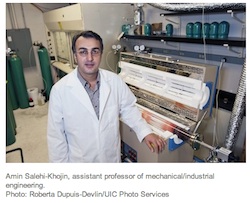
University of Illinois at Chicago (UIC) scientists, under the lead of Amin Salehi-Khojin, UIC professor of mechanical and industrial engineering, have synthesized a catalyst that improves their system for converting waste carbon dioxide into syngas. The syngas is a percursor of gasoline and other energy-rich products and this recent achievement in the the research team’s process has brought the production of CO2 to energy closer to commercial viability. The study was published in the journal Nature Communications on July 30, 2014.

The research team developed a unique two-step catalytic process that uses molybdenum disulfide and an ionic liquid to “reduce,” or transfer electrons, to carbon dioxide in a chemical reaction. The new catalyst improves efficiency and lowers cost by replacing expensive metals like gold or silver in the reduction reaction.

UIC researcher Amin Salehi-KhojinMohammad Asadi, UIC graduate student and co-first author on the paper said the discovery is a big step toward industrialization. “With this catalyst, we can directly reduce carbon dioxide to syngas without the need for a secondary, expensive gasification process,” explained Asadi. In other chemical-reduction systems, he noted, the only reaction product is carbon monoxide. The new catalyst produces syngas, a mixture of carbon monoxide plus hydrogen.

Salehi-Khojin, principal investigator on the study continued the explanation by noting the high density of loosely bound, energetic d-electrons in molybdenum disulfide facilitates charge transfer, driving the reduction of the carbon dioxide. “This is a very generous material,” said Salehi-Khojin. “We are able to produce a very stable reaction that can go on for hours.”

The proportion of carbon monoxide to hydrogen in the syngas produced in the reaction can also be easily manipulated using the new catalyst, said Salehi-Khojin.

“Our whole purpose is to move from laboratory experiments to real-world applications,” he said. “This is a real breakthrough that can take a waste gas — carbon dioxide — and use inexpensive catalysts to produce another source of energy at large-scale, while making a healthier environment.”

Alternative energy, biogas, Carbon, Research

MSU to Develop Hardier Switchgrass for Biofuels

Joanna Schroeder

The U.S. Department of Energy (DOE) along with the U.S. Department of Agriculture have awarded $1 million to Michigan State University (MSU) to develop hardier switchgrass. The feedstock is a North American native plant that holds great potential as a biofuel source. The research team believes that if switchgrass would better survive northern winters, the plant could be an even better source for clean energy.

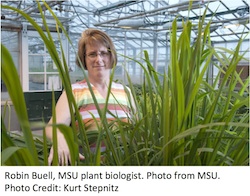
Robin Buell, MSU plant biologist, will work to identify the genetic factors that regulate cold hardiness in switchgrass. “This project will explore the genetic basis for cold tolerance that will permit the breeding of improved switchgrass cultivars that can yield higher biomass in northern climates,” said Buell, also an Robin Buell MSUMSU AgBioResearch scientist. “It’s part of an ongoing collaboration with scientists in the USDA Agricultural Research Service to explore diversity in native switchgrass as a way to improve its yield and quality as a biofuel feedstock.”

One of the proposed methods to increase the biomass of switchgrass is to grow lowland varieties in northern latitudes where they flower later in the season. Lowland switchgrass is not adapted to the colder conditions of a northern climate, however, and merely a small percentage of the plants survive. It is these hardy survivors that are the subject of Buell’s research.

“Dr. Buell’s investment in this collaborative project will identify important genetic elements in switchgrass that control survival over the winter and can be used to breed better adapted cultivars to meet biomass production needs,” noted Richard Triemer, chairperson of the plant biology department.

Buell hopes to identify alternative forms of the same gene that is responsible for cold hardiness by studying switchgrass’ genetic composition, These could then be applied in breeding programs for switchgrass that can thrive in northern climates.

advanced biofuels, feedstocks, Research

BioEnergy Bytes

Joanna Schroeder

  • BioEnergyBytesDFGevo, Inc. has announced that it intends to offer and sell, subject to market and other conditions, common stock units. Each common stock unit will consist of one share of common stock and a warrant to purchase a certain number of shares of common stock. The units are to be sold by Gevo subject to market and other conditions in an underwritten public offering. Gevo currently intends to use the net proceeds from the offering to fund capital to complete the side-by-side configuration of its Luverne, MN facility, to fund working capital and for other general corporate purposes.
  • The Solar Foundation has recognized community-owned solar developer Clean Energy Collective as a 2014 Solar Foundation Award recipient for exceptional work and dedication to advancing solar energy. Clean Energy Collective received the Industry Advancement Award for its innovative approach to community-owned solar.
  • San Carlos Solar Energy, Inc. was recently presented with the 2014 Philippines Solar Photovoltaic (PV) System Integrator of the Year award at the 2014 Frost & Sullivan Philippines Excellence Awards held on July 17, 2014 at the Makati Shangri-la Hotel, Manila. This award is presented to the company that has demonstrated excellence in the three key areas of demand generation, brand development and competitive positioning.
  • JinkoSolar Holding Co., Ltd. has announced that China Development Bank International, the Macquarie Greater China Infrastructure Fund, a fund managed by Macquarie Infrastructure and Real Assets, and New Horizon Capital have agreed to invest a total of US $225 million in the company’s downstream solar power project business.
Bioenergy Bytes

New Jersey Home to First Energy Resilience Bank

Joanna Schroeder

New Jersey has created what they term the first of its kind in the U.S. “Energy Resilience Bank” (ERB) to focus on energy resilience. The bank was created in response to the impacts of SuperStorm Sandy where over 8 million people lost electric power in the region – many for several days. The ERB will provide $200 million for municipalities to finance clean resilient power solutions. Projects could include those that “would ensure a highly reliable power supply to critical public facilities such as water and wastewater treatment plants, hospitals, shelters, emergency response centers and transit networks in the event the larger electrical grid fails.”

New Jersey Disaster Recovery Action PlanOn July 23, 2014, the New Jersey Board of Public Utilities approved a sub-recipient agreement with the New Jersey Economic Development Authority to work jointly in the establishment and operation of the ERB. The ERB would be financed through use of $200 million of New Jersey’s second Community Development Block Grant-Disaster Recovery (CDBG-DR) allocation. According to the Governor Christie’s announcement, “the ERB will support the development of distributed energy resources at critical facilities throughout the state …to minimize the potential for future major power outages and increase energy resiliency.”

Clean Energy Group’s President, Lewis Milford, applauded the creation of the ERB. “New Jersey has created a model for all states to finance resilient power projects, to protect against power outages during severe weather events. The ERB is an important way for states to finance projects like solar with energy storage in food banks, fire stations, wastewater treatment plants, and schools. It deserves to be a national infrastructure finance model for states around the country.”

The Clean Energy Group is working with states and communities to help deploy more resilient power projects, and the organization cites financing as a remaining a key stumbling block. The New Jersey approach through the new ERB is a model that all states should consider as they deal with increasing problems of severe weather and the power system, problems that are only growing worse, according to Clean Energy Group.

Alternative energy, Clean Energy, Electricity