Vaisala: Q4 U.S. Wind Production to Remain Low

Joanna Schroeder

Vaisala is predicting that wind energy performance is expected to remain below normal in most regions into the fourth quarter (Q4). The company said earlier this year there were record low wind anomalies that challenged many wind operators, and due to a persistent El Niño that is forecast to remain in effect throughout the end of the year wind production will be lower than average.

The wind forecast anticipates that power producers in the Northeast, Northwest, and much of the U.S. wind belt will see below average wind speeds in Q4 2015. While the El Vaisala Q4 Wind PredictionsNiño pattern largely has a negative impact, particularly along the Rocky Mountains, it will have a positive impact in some areas with significant wind generation according to the report.

However, the analysis finds the Southwest, Southeast, Indiana, and southern Texas should see above normal wind speeds. California is an especially bright spot with a high likelihood of elevated wind speeds, which should signal a return to smooth profitability for investors following the lows of the last six months.

“For managing portfolio risk, it is imperative to have a detailed understanding of how over or underperformance at each of your project sites fits within the historical record,” said Dr. Jim McCaa, manager of advanced applications at Vaisala. “As acquisition and merger activity increases, the industry also needs to start thinking strategically about the variability of the assets they are looking to buy and how they fit within the existing portfolio.”

Vaisala has been following the evolution of North American wind anomalies in particular detail since the release of its Q1 study revealing 40-year record low wind speeds. The low wind event caused significant reductions in generation for utilities and project owners, a number of whom reported expected shortfalls in quarterly and annual wind production.

The company’s forecast is based on the wide agreement of the atmospheric research community and all the major global weather models that the current El Niño climate signal will continue through the end of the year. The forecast was created using an ensemble approach blending mesoscale model predictions with three of the leading reanalysis datasets, each representing 35 years of climate data.

Clean Energy, Electricity, Wind

BioEnergy Bytes

Joanna Schroeder

  • BioEnergyBytesDF1Gevo, Inc. has announced the appointment of Johannes Minho Roth to Gevo’s Board of Directors. Roth is the Founder and Chief Executive Officer of FiveT Capital Holding AG, a Zurich based independent asset management firm, established in 2006, that specializes in investment solutions for high net worth clients, family offices and institutional investors. Roth is also a member of the Board of Directors for Plug Power Inc. Ganesh “Kish” Kishore who joined the Board in 2008, will resign from the Board after many years of service to the Company.
  • Shunfeng International Clean Energy Ltd. (SFCE) has announced a strategic cooperation agreement with the NARI Group Corporation. Under the agreement, SFCE and NARI Group will focus on joint development and deployment of the cutting-edge technologies and commercialized applications in clean energy sector, total collaboration in the PV power plants development and construction, and co-promotion of smart city and low carbon solutions around the world.
  • Ampt LLC, a leader in power conversion technology for solar power plant optimization, has announced $20 million in Series C funding and $5 million in working capital to support continued growth. The funding will be used to expand production and accelerate global sales and partnership activities, as well as to support ongoing product innovation. The funding round was led by Bohemian Investments – a prominent investment firm named 2014 Investor of the Year by the Colorado Cleantech Industries Association. Existing strategic investor and co-founder of Ampt, Doug Schatz, also participated in the round through the Schatz Family Trust.
  • JuiceBox Energy recently graduated its 50th solar energy storage installer as part of their certified installer network. The Certified Installer Program is building a network of highly qualified solar installers to design and install safe and code-compliant residential energy storage systems. The one day class is a mix of classroom presentation and practical labs and covers battery fundamentals, JuiceBox value streams, site design and finishes with an actual installation. Graduation includes a certification and a commitment by JuiceBox and the installer to work together to bring the JuiceBox system to their home markets.
Bioenergy Bytes

UNICA Joins Global Renewable Fuels Alliance

Cindy Zimmerman

global-rfaThe Brazilian Sugarcane Industry Association (UNICA) with its president Elizabeth Farin has become the newest member of the Global Renewable Fuels Alliance (GRFA).

“Brazil is truly a trailblazer in the global biofuels industry, not only as one of the world’s largest producers of biofuels, but one of the first,” said Bliss Baker, spokesperson for the GRFA. “As the largest ethanol producer in Brazil, we are honoured to have UNICA join our ranks to represent the industry on the world stage.”

UNICA is the largest organization in Brazil representing sugar, ethanol and bioelectricity producers. UNICA members represent more than 50% of all ethanol produced in Brazil and 60% of overall sugar production.

“As a global leader in ethanol production, UNICA is proud to be a member of the GRFA,” said Ms. Farina. “We look forward to working with the other members of over 44 biofuel producing countries to collectively promote the expanded use of renewable fuels throughout the world and advocate for sound public policy and responsible research.”

The Global Renewable Fuels Alliance is a non-profit organization dedicated to promoting biofuel friendly policies internationally. Alliance members now represent over 90% of the global biofuels production from 45 countries.

biofuels, Brazil, Ethanol, Ethanol News, UNICA

Bacteria Can Help Boost Ethanol Production

John Davis

noguera1Microbes play an important role in ethanol production, and researchers in the Midwest are finding a way to get more out of the little bugs to get the most green fuel out of feedstocks, especially waste materials. This news release from the University of Wisconsin-Madison says scientists there teamed up with Michigan State University researchers to create a process for making the work environment less toxic — literally — for the organisms that do the heavy lifting in turning biomass into cellulosic ethanol.

When industrious bacteria like Saccharomyces cerevisiae, Zymomonas mobilis and Escherichia coli go to work converting the sugar in corn stover and other plant-derived materials into ethanol, they also run into aromatic compounds, which, for these particular organisms, are toxic. This slows down the conversion process, a big problem in a field that needs to economize as much as possible to compete with fossil fuels.

“There’s about a billion tons of that biomass material that the U.S. could produce in a year, separate from food production,” says Daniel Noguera, Wisconsin Distinguished Professor of civil and environmental engineering at UW-Madison. “If that material could be converted to just glucose, that would be perfect. But there are other materials that are part of the plants.”

Noguera — along with a team of chemists, microbiologists and engineers associated with the U.S. Department of Energy’s Great Lakes Bioenergy Research Center and the Wisconsin Energy Institute at UW-Madison — proposes sending in a sort of microbial cleanup crew to make things safer for the glucose-eaters.

The plan relies on Rhodopseudomonas palustris, a versatile bacterium that feeds on the aromatics but isn’t interested in the sugars. This offers an advantage over currently available chemical processes for removing the aromatics, which also remove some of the valuable glucose.

Ethanol, Ethanol News, Research

MIT Finds Way to Help Ethanol Yeast Thrive

John Davis

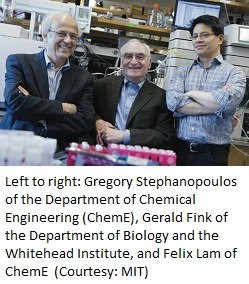
MIT1Ethanol producers might get more production out of the yeast they use, thanks to researchers at MIT. This news release from the school says scientists have added potassium and an acidity-reducing compound to the yeast that helps it tolerate higher concentrations of the ethanol it’s making without dying.

Aided by those “supplements,” traditionally underperforming laboratory yeast made more ethanol than did industrial strains genetically evolved for ethanol tolerance. The supplements also enabled lab yeast to tolerate higher doses of high-energy alcohols such as butanol, a direct gasoline substitute. In other “firsts,” the researchers described the mechanism by which alcohols poison yeast; they defined two genes that control ethanol tolerance; and they modified those genes in lab yeast to make them out-produce the industrial strains — even without the supplements.

Manufacturers worldwide rely on yeast to convert sugars from corn or sugar cane into ethanol, a biofuel now blended with gasoline in cars and trucks. But there’s a problem: At certain concentrations, the ethanol kills the yeast that make it. As a result, a given batch of yeast can produce only so much ethanol.

“The biggest limitation on cost-effective biofuels production is the toxic effect of alcohols such as ethanol on yeast,” says Gregory Stephanopoulos, the Willard Henry Dow Professor of Chemical Engineering at MIT. “Ethanol is a byproduct of their natural metabolic process, as carbon dioxide is a byproduct of ours. In both cases, high doses of those byproducts are lethal.”

Efforts to grow genetically modified yeast weren’t successful, but it did give the researchers the idea for adding the common chemicals.

Ethanol, Ethanol News, Research

Natural Gas as a Marine Fuel

Joanna Schroeder

Natural gas is being tested in Canada as a marine fuel. The NM F.-A.-Gauthier has officially been commissioned and is the first ferry in North America to be fueled with liquified natural gas (LNG). It is also the first ship of any kind running on LNG in Canada. Gaz Métro, a company that sells LNG, applauded the trial and the noted in a press statement that by choosing natural gas as the fuel for its new admiral-ship, the Société des traversiers du Québec is reaching an important milestone in the Québec maritime transport sector and paving the way for local shipowners to use a proven, high-performance and cleaner technology.

NM F.-A.-Gauthier, the first ferry to run on liquefied natural gas (LNG) in North America. Photo Credit: Gaz Metro.

NM F.-A.-Gauthier, the first ferry to run on liquefied natural gas (LNG) in North America. Photo Credit: Gaz Metro.

Gaz Métro also states the use of LNG makes it possible to reduce greenhouse gas emissions by up to 25 percent, compared with marine diesel, in addition to almost completely eliminating fine particle emissions and other air pollutants. LNG motors are also quieter and produce less vibration, which is more respectful of marine life.

LNG motors are a proven technology widely used for many years in road and maritime transport worldwide, particularly in Europe. “It’s extraordinary that this major first is happening here in Québec, and Gaz Métro is very proud to be a part of it,” highlighted Martin Imbleau, vice president, Development and Renewable Energies at Gaz Métro. “In support of Québec’s Maritime Strategy, LNG is a concrete solution for fighting climate change and allows local shipowners to comply with the increasingly stringent standards regarding polluting emissions onNorth America’s waterways.”

Following an agreement concluded in 2013, Gaz Métro, through its subsidiary Gaz Métro LNG L.P., was chosen as the LNG supplier to fuel three new Société des traversiers du Québec ferries, including the NM F.-A.-Gauthier. Today this ship is replacing the NM Camille-Marcoux for the Matane–Baie-Comeau–Godbout ferry service. The two other ships will be assigned to the Tadoussac–Baie-Sainte-Catherine crossing.

Liquefied natural gas (LNG)

Colorado’s RPS Going Forward

Joanna Schroeder

Colorado’s Renewable Portfolio Standard (RPS) is going forward. The Tenth Circuit Court of Appeals has upheld the constitutionality of the legislation stating the RPS does not impose unlawful regulations on out-of-state companies. In their written opinion, the judges determined that Colorado’s RPS would not harm interstate commerce.

Current state law requires electric generators to ensure that a percentage of the electricity they sell to Colorado consumers comes from renewable sources. That prompted the Energy and Environment Legal Institute (EELI), which has longtime ties to the coal industry according to the renewable energy industry to file suit in federal court – arguing that out-of-state companies wereScreen Shot 2015-07-14 at 10.14.43 AM unfairly and adversely impacted.

The Solar Energy Industries Association (SEIA) and the Interwest Energy Alliance (a regional partner of the American Wind Energy Association (AWEA)) were two of several organizations to intervene on behalf of the Colorado Public Utilities Commission and in support of the state’s RPS.

“Because electricity can go anywhere on the grid and come from anywhere on the grid, and because Colorado is a net importer of electricity, Colorado’s renewable energy mandate became a ‘target’ for people and groups hoping to freeze or rollback RPS programs – not only in Colorado, but also in other states around the nation,” said SEIA President and CEO Rhone Resch. “By ruling on the substance of the issue, we believe the Tenth Circuit Court of Appeals decision sends a clear signal that renewable energy standards are, in fact, legal under the Constitution’s dormant commerce clause. We applaud the court for its clear guidance.”

Colorado was the first state in the U.S. to adopt a renewable energy standard by a popular vote. The renewable energy industry said the law has widely benefited the state as wind power supports up to 7,000 well-paying jobs, including manufacturing jobs at 22 facilities around the state and wind has attracted $7.8 billion in capital investment to the state’s economy.Read More

Clean Energy, Electricity, Renewable Electricty Standard (RES), Solar, Wind

BioEnergy Bytes

Joanna Schroeder

  • BioEnergyBytesDF1Amazon Web Services, Inc. has announced that it has contracted with Iberdrola Renewables, LLC to construct and operate a 208 MW wind farm in Perquimans and Pasquotank counties, North Carolina, called the Amazon Wind Farm US East. This new wind farm is expected to start generating approximately 670,000 megawatt hours (MWh) of wind energy annually starting December 2016. When completed, it will be the first utility-scale wind farm in the state of North Carolina, with the energy generated delivered into the electrical grid that supplies both current and future AWS Cloud data centers.
  • The Green Mountain Energy Sun Club®, a program formed by Green Mountain Energy Company to donate solar projects to non-profit organizations, has been transformed into an independent non-profit and is expanding its mission and scope to go beyond solar power to solutions for a sustainable lifestyle. As a newly formed non-profit, the Sun Club has announced an expanded mission to enhance the quality of life through long-term, sustainable solutions that focus on people and the planet, which will include donations of new sustainability technologies, like water conservation, energy efficiency or waste reduction tools, to non-profits.
  • Abengoa has announced that a project sponsored by Abengoa in collaboration with Starwood Energy has been selected by the California Independent System Operator (CAISO) as the approved sponsor to finance, construct, own, operate and maintain the Delaney to Colorado River 500 kV transmission line project.
  • IncBio has secured an agreement to design and build a 75,000 MT/year biodiesel plant, for Biocosta Green Energy SA in Santa Marta, Colombia. The plant will be producing biodiesel directly from crude palm oil blended with palm acid oil and PFAD up to a total of 25% FFA, and will include pre-treatment, acid esterification with IncBio’s solid catalyst technology, transesterification, dry wash using ion exchange resin and biodiesel distillation. It will incorporate IncBio’s ultrasonic technology in all steps of the plant in order to produce the highest quality biodiesel at the lowest possible cost. The plant will use locally sustainably produced palm oil as feedstock. IncBio expects the plant to be started up in May 2016.
Bioenergy Bytes

LanzaTech Teams with Others to Build Ethanol Plant

John Davis

LanzaTechghent1LanzaTech is partnering with two companies in the metals businesses to build a nearly $97 million ethanol plant. This company news release says LanzaTech, ArcelorMittal a steel and mining company, and Primetals Technologies, in the iron and steel industry, will construct Europe’s first-ever commercial scale production facility to create bioethanol from waste gases produced during the steelmaking process. The resulting bioethanol can cut greenhouse gas emissions by over 80 per cent compared with conventional fossil fuels.

The 47,000 ton ethanol/annum project, sufficient to fuel half a million cars with ethanol blended gasoline, will demonstrate the added value of recycling waste streams, not only by reducing emissions at source, hence reducing ArcelorMittal’s direct carbon footprint, but by keeping fossil fuels in the ground through the production of commodity chemicals and fuels that would otherwise be made from oil.

Approximately 50 per cent of the carbon used in the chemistry of steelmaking leaves the process as carbon monoxide. Today, this waste gas stream is either flared or used to heat and power the steel mill. In either case, the carbon monoxide is combusted and the resulting CO2 is emitted. LanzaTech’s technology, however, recycles the waste gases and ferments them with a proprietary microbe to produce bioethanol. Every ton of bioethanol produced, displaces 5.2 barrels of gasoline as well as reducing ArcelorMittal’s CO2 emissions by 2.3 tons.

The project will be located at ArcelorMittal’s steel plant in Ghent, Belgium, is anticipated to commence later this year, with bioethanol production expected to start mid-2017.

Ethanol, Ethanol News, International

NREL Expert on E15 Infrastructure at ACE

John Davis

aceA senior National Renewable Energy Laboratory (NREL) analyst will discuss E15 infrastructure at the upcoming American Coalition for Ethanol’s (ACE) Conference. This ACE news release says Kristi Moriarty, the principle author of a recent government report examining the compatibility of existing fuel station infrastructure for E15, will speak during the conference August 20 in Omaha, Nebraska.

“One reason the ethanol industry petitioned EPA to approve the use of E15 is because existing standards indicated the blend was compatible with most existing equipment,” said ACE Senior Vice President Ron Lamberty. “Unfortunately, gas station owners have been misled by ethanol detractors into believing that adding E15 would cost hundreds of thousands of dollars in new equipment. We’re looking forward to hearing from Kristi Moriarty, the lead author of the NREL report which destroys the E15 compatibility and cost myths,” said Lamberty.

The theme of the August 19-21 ACE Conference is “Quiet Ingenuity, Bold Advance.” The event will also feature a talk on technology and advanced biofuel innovations involving Ray Defenbaugh, President and CEO of Big River Resources LLC, Delayne Johnson, CEO of Quad County Corn Processors, and Jeff Oestmann, President and CEO of East Kansas Agri-Energy, LLC, a retailer panel discussion on E15 and flex fuel sales, a progress report on ethanol and DDGs exports, ethanol plant board member training, and much more.

This link has more information on the ACE Conference.

ACE, conferences, E15, Ethanol, Ethanol News