Groups Ask for Advanced Biofuel Tax Extension

Joanna Schroeder

As the advanced biofuel tax credits get closer to expiring, six biofuel trade associations have called on federal legislators to pass a multi-year extension of the credits. In 2015, through the Protecting Americans from Tax Hikes Act of 2015, several programs were extended including: the Second Generation Biofuel Producer Tax Credit; the Special Depreciation Allowance for Second Generation Biofuel Plant Property; the Biodiesel and Renewable Diesel Fuels Credit; the Alternative Fuel and Alternative Fuel Mixture Excise Tax Credit; and the Alternative Fuel Vehicle Refueling Property. While these were extended through 2019, the advanced biofuels tax credit is set to expire at the end of this year.

The letter sent today to Senate and House leaders, the Senate Committee on Finance leaders and the House Ways and Means Committee leaders and was signed by The Advanced Biofuels Business Council, Algae Biomass Organization, Biotechnology Innovation Organization (BIO), Growth Energy, National Biodiesel Board, and Renewable Fuels Association.

Screen Shot 2016-04-05 at 12.29.51 PMThe letter stated, “This short-term expiration of tax incentives is jeopardizing the long-term investment necessary for advanced biofuels. This creates uncertainty for investors and industry about the availability of these credits in the future. As leaders in a critical innovation sector in the United States, we are well aware of the financial constraints facing this country. However, as Congress works on developing energy tax extenders legislation, we urge you to ensure that advanced biofuels are part of the package. Extending some 2016 expiring energy tax provisions and not others creates a piecemeal approach and investment uncertainty across the energy sector and distorts the playing field for biofuel producers.”

Additional comments were made by each of the six organizations that signed the letter. These comments can be found below.

Bob Dinneen, president and CEO of the Renewable Fuels Association said, “Short-term tax incentives are akin to new drivers in a stick shift vehicle. The cars haltingly lurch forward for a time, but suddenly stall. The advanced biofuel industry needs certainty if it is to remain commercially viable, as it continues to bring new facilities and technologies online. Longer term incentives would go a long way to making sure the industry continues its growth, and don’t leave consumers stalled along the way.”Read More

advanced biofuels, BIO, Growth Energy, NBB, RFA

EIA Begins Tracking Biofuels by Rail

Joanna Schroeder

Ethanol tank. Photo credit: Joanna Schroeder

Ethanol tank. Photo credit: Joanna Schroeder

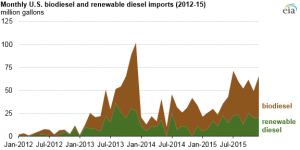
This week marked new data being compiled by the U.S. Energy Information Administration (EIA) including data on ethanol and biodiesel being transported by railroads. With this addition, EIA now reports on monthly rail movements for crude oil, ethanol and biodiesel.

According to EIA, adding movements of ethanol and biodiesel by rail to existing movements between Petroleum Administration for Defense Districts (PADDs) by pipelines, tankers, and barges provides more complete data on inter-PADD movements of biofuels. In addition, incorporating ethanol and biodiesel movements into regional volumetric balances also improves supply estimates for finished motor gasoline and distillate fuel oil.

The first reportable data was the March report that included both January data and also included monthly rail movements of ethanol and biodiesel back to January 2014.

Biodiesel, Ethanol

REG Begins Ames Lab Expansion

Joanna Schroeder

Renewable Energy Group has begun its expansion of its laboratory at its Ames, Iowa headquarters. The upgraded lab will enable the company to further enhance renewable chemical related biotechnology research, development and commercialization including the installation of fermentation equipment and significant analytical capabilities. Once complete, full-time positions will be added to focus on commercialization and integration of products to be developed by REG in South San Francisco into production and delivery platforms.

REG“This expansion is simply one of many examples of REG’s commitment to innovation and economic development in Iowa and in particular Ames which is a cornerstone of Iowa’s Cultivation Corridor,” said REG President and CEO Daniel Oh. “These upgrades will allow us to increase our midwestern focus on product development for renewable chemicals.”

Oh said renewable chemicals legislation is expected to be signed soon by Governor Terry Branstad, a bill that will provide tax credits for the renewable chemical industry. Oh believes these credits will provide extra momentum for REG’s investments. “The state’s efforts to promote and grow renewable chemicals are a natural extension of the state’s support of agriculture and renewable fuels. This bill shows commitment and purpose and demonstrates that the investment is desired here in Iowa, and we are thankful for the support of our elected officials in getting it done. ”

advanced biofuels, biochemicals, biomaterials, bioproducts, REG

Intrexon’s Pilot Isobutanol Plant Online

Joanna Schroeder

Intrexon Corporation has announced that its pilot plant for the production of natural gas-to-liquids is online. Located in San Fransisco, the facility will be producing isobutanol, a drop-in fuel. Intrexon says that isobutanol has several advantages over other biofuels including cleaner burning combustion, less corrosion, more energy content and compatibility with existing pipelines.

INTREXON logo“Reaching operational status with our pilot plant is one of several important milestones we expect to reach this year as we continue to move closer to commercialization of our ground-breaking bioconversion platform for the production of isobutanol,” said Robert F. Walsh, Senior Vice President, Head of Intrexon’s Energy Sector and Industrial Products Division. “Data from the pilot plant will be utilized to further refine our commercial scale facility design.”

The company reports that it has been refining its process and improving the output of isobutanol from its engineered microbes including greater than 50 percent increase since its investor day last November. Intrexon also reports that with the pilot plant operational, they are closer to achieving the yields needed to move to commercial scale later this year and anticipate its first commercial plant will be online in 2018.

isobutanol, Natural Gas

ACE Ready for Annual Fly-in

Cindy Zimmerman

ace16-flyin The 8th annual American Coalition for Ethanol (ACE) legislative fly-in is coming up next week, April 13-14, and some 70 members of the organization from about 15 states are planning to attend this year.

“It’s really important that we show the human face of ethanol and renewable fuels,” said ACE Executive Vice President Brian Jennings. “We spend a lot of time with our participants to get them to think about the personal side of ethanol and what it has meant to them and we ask them to convey that when they sit in these meetings.”

Jennings says they have meetings set up with over 100 members of Congress or staff during the two days of the event. “We try to seek as many meetings out with so-called opponents of renewable fuels as we can (because) we want our folks to have an opportunity to change hearts and minds, and we know that’s not always easy…we think it’s really important to not just preach to the choir.”

The 2016 election year will definitely play a part in what ethanol supporters will be discussing next week on Capitol Hill. “Not only are we electing a president, but every member of Congress is up for re-election and about one-third of the U.S. Senate,” said Jennings. “The message we want to convey to members of Congress is that it’s in your best interest to continue to support renewable fuels if you have, or give renewable fuels another look if you haven’t been a supporter.”

In addition to meeting with Congressional representatives, fly-in participants will also hear from administration officials and there will be a briefing for Senate staffers by fuel retailers who sell higher blends. “We continue to get attacked on the so-called blend wall…and this is our attempt to have the most effective, persuasive messengers when it comes to the blend wall, retailers who are actually selling E-15 and flex fuels to consumers,” Jennings said.

Fly-in registration information is available at this link on the ACE website. And if you can’t be there in person, stay tuned here for photos and interviews from the event.

Learn all about the ACE Fly-in here: Interview with ACE Executive Vice President Brian Jennings

ACE, Audio, Ethanol, Ethanol News, Government

GRFA Commends Countries for Biofuels Leadership

Cindy Zimmerman

GRFA logoThe Global Renewable Fuels Alliance (GRFA) is commending the leadership of 13 countries that highlighted biofuels as part of their Intended Nationally Determined Contribution (INDC) plans at the recent Conference of the Parties to the UN Framework Convention on Climate Change (COP21) in Paris.

GRFA president Bliss Baker sent letters to leaders of the 13 nations thanking them for recognizing the significant contributions that ethanol-supportive policies have made, and continue to make, in reducing CO2 emissions in the transport sector. “If the enormous potential of biofuels as the only commercially viable technology available to significantly offset emissions in the transport sector is to be achieved, strong policies must be put in place to increase global production, innovation and consumption of ethanol,” said Baker.

In the letters, Baker offered the expertise of GRFA members to work with government leaders in the development of policies that “maximize the advantages of biofuel technologies that are demonstrated to be effective, affordable and immediately available.”

The 13 countries are Angola, Argentina, Brazil, China, Fiji, India, Malawi, Malaysia, Mozambique, Nigeria, Philippines, Uruguay, and Zimbabwe.

advanced biofuels, biofuels, International

DuPont Honored for Cellulosic Ethanol

Cindy Zimmerman

bdc-dupontDuPont Industrial Biosciences has been recognized by the Biorenewable Deployment Consortium (BDC) with the organization’s 2016 Outstanding Achievement Award for the company’s continuous contributions to the deployment of biochemical and advanced cellulosic biofuels.

“The Biorenewable Deployment Consortium is proud to honor DuPont with its 2016 Outstanding Achievement Award,” said BDC President and Co-Founder Masood Akhtar. “DuPont sets a strong example for others around the world who are working to expedite the transition from a petroleum-based to a biobased economy.”

“DuPont Industrial Biosciences is proud to be recognized by the Biorenewable Deployment Consortium for our work in the ever-growing bioeconomy sector. We accept this award on behalf of a global team of innovators who are focused on providing market-driven, biobased solutions to meet the needs of a growing population, while protecting our environment for future generations,” said DuPont Business Director for Cellulosic Ethanol Steve Mirshak, who received the award on DuPont’s behalf.

DuPont established the world’s largest cellulosic ethanol facility in Nevada, Iowa and with its
partner Tate & Lyle, is the leading producer of Bio-PDO®, a petroleum-free propanediol. BDC has worked toward the deployment of bio-processes since 2006 and holds two annual symposiums a year for its members.

biofuels, Cellulosic, Ethanol, Ethanol News

Ethanol Report on Trade Mission to Peru

Cindy Zimmerman

ethanol-report-adThe Renewable Fuels Association (RFA) was part of a recent trade mission to Peru led by Agriculture Secretary Tom Vilsack which included discussions about increasing cooperation with that country when it comes to ethanol production and exports. The March 13-15 trip went to Lima and the Piura region, where cane-based ethanol is produced, and featured meetings with ministry of energy officials and a biofuels roundtable with ethanol producers and fuel distributors.

RFA General Counsel Ed Hubbard was among nearly 40 industry and government representatives on the trip. In this edition of the Ethanol Report, Hubbard talks about the mission and opportunities with Peru to expand ethanol

Listen to it here: Ethanol Report on Trade Mission to Peru

Audio, Ethanol, Ethanol News, Ethanol Report, Exports, International, RFA

USDA Reports Positive for #Corn Supplies

Cindy Zimmerman

USDAThe 2016 Prospective Plantings report out today from USDA’s National Agricultural Statistics Service (NASS) shows farmers expect to plant more corn than expected this year.

U.S. corn growers expect to plant 93.6 million acres to corn this year, the first increase in corn planted acreage since 2012 and, if realized, will be the third largest corn acreage since 1944. Farmers in 41 out of the 48 states expect to either maintain or increase the number of acres they plant to corn. Growers in Illinois, Iowa, Kansas, and North Dakota expect to increase their corn acreage by 400,000 or more acres in 2016. Assuming the five-year average 91.3 percent harvest rate and the projected 25-year trend yield of 165.4 bushels per acre is achieved, farmers will harvest 14.13 billion bushels, nearing the production record of 14.2 billion bushels set in 2014, according to the National Corn Growers Association (NCGA).

In addition, the new grain stocks report increases corn stocks in all positions as of March 1 by one percent compared to this time last year. Stocks totaled 7.81 billion bushels and of the that, 4.34 billion bushels were stored on farms, down 1 percent from a year earlier. Off-farm stocks, at 3.47 billion bushels, are up 3 percent from a year ago.

“U.S. farmers produced an abundant crop in 2015. Given the strong carryover entering this growing season, we may see quite a large corn supply at harvest should weather prove favorable in 2016,” said NCGA President Chip Bowling. “While many factors may change the reality on the ground as planting progresses, American corn supplies should remain ample for the year to come. Given the impact this continues to have on prices, the work being done at NCGA to grow demand will prove even more important as we work to find markets for our product and remain profitable into the future.”

Renewable Fuels Association (RFA) president and CEO Bob Dinneen says the planting intentions show that American farmers are continuing to hold up their end of the deal when it comes to the Renewable Fuel Standard (RFS). “They’ve made the investments and planting decisions necessary to provide adequate supplies of grain to meet all demands, including the feedstock needed to produce the 15 billion gallons of ethanol required in 2016 under the RFS statute,” commented Dinneen. “But by slashing the RFS requirements for 2016 below statutory levels, the Administration isn’t honoring its commitment to our nation’s farmers and is contributing to great economic uncertainty in the agriculture sector.”

Dinneen adds that the report underscores the importance of getting the RFS back on track and growing corn demand.

corn, Ethanol, Ethanol News, NCGA, RFA, RFS, USDA

Consumers Insulted by #Ethanol Poll

Joanna Schroeder

Renewable Fuels Association President and CEO Bob Dinneen reacted today to a poll released by the Outdoor Power Equipment Institute (OPEI) saying consumer awareness and knowledge of how to use higher ethanol blends remains relatively unchanged. The poll also found that consumers do not pay attention to the fuels they use. Dinneen pointed out that there has never been even one case of misfueling or engine damage since E15 was introduced into the marketplace. He also noted that E15 is sold at less than 2 percent of gas stations nationwide and the majority of people polled live nowhere near a station that sells E15. Dinneen added that education will come with more widespread use of higher ethanol blends including E15.

dreamstime_xs_55164057“By law, all gasoline station pumps must post clearly labeled signs indicating what fuel is being dispensed and what vehicles can operate on those fuels,” explained Dinneen. “For higher ethanol blends above 10 percent, only flexible fuel vehicles and 2001 and later model year vehicles are approved — not small engines, lawnmowers or any other off-road vehicle. This has been the case since EPA gave final approval to E15 in 2012, four years ago.”

Dinneen continued, “OPEI’s poll is insulting to consumers. OPEI seems to think the average consumer is stupid enough to purposely ignore a very clear label and knowingly violate the law to save a few cents per gallon on a typically low-volume fill up for small engines.

“E10 is sold at nearly every single gasoline station in the U.S. and has been used in small engines for decades. All major small engine manufacturers approve and warranty the use of E10 in their equipment.

“Ethanol blends are typically the lowest-cost fuel option at retail gasoline stations and E15 has generally been even cheaper than E10. That is good news for consumers. However, consumers are still smart enough to know they should use only approved fuels for their equipment.Read More

biofuels, E15, Ethanol, Ethanol News, RFA