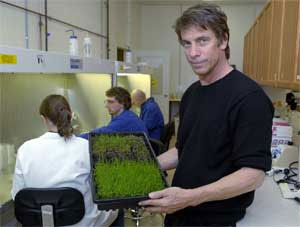
 A University of Rhode Island plant geneticist has launched “Project Golden Switchgrass” to develop “the variety of enhanced switchgrass that everyone needs” as an alternative crop to produce ethanol.
According to a URI release, Albert Kausch is a world leader in developing transgenic grasses, having spent 20 years genetically modifying turf grasses, rice and corn. He is also an expert on “gene confinement” who is working to create a switchgrass that does not flower or reproduce, thereby ensuring that the genetically modified organisms do not escape into the environment and affect wild switchgrass.
Kausch is now genetically engineering switchgrass that is both sterile and resistant to herbicides, and he has a long list of other traits he hopes to improve as well, including drought tolerance, salt tolerance and cold tolerance. He expects to have test plots of the genetically modified plants on the URI campus within two years, and he hopes the first varieties will be in commercial production by 2011.
 Approximately 1,800 people attended
 The House will be forming a new agricultural energy subcommittee in response to the role farming will play in reducing America’s dependence on imported oil, according to Representative John Salazar, a Democrat from Colorado.
  The December edition of
  The state of Alabama is focusing on alternative fuels.
 For corn growers, ethanol means markets as usual. In other words, up and down.
 Every month there’s a new record set for ethanol production and the bar has now been raised to 333,000 barrels a day. That’s a 55,000 barrel per day increase since the beginning of the year, according to the latest figures released by the