

Officials from the Chicago Board of Trade (CBOT) joined with government officials and representatives from the IndyCar Series and the ethanol industry on Monday in a tribute to the “Greening of Racing.”
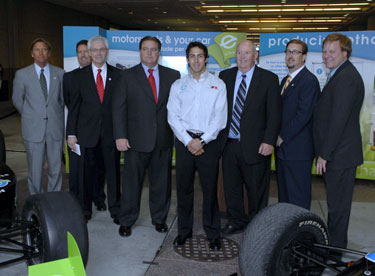
Pictured from left to right are Terry Angstadt, IndyCar Series president; CBOT Executive Vice-President for Marketing and Business Development Chris Malo; USDA Under Secretary for Rural Development Thomas Dorr; CBOT Chairman Charlie Carey, Team Ethanol car driver Jeff Simmons; Illinois Director of Agriculture Chuck Hartke; EPIC Executive Director Tom Slunecka; and Doug Scott, Director of the Illinois Environmental Protection Agency.
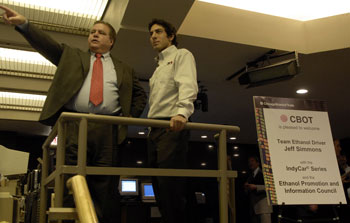
Prior to the opening bell, CBOT Executive Vice-President for Marketing and Business Development Chris Malo talked about how the commodity exchange created ethanol contracts two years ago as a price discovery tool for the industry.
“When we launched our ethanol futures contract in March 2005 we knew we were early to the market place,” said Malo. “However, we recognized the increasingly important role that ethanol can play in meeting the nation’s energy needs before ethanol became a daily news story.”
U.S. Department of Agriculture Undersecretary for Rural Development Thomas C. Dorr played a part in the tribute, detailing the enormous growth of the ethanol industry.
“Ethanol production in 2000 was 1.6 billion gallons, today its six billion gallons and new capacity under construction will add another 6.4 billion gallons,” said Dorr. “Cellulosic ethanol will give us the potential to supply a third or more of our liquid fuels.”
Tom Slunecka, Executive Director of the Ethanol Promotion and Information Council (EPIC) said that ethanol has become more than just a product. “Ethanol is a movement,” he said. Besides being proud to partner with the Indy Racing League, Slunecka says EPIC is “proud to partner with the American consumer to help change our future.”
Terry Angstadt, IndyCar Series president, says the partnership with ethanol fits in perfectly with their mission.
“The Indianapolis Motor Speedway was built in 1909 literally as a test track to support the auto industry in technology and innovation,” he said. “That’s why the association with the ethanol industry, EPIC, the Rahal Letterman race team, Jeff Simmons is a perfect association for a business and series that is so aligned with technology and innovation as our cornerstone.”
 The
The 
 An Arizona dairy is looking at expandng its operations into biofuels. Phoenix-based XL Dairy Group is planning to build a dairy/biorefinery at a site about 100 miles west of Phoenix.
  Shipping giant DHL is looking at testing some of its United Kingdom delivery fleet running on 100% biodiesel. According to this story on the Biofuel Review web site, the testing will begin at the end of this month:
 The
The 

 The students’ use of a less polluting fuel in the contest caught the attention of the
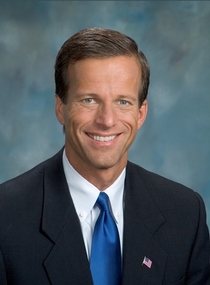 U.S. Senator John Thune (R-South Dakota) will hold a wind energy roundtable this coming Monday, May 14th at 1:00 PM (CDT) at the Sheraton Hotel in Sioux Falls.
  Drivers along a stretch of Interstate 15 in Utah might be used to seeing biodiesel-powered vehicles, but the same stretch of road is becoming home to the raw materials used to make biodiesel.