

 Green Power Generators is helping the entertainment industry lessen its carbon footprint. GPG is already known for its biodiesel-fueled power generators. According to this story posted on on BusinessWire.com, the company has come up with the next generation of green fuel power:
“We’re very excited to be able to provide the entertainment industry with the only truly eco-friendly energy outsourcing option available today,” explained Tomer DeVito, co-founder of GPG and a television commercial and music video producer. “Generators are the biggest polluters on sets, at concerts and events, and we wanted to change that. We hope to pioneer a change in the way we do things in Hollywood, and beyond. We have already been embraced by several environmental non-profits who will help us encourage all large scale productions to use clean burning fuel.”
Adds Alton Butler, co-founder of GPG and president of Line 204 Studios, GPG’s parent company: “This is a real breakthrough in a business world that is growing increasingly concerned about the environment. The industry standard tier-2 diesel engines are not qualified to burn biodiesel. The available industry standard diesel-engine generators can burn only up to 5% bio-diesel (B5) – if you burn a higher percentage you risk losing your warranty. Currently productions don’t have an option for burning cleaner fuels. GPGs are specially designed to burn the cleanest biodiesel fuels possible”.
A recent report pegs the movie industry as the second-biggest polluter in California. GPG’s new line of generators burn cleaner and are quiet enough to use on a movie set.
 The Iowa Soybean Association will be using some of its checkoff dolars to form the Iowa Biodiesel Board… with the obvious mission of promoting Iowa’s biodiesel industry.
  Daniel Oh, the CEO of Renewable Energy Group, will chair the new board.
 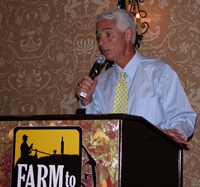 Government and industry leaders addressed a sold-out crowd at the second annual
  Rahal Letterman Racing announced today that Ryan Hunter-Reay will be taking over driving duties with the team’s #17 Team Ethanol car effective immediately. I look forward to meeting him soon and I’m sad to see Jeff Simmons replaced. As Bobby Rahal explains in the announcement which I’ve posted below, Jeff stepped into a difficult situation last season. I think Jeff is a class act and was doing a great job as a spokesperson for the team and Team Ethanol. We’ll miss him and wish him and his fiance, Stephanie, all the best.
 A new USDA report says that about half of the cattle and hog operations in a 12-state Midwest region either fed ethanol co-products or considered feeding them to their livestock last year.
  The second annual Virgin Festival sponsored by Virgin Mobile will try to be as environmentally conscious as possible during the two-day concert, August 4-5th at Pimlico Race Course in Baltimore, Maryland.
 A report from Global Industry Analysts, Inc. says rising crude oil prices, and much of the world’s desire to find alternatives to fossil-based fuels, will push world biodiesel sales to 4.7 billion gallons a year by 2010.
 Tomorrow morning, Wednesday, July 18th between 8 and noon, Kum & Go gas stations in 17 locations in Iowa will hold “Biodiesel Appreciation Day”… offering B2 biodiesel for 10 cents a gallon off the regular price.
 “While ethanol makes a lot of headlines, especially here in Iowa, biodiesel has become the sleeping giant of biofuels,” said Jessica Zopf, environmental health coordinator for the American Lung Association of Iowa. “Iowa produces 225 million gallons of cleaner-burning biodiesel a year, which can significantly reduce harmful tailpipe emissions when used in higher concentrations. Buying a two percent blend biodiesel may be a small step, but it is a vital beginning on a path toward cleaner air, greener fuels and less dependence on petroleum.”
 Where Sweden is the leader in the Ethanol movement in Europe, Minnesota is clearly designated as the leader in the United States with over 300 stations strong and growing, totalling roughly one third of Sweden’s entire nationwide coverage. In Sweden, there are almost 900 E-85 filling stations covering the entire country according to the Swedish Ethanol Development Foundation. In Minnesota, this works out to about one E-85 pump per every 17,000 persons in Minnesota that has a population at just over 5 million people. In Sweden, there is roughly one E-85 pump per every 10,000 persons with their total country’s population totalling around 9 million people.