

 The sudden skyrocketing of wind energy production, especially in areas of the Midwest and rural parts of Texas and California, is outdistancing the the capacity for the nation’s high-voltage lines to get that clean electricity into the nation’s cities.
This story from USA Today says the problem could keep some projects from even getting started and states from meeting their renewable energy goals:
Wind power depends on a robust transmission grid. Wind farms are in remote reaches where gusts are strongest, while the greatest power demand is in cities.
Until now, wind developers have piggybacked on existing wires, says analyst Stow Walker of Cambridge Energy Research Associates. But after wind energy soared 45% last year, spare transmission capacity is depleted. Wind power generates more than 1% of U.S. electricity.
Stringing new wires is easier said than done. Wind developers won’t go ahead with projects until transmission lines are in place, and utilities are loath to build the lines until they’re sure the developers won’t back out. Also, the first wind developer in an area is often asked to shoulder much of the $1.5 million-per-mile cost of a high-voltage line.
In Texas, which has about 25% of U.S. wind power, more eye-popping growth in 2008 is expected to push generation past transmission capacity by 65% by year’s end, says Bill Bojorquez, vice president of the Electric Reliability Council of Texas, a power-grid manager.
Some areas are trying to solve the problem by combining assets to put in the transmission lines, because while it only takes 18 months to put in the wind farm, the power line to get the energy to the consumers can take five to 10 years.
 The U.S House today approved $18 billion in new taxes on the oil companies that will fund incentives for renewable energy.
 Buses in Central Florida will soon be running on a blend of their own biodiesel… a first in the country for any bus fleet.
 The
The 
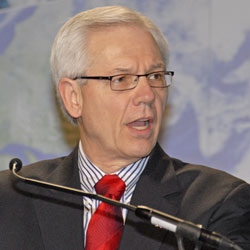 Our Undersecretary for Rural Development, Tom Dorr, was first up on the program here this morning at the National Ethanol Conference to speak about the farm bill and focus on renewable fuel policies and provisions.
 Florida Power and Light has picked up a $2.5 million state grant to help build a major wind power plant.
 While California leads the nation in alternative fuel stations, pumps offering E85 ethanol and biodiesel are still extremely rare.
 Government to Greenpeace will be taking part in the
  The National Ethanol Conference got a little bit country and a little bit rock and roll tonight and a whole lot of corn fed. I don’t know about you but I love being corn fed and I love
 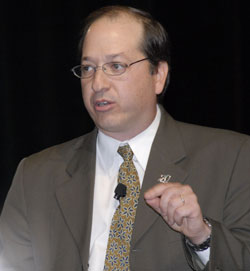 Bob Dinneen, RFA President, isn’t the only one to preach a powerful sermon here at the National Ethanol Conference. I was very surprised and pleased to hear Andy Karsner, Assistant Secretary for Energy Efficiency & Renewable Energy, U.S. Department of Energy, speak at today’s luncheon. He gave a very passionate speech that you would really enjoy listening to. That’s why I decided to post a link to the full speech below for you. I know it’s a little long but you can listen to as little or as much as you’d like this way.