

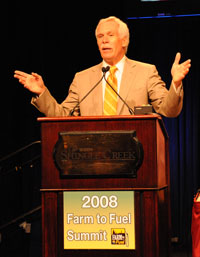
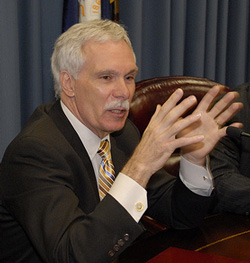
 U.S. Secretary of Agriculture Ed Schafer traveled to Florida to address the third annual Florida Farm to Fuel Summit in Orlando.
“This is the theme park capitol of the world, it is a city of dreams and the power of imagination,” Schafer told the group. “As we sit here in the land of imagination and dreams, it’s up to all of us to meet the needs of the future through renewable fuels and we can change from wild imagination to realizable dreams.”
“Biofuels are an important part of the solution to our nation’s energy challenges and they are an important part of the economic future of rural America as well,” Schafer said. “That means that agriculture is going to be right in the middle of the game.”
“Here in Florida, the sheer variety of agriculture really make you a state that is a great laboratory for the future,” he added. “When breakthroughs come, I’m really counting on Florida to lead the way.”
He commended Florida Governor Charlie Crist, Agriculture Commissioner Charles Bronson and the state legislature for the state’s efforts to stimulate innovation with the Farm to Fuel program.
Listen to Secretary Schafer’s remarks here: [audio:http://www.zimmcomm.biz/florida-fuel/f2f-08-schafer.mp3]
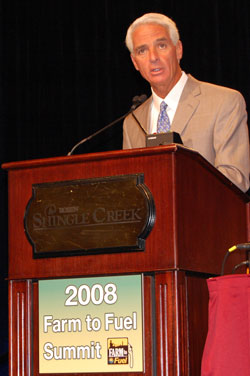 Florida Governor Charlie Crist spoke to a group of over 450 gathered for the third annual
  The
The 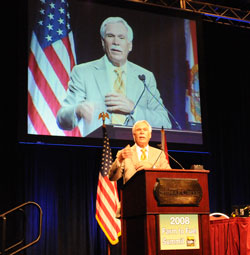 This morning the
  The nation’s biggest biodiesel refinery has installed a quality control system that promises to cut testing times from hours to minutes.
 Battling the myths and misinformation that swirl around both ethanol and biodiesel seems to be a fulltime job these days. While some groups, such as the American Soybean Association and the Renewable Fuels Association, fight these battles daily, they could use a little help from the novices and those interested in the success of biofuels. That’s why the ASA is giving them the tools to beat back those naysayers against the green fuels.
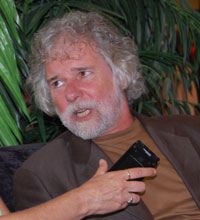 True rock and roll fans will recognize the name Chuck Leavell as keyboardist for the Rolling Stones – in addition to many other well-known rock legends such as The Allman Brothers and Eric Clapton.
 Massachusetts Governor Deval Patrick has signed into law a measure that is hoped to make his state a leader in biofuels by exempting cellulosic biofuels (ethanol) from state taxes and creating a mandate for biodiesel in home heating oil.
 Last month’s floods in the Midwest might not have put the corn and soybean crops, which are vital to ethanol and biodiesel production, in as much peril as originally feared.