DOE Conference Focuses on Biomass Future

Cindy Zimmerman

With appropriate policies to help overcome current fiscal constraints, the advanced biofuels industry can meet environmental goals, create new green jobs and contribute to economic growth, according to industry leaders who met this week at the U.S. Department of Energy (DOE) Office of the Biomass Program’s Biomass 2009: Fueling Our Future conference.

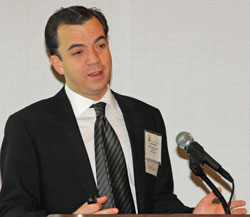
biomass 2009During the conference opening plenary session, titled “Dispelling the Myths and Addressing the Challenges,” Biotechnology Industry Organization (BIO) executive vice president Brent Erickson stressed the economic potential that development of the advanced biofuels industry holds.

“Building advanced biofuel production to a modest target of 45 billion gallons by 2030, which can be achieved by maintaining the same pace of technology development, could create more than 400,000 jobs within the industry and 1.9 million new jobs throughout the economy,” said Erickson. “Further, it could provide an economic boost of $300 billion.”

Richard Hamilton, chief executive of energy crop company Ceres, Inc., said large increases expected in crop productivity, as well as better utilization of fallow or marginal land, will absorb the demands being placed on U.S. farmers by bioenergy. “And if we look at improved ways to roll-out advances in plant science globally, and rely primarily on non-food, low-carbon crops like switchgrass, sorghum and Miscanthus, then the math behind biofuels looks even more promising,” he said.

Jack Huttner with DuPont Danisco Cellulosic Ethanol discussed some of the economic and policy challenges facing the industry and noted that everything depends on a robust government support structure. “We won’t need incentives and subsidies forever, but we need them to get started. In particular, we need regulatory regimes and policies from agencies like the EPA that don’t send the wrong signals to the marketplace.”

The conference was held yesterday and today at the Gaylord National in National Harbor, MD.

BIO, biomass, Government

Ethanol Minute Radio Returns to the Air with Ed Schafer

edshaferEd Schafer, U.S. Secretary of Agriculture under George W. Bush, Governor of North Dakota from 1992-2000, and one of the founders of the Governors’ Biofuels Coalition will be the first guest on the 2009 edition of the Ethanol Minute Radio program beginning this week.

In this year’s inaugural broadcast of the highly successful series, Secretary Schafer says that America can continue to be the breadbasket of the world while playing a vital role in the development of renewable energy. He notes that biofuels had little impact on a spike in food prices last year that were in reality due to skyrocketing energy costs, a global drought, and a surge in world demand.

“Although corn and oil prices are now at their lowest in years, food manufacturers continue to charge high prices and rake in record profits. It is time for them to stop blaming biofuels and provide some relief to the American consumer,” said Mr. Schafer. “Working together, we can turn the economy around with both the energy and food sectors doing their part. As a Governor I had to balance the needs of many different industries and the biofuels program does just that.”

ethanol-across-americaThe Ethanol Minute is broadcast nationally with nearly 1,000 minutes per week airing from coast to coast reaching more than 50 million listeners. Guests include people from all walks of life providing a perspective from a variety of industry, government, and public interests in a concise and targeted format.

The Ethanol Minute is part of the Ethanol Across America Education Campaign. The program is produced in cooperation with the US Department of Agriculture, with additional support provided by Growth Energy.

communications, Ethanol, Farming, News

Oil Company Buys Ethanol Plants

Cindy Zimmerman

VerasunWhen the dust finally settled yesterday, oil company Valero came out with the winning bid of $477 million for seven ethanol plants owned by bankrupt producer VeraSun Energy.

ValeroAccording to a release from VeraSun, Valero Renewable Fuels was selected as the successful bidder for assets contained in the “VSE Group”, in addition to ethanol production facilities in Albion, Neb., and Albert City, Iowa, following an auction in Wilmington, Del. The VSE Group consists of production facilities in Aurora, S.D.; Charles City, Fort Dodge and Hartley, Iowa, and Welcome, Minn., and a development site in Reynolds, Ind.

The auction began Monday but ended up continuing into Tuesday because a number of other bidders ended up participating in the process, including Archer Daniels Midland, although they did not acquire any assets.

The secured lenders for nine other VeraSun facilities submitted successful credit bids. The company hopes to close the deals in April. VeraSun had filed to reorganize under Chapter 11 of federal bankruptcy law late in October.

Ethanol, Facilities

Happy National Biodiesel Day!

John Davis

diesel2Today is National Biodiesel Day, celebrated on the 151st anniversary of the birth of Rudolf Diesel… the inventor, of course, of the diesel engine. But what you might not know is that Diesel’s first innovative engine ran on peanut oil… the first biodiesel! That’s why the National Biodiesel Board has chosen today to celebrate National Biodiesel Day and to highlight the sustainable nature of the “Scientists for Biodiesel” declaration a month and a half ago:

“Rudolf Diesel understood that fossil resources were not a bottomless barrel,” said Joe Jobe, National Biodiesel Board CEO. “He foresaw that sustainable fuels, like modern-day biodiesel, would be a key to energy resources and continued technological advances.”

nbb-logo1Biodiesel is a cleaner burning, advanced biofuel made from renewable resources. It is domestically produced from a range of readily available products like soybean and other plant oils, animal fats, recycled restaurant grease, and waste grease. In addition work continues on new renewable fuel sources, including algae, to bolster what is already the most diversified fuel on the planet.

Scientists from U.C. Berkeley, Texas Tech and Penn State, and from National Renewable Energy Laboratory (NREL), U.S. Food and Drug Administration (FDA) and Sandia National Laboratories, just to name a few, recognize the promise of sustainable biodiesel. In just six week, 60 experts who share in Diesel’s passion for innovation have signed the “Scientists for Biodiesel Declaration.”

Among them is founder and a director of the Thomas Jefferson Agricultural Institute, Dr. Rob Myers.

“Scientists sometimes have differences of opinion, but this declaration is intended to show the broad consensus among scientists about the benefits of biodiesel,” Dr. Myers said.

The declaration highlights biodiesel’s sustainability and its benefits to reduce dependence on petroleum, help address climate change and boost domestic economies. It also voices support for additional research and development.

The NBB goes on to point out that burning the 700 million gallons of the green fuel produced last year reduced greenhouse gas emissions the equivalent of taking nearly 1 million vehicles off U.S. roads. In addition, for every unit of energy to produce biodiesel, at least 3.5 units are gained; soybean-based biodiesel uses just the oil, leaving 80 percent of the bean for high-quality food source for animals and people; and biodiesel biodegrades about as fast as sugar.

So, happy birthday, Mr. Diesel and happy National Biodiesel Day!

You can read the “Scientists for Biodiesel” declaration by going to www.biodieselsustainability.com.

Biodiesel

$1.3 Million Grant Helps Build Connecticut Biodiesel Plant

John Davis

greenleafbiofuelsA $1.3 million State of Connecticut grant will help a private company build a biodiesel refinery.

This press release from Greenleaf Biofuels, LLC, says the company inked the deal to build a waste-grease feedstock biodiesel plant in New Haven harbor:

The grant to Greenleaf is the largest of several announced by Connecticut late last year and is part of the State’s production facility program to directly support biodiesel production. Greenleaf’s grant is underwritten by Connecticut’s Department of Economic and Community Development (DECD) and administered through the Connecticut Center for Advanced Technology (CCAT).

“Projects such as this biodiesel facility and companies like Greenleaf are critical components to the state’s economic future,” said Joan McDonald, commissioner of DECD and chair of Connecticut Innovations. “Connecticut must continue to innovate and focus on developing new, cutting-edge jobs. We need to develop alternative sources of energy, breaking free from our dependence on foreign oil and using our natural resources more responsibly. These are key elements of a new economic development agenda that will lead the state in the next generation.”

Discussing the Greenleaf New Haven facility, Gus Kellogg, founder and CEO of Greenleaf, said: “The technology for building advanced biodiesel processing facilities is ready now to meet customer needs at prices competitive even at today’s suddenly lower fuel prices. In the future, we believe our products will become even more attractive to energy customers. That’s because, since the 1970’s when current energy supply and related environmental issues first emerged, fossil fuel prices have mostly trended upward.”

Officials say when the plant is up and running next year, it will be able to make 6.7 million gallons of biodiesel a year from used cooking oil and grease. They add the plant will use little water and generate little waste, among other earth-friendly practices the refinery will employ.

Biodiesel

Algae Biodiesel Maker Announces Opening of Plant

John Davis

stellarwindGreen pond scum will become green fuel at a new pilot production plant in Indiana.

Stellarwind Bio Energy, LLC, a producer of fuel oil from algae, announced the opening of its new small scale pilot production facility and corporate headquarters in Indianapolis. The plant has a 1/10th acre greenhouse, along with offices and an advanced research and development

Leveraging two years of research, design and development, the new headquarters located at 8440 W. 82nd Street, Indianapolis, IN, will allow Stellarwind Bio Energy to build a scaled pilot production facility deploying its PhycoGenic ReactorTM and PhycoProcessorTM. During this phase intensive effort will continue as the company refines its systems and manufacturing processes.

Our Vision Statement – “To reshape the competitive energy landscape by providing a new domestic source of eco-friendly renewable energy.”

“Our vision statement says it all. Renewable, eco-friendly fuel sources are no longer an option; they are now a necessity. For years, science has known that algae are a far better producer of fuel oils than other biological sources. The problem has been to cost-effectively build a bioreactor that can inexpensively grow, harvest and process commercially viable quantities of fuel oil from algae. We are committed to deploying such a system,” states [Will Kassebaum, President and CEO of Stellarwind Bio Energy].

Company officials says their PhycoGenic ReactorTM will allow them to grow algae very cheaply… key to making the venture sustainable. They also claim that algae, which produces 10,000 gallons of fuel per acre each year, is a better biofuel feedstock than corn (150-330 gallons of ethanol per acre per year) or soybeans (70-100 gallons of biodiesel per acre per year). Plus, they say the oil from algae is easier to refine into gasoline, kerosene or aviation fuel.

algae, Biodiesel

E85 Bill Now in Hands of Indiana Governor

ron-altingIndiana Senate lawmakers today approved a bill that would allow schools to receive grants to install E85 dispensing units. House Bill 1193 was sponsored by State Senator Ron Alting (shown right).

“Currently, retailers and local governments can receive grants to invest in E85 pumps and fuel tanks,” Alting said. “This legislation would allow school corporations and universities to also receive grants so they can install E85 fuel tanks on campuses.” Alting said since grants became available last year, more than $135,000 has been provided to various retailers.

Along with a Federal income tax credit for E85 infrastructure, Indiana also offers tax breaks and incentives for those who produce and/or use biofuels. Funding for these grants comes from corn check-off funds and has no cost to Indiana taxpayers.

There are currently 116 E85 fueling locations within the state of Indiana.

E85, Ethanol, Facilities, Government, News

Ford to Unveil Tri-Fuel Mondeo

trifuel_mondeoFord plans to unveil a vehicle that is capable of running on gasoline, up to 85 percent ethanol fuel, as well as LPG (liquefied petroleum gas). The Mondeo will be displayed at the AMI Leipzig Motor Show in Germany starting March 28. The vehicle will be available in a four-door sedan, five-door liftback and in station wagon forms.

According to Ford, when the 2.0-liter Duratec engine uses LPG, the Mondeo Sedan and Liftback models can cover an estimated total of 286 miles. When running on conventional fuel and/or E85, the Mondeo has a range of 529 miles, meaning that the combined range is over 746 miles.

The Ford Mondeo tri-fuel vehicle will be sold in certain European beginning in April.

blends, E85, Ethanol, News

ACE Thanks EPA Administrator for Support

Cindy Zimmerman

ACEThe American Coalition for Ethanol (ACE) sent a letter this week to Environmental Protection Agency Administrator Lisa Jackson thanking her for EPA’s consideration of the application for approval to use ethanol blends up to E15.

EPA Lisa Jackson Addresses ACEJust a few days before the waiver petition was filed, Administrator Jackson met with a group of 30 ethanol supporters who traveled to Washington DC for the “Biofuels Beltway March,” a grassroots ethanol advocacy fly-in organized by ACE. In the letter, ACE executive vice president Brian Jennings expressed his appreciation to Jackson for taking time to meet with the group.

“We are most grateful you took the time to address our concerns about the E10 blend wall and the role EPA has in examining the scientific data to consider how midlevel blends, up to E15, may be approved for use in motor vehicles,” said Jennings. “ACE agrees with you that science, not politics, must drive the decision to move beyond E10. We are further convinced the scientific data contained in our petition and available today on the use of blends up to 15 in legacy motor vehicles justifies its approval.”

Jennings also invited Jackson to visit “a modern-day, state-of-the-art ethanol biorefinery to discover more about how technology innovations are helping biofuels contribute to a low-carbon future” and offered to arrange a tour of a facility for the administrator or her staff.

ACE, blends, Energy, Environment, Ethanol, Government

Ethanol Workshop Celebrates 25 Years

Cindy Zimmerman

2009 marks the silver anniversary of the Fuel Ethanol Workshop, the industry’s largest and most widely attended expo and educational event.

FEW 09With the economy in mind, the 2009 International Fuel Ethanol Workshop & Expo has joined with the 2009 International Distillers Grains Conference & Trade Show and the Advanced Biofuels Workshop, to give industry professionals the ability to attend all three shows in one trip. In addition, FEW is offering a special deal for all existing and under construction ethanol plants to send two members of their team for free.

All three events will be held at the Colorado Convention Center in Denver, with the Distillers Grains Conference kicking it off on June 14-15. The Advance Biofuels Workshop will be held on June 15 and the 2009 FEW on June 15-18.

Registration information and details for all three events, which are all organized by BBI International, can be found on-line here.

conferences, Distillers Grains, Ethanol, FEW