

 According to the Clean Fuels Development Coalition, two timely publications addressing the environment were recently released at the Fuel Ethanol Workshop by the Ethanol Across America (EAA) education campaign.
The first publication is part of the highly successful Issue Brief series which to date has covered subjects such as Net Energy Balance; Economic Impacts of Ethanol; Food, Feed and Fuel; and other areas. The latest in the series released is the Environmental Impacts of Ethanol Production.
Ethanol Across America Director Douglas A. Durante said the focus on the environment and the urgency to go green makes this is a timely publication. “As ethanol production increases in response to the Renewable Fuel Standard, it is important that people understand the environmental impacts of ethanol, and this Issue Brief should serve that purpose very well. With reduced emissions, low energy use, minimal water consumption, increasingly efficient farming practices, and a resulting low impact on land use, we have a good story to tell.”
The direct and indirect land use issue has been particularly visible of late due to proposed Environmental Protection Agency (EPA) regulations and Durante said the new White Paper also released here this week is a complimentary piece to the brief. The White Paper series is an editorial-like forum for ideas, proposals, concepts, and “think pieces” according to Durante and has featured numerous guest authors.
“Rethinking the Value of Corn Ethanol Co-Products in Lifecycle Assessments: Producing More Food and Fuel with Less Carbon” is written by Dave Vander Griend, President and CEO of ICM, Inc., one of the nation’s leading ethanol process design and engineering firms. Mr. Vander Griend makes a compelling case in the White Paper for totally rethinking the land use issue in consideration of several critical factors that EPA models and others are not considering.
“It is important we look at the net impact of corn usage for ethanol, and that net is considerably lower than what the numbers might indicate on the surface. We return 1/3 of the volume of corn back to the animal feed supply, but we are returning nearly 1/2 of the nutritional, or feeding value. The end result is that for every two bushels of feed corn we use for ethanol we are returning one back into the supply.”
Vander Griend goes on to explain in the White Paper that along with the feed value, the increased yields of corn grown per acre means that meeting the first 15 billion gallons of ethanol demand of the RFS from corn will have no land use impact in that essentially no new land is being used — and over time there will be a reduction in land use. “All of this leads to less carbon emissions, which is a fundamental objective of our energy strategy,” he said.
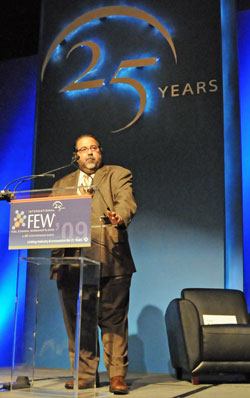 He preached a powerful sermon this morning. He’s the Reverend of Renewable Fuels. He’s Bob Dinneen, CEO, RFA. Bob was on our program at the opening general session of the Fuel Ethanol Workshop. This is the 25th FEW and Bob has attended 21 of them now!
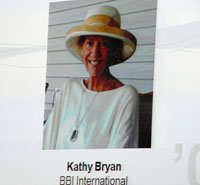 This morning, Kathy Bryan, BBI International, was presented with the FEW High Octane award for a lifetime of commitment to the industry. Unfortunately, due to health reasons, she could not be with us. It was an emotional scene as her son Tom accepted the award for her.
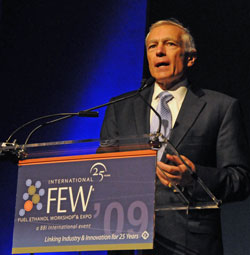 Gen. Wesley Clark,
  Mike Bryan, CEO, BBI International, opened the general session this morning.
 Biofuels has been compared with fossil fuels, blamed for worldwide starvation, linked to CO2 increases and decreases, and born the brunt of scrutiny for rainforest destruction (aka
  The report recommends that specific biofuel crops should be grown in certain regions. For example, corn for ethanol should be grown in states like Iowa where only one percent of the crops are irrigated, whereas significantly less corn should be grown in Nebraska where 61 percent of corn is irrigated. The report ultimately calls for more attention to the
  At the 2009 Fuel Ethanol Workshop, the
  In existence since 1996, the NEVC has assembled a broad coalition of like-minded industry and government leaders, environmentalists and consumers, and many other organizations and individuals interested in reducing oil imports, stimulating the economy, and improving the environment. The non-profit group had 1,600 members and their employees now become part of the Growth Energy team.
 The 25th Annual
 The driver of a tanker truck hauling 8,000 gallons of ethanol on a highway in Long Beach was killed Saturday when the truck hit a guard rail and exploded into flames. Officials with the