

 Iowa-based biodiesel producer Renewable Energy Group has released a report that looks at a wide variety of biodiesel feedstocks and the characteristics of both that feedstock and the fuel produced from it.
In the “Feedstock and Biodiesel Characteristics Report,” a first-of-its-kind of publication, REG, in cooperation with the Iowa Power Fund Board and the Iowa Office of Energy Independence, evaluated 36 biodiesel feedstocks and produced fuel from 34 of them:
These feedstocks varied from traditional fats and oils to novel feedstocks from around the world…
Each feedstock was tested for the following characteristics: moisture, free fatty acid, kinematic viscosity, FAC color, saponification value, moisture and volatile matter, insoluble impurities, unsaponifiable matter, MIU, oxidation stability, sulfur, phosphorous, calcium, and magnesium. If a feedstock exceeded 10 ppm phosphorous, 5 ppm calcium and magnesium, it was pretreated using the phosphoric acid procedure and dried. Feedstocks having free fatty acid in excess of 0.5 wt % were esterified using Amberlyst BD 20. The feedstocks were transesterified using identical reaction conditions and production protocols. Each biodiesel was characterized according to the American Society for Testing and Materials (ASTM) D6751 and other properties. These characteristics were: cloud point, cold filter plugging point, cold soak filtration, fatty acid profile, relative density, kinematic viscosity, sulfated ash, carbon residue, water and sediment, visual inspection, free and total glycerin, flash point, copper corrosion, phosphorous, calcium, magnesium, total acid number, moisture, sulfur, oxidation stability, and FTIR.
What makes the project so unique is that all of the wide range of feedstocks were pretreated, esterified, and transesterified using the same procedures and conditions to allow for uniform comparisons of critical fuel properties.
You can read the report for yourself here.
 A big issue in the current Renewable Fuels Standard … as well as the new RFS2 under consideration by the EPA … is the Renewable Identification Numbers (RINs).

 There’s an old saying that goes, “If you think education is expensive, try ignorance.” While it might be true that college does cost, there are some cheaper options out there. And more of those options are including solar and wind degrees from the less expensive community college route.
 GE has donated a small wind turbine to Mesalands Community College in Tucumcari, N.M., and has plans to hire graduates of the school’s new wind energy technician program. And at Milwaukee Area Technical College, local industrial giant Johnson Controls (JCI, Fortune 500) is building a 2,500-panel solar education farm where students can learn to become photovoltaic installers and designers.
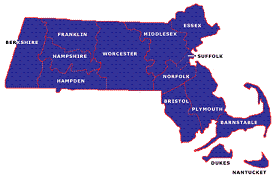 A 2 percent biodiesel mandate beginning next year and increasing to 5 percent in 2013 in Massachusetts has hit some glitches … thanks to confusion over what the next Renewable Fuels Standard (RFS2) might bring …. but it could now be moving forward.
 Members of the National Biodiesel have chosen who will represent the trade association on its governing board and leadership committee.

 The front-end fermentation unit scales up production of the naturally occurring bacteria, called an acetogen, which ZeaChem uses in its fermentation process. Acetogens are highly robust and, unlike yeast, produce no carbon dioxide (CO2) during the fermentation process, allowing ZeaChem to realize a significant efficiency and yield advantage. ZeaChem has successfully produced acetogens at the lab scale for over 1,000 fermentation trials of sugars as well as hydrolyzate derived from cellulosic biomass. The facility will have capacity to produce 250,000 gallons of biofuel per year.