Soybean Genome Shows Ways to Improve Biodiesel

John Davis

soybeanA team of scientists has cracked the code on the soybean genome, and that information could lead to better biodiesel yields from the oilseed.

This article from Physorg.com says the team consists of 18 institutions, including the U.S. Department of Energy Joint Genome Institute (DOE JGI), the U.S. Department of Agriculture-Agricultural Research Service (USDA-ARS), Purdue University and the University of North Carolina at Charlotte. The DOE, National Science Foundation, USDA and United Soybean Board supported the research:

“The soybean genome’s billion-plus nucleotides afford us a better understanding of the plant’s capacity to turn sunlight, carbon dioxide, nitrogen and water, into concentrated energy, protein, and nutrients for human and animal use,” said Anna Palmisano, DOE Associate Director of Science for Biological and Environmental Research. “This opens the door to crop improvements that are sorely needed for energy production, sustainable human and animal food production, and a healthy environmental balance in agriculture worldwide.”

With the soybean genetic code now determined, the research community has access to a key reference for more than 20,000 legume species and can explore the extraordinary evolutionary innovation of nitrogen-fixing symbiosis that is so critically important to successful agricultural crop rotation strategies.

Jeremy Schmutz, the study’s first author and a DOE JGI scientist at the HudsonAlpha Institute for Biotechnology in Alabama, said that the soybean sequencing was the largest plant project done to date at the DOE Joint Genome Institute. “It also happens to be the largest plant that’s ever been sequenced by the whole genome shotgun strategy—where we break it apart and reassemble it like a huge puzzle,” he said. Of the more than 20 other plant genomes taken on by the DOE JGI, those already sequenced include the black cottonwood (poplar) tree and the grain sorghum, both targeted because of their promise as biomass feedstocks for biofuels production.

Soybean farmers will also be glad that the research could end the threat of soybean rust.

Biodiesel, Soybeans

WASDE: Soybean Exports Up; Biodiesel Unchanged

John Davis

usda-logo2It looks like there will be plenty of soybeans for food and fuel use, especially since the non-renewal of the biodiesel tax incentive seems to have put a lot of refineries’ operations on hold.

The latest World Agriculture Supply and Demand Estimate report from the USDA pushes up the 2009 U.S. soybean crop now to an estimated record 3.36 billion bushels, up 42 million bushels from the previous month. Biodiesel Magazine reports that soybean export projections were raised 35 million bushels to a record 1.38 billion led by strong sales and shipments to China and several other markets including Taiwan, Thailand, Egypt, and Canada:

The projected U.S. soybean crush was raised 15 million bushels from the previous month’s report to 1.71 billion reflecting increased soybean meal exports. Soybean ending stocks were projected at 245 million bushels, down 10 million from last month. Despite increased crush, soybean oil production was reduced due to a lower extraction rate. With projected use unchanged, soybean oil stocks were projected at 2.15 billion pounds, down 155 million from last month. The estimate for methyl ester use was unchanged at 2.2 billion pounds for the current 2009/10 marketing year. That compares with 1.9 billion pounds in 2008/09 and 3.24 billion pounds the previous year.

The report goes on to say that U.S. soybean yields averaged an estimated 44 bushels an acre, also a record. Hopefully, this increased size of crop and higher yields will quiet some of the critics who say we can’t have food and fuel.

Biodiesel, Soybeans

Danforth Center Receives $44 Mil for Biofuels Research

John Davis

Danforth Center jpegThe St. Louis-area Donald Danforth Plant Science Center will receive $44 million in stimulus bucks to conduct advanced biofuels research.


This press release from the center says the money from the U.S. Department of Energy will go to helping the center to serve as the lead organization in a consortium:

The National Alliance for Advanced Biofuels and Bioproducts (NAABB) led by the Donald Danforth Plant Science Center is one of two cross-functional groups that will seek to breakdown critical barriers to the commercialization of algae-based and other advanced biofuels such as green aviation fuels, diesel, and gasoline that can be transported and sold using today’s existing fueling infrastructure. Ten to 15 jobs in St. Louis will be immediately created as a result of the project. Biofuels generate more jobs than any other sector of sustainable energy. As the industry grows, there is potential for hundreds of thousands of new jobs nationally.

The NAABB will develop a systems approach for sustainable commercialization of algal biofuel (such as renewable gasoline, diesel, and jet fuel) and bioproducts. NAABB will integrate resources from companies, universities, and national laboratories to overcome the critical barriers of cost, resource use and efficiency, greenhouse gas emissions, and commercial viability. The consortium will develop and demonstrate the science and technology necessary to significantly increase production of algal biomass and lipids, efficiently harvest and extract algae and algal products, and establish valuable certified co-products that scale with renewable fuel production. Co-products include animal feed, industrial feedstocks, and additional energy generation. Multiple test sites will cover diverse environmental regions to facilitate broad deployment.

The release goes on to say that the award will help cements St. Louis as a center for the development of renewable energy from algae.

algae, biofuels, Research

Book Review – The Boy Who Harnessed The Wind

Joanna Schroeder

TheBoyWhoHarnessedTheWindI have a new hero and his name is William Kamkwamba – “The Boy Who Harnessed The Wind.” William begins his story by writing, “A windmill means more than just power, it means freedom.” William was born in Malawi and like many in his country, his family struggled to survive in a country defined by drought and hunger. Unable to pay for school, William, gifted in the sciences, began spending his time in the library where he discovered how to bring electricity to his home with a windmill in the outdated American textbook, Using Energy.

What happened after he found that book is absolutely amazing – William spent months collecting the pieces that he would use to fashion a windmill out of junk. Fueled by ridicule and passion along with the support of his family and two best friends, William succeeded in creating a windmill that brought electricity to his home. Word spread and people began coming from miles and miles away to see “The Boy Who Harnessed The Wind.”

William understood what most take for granted – that electricity would help the family survive. It would replace the expensive kerosene that his family had to travel nearly seven kilometers to purchase. It would bring light to the darkness and it would allow them to pump water and irrigate the land, not only improving the bushel per acres of their crops, but allow them to plant and harvest two crops a year, helping to eliminate the months of hunger suffered year after year.

But the completion and success of his windmill didn’t fix his families problems right away. Read More

book reviews, Wind

Waste Management Recieves EPA Recognition

Joanna Schroeder

The Environmental Protection Agency (EPA) has recognized Waste Management, Inc. for its innovation and creativity in the development of the Altamont Landfill Gas to Liquefied Natural Gas Facility that went online in Livermore, CA in late 2009. The award was presented during the EPA’s 13th annual Landfill Methane Outreach Program Conference and Project Expo.

lng_plantforDFThe project is a joint venture with Linde North America, which is part of The Linde Group. According to Waste Management, the Altamont facility is the largest landfill gas (LFG) to liquefied natural gas (LNG) plant in operation in the world and produces 13,000 gallons of LNG per day. This is enough renewable fuel for Waste Management to operate 300 out of its 485 LNG waste and recycling collection vehicles in 20 communities in California.

“The Altamont LFG-to-LNG facility enables us to recover and utilize a valuable source of clean energy in another practical way, reducing our dependence on fossil fuels. Conventional LNG is already a clean-burning and economically viable alternative fuel for our collection trucks,” said Paul Pabor, vice president for Waste Management’s Renewable Energy Group. “The ability to use recovered landfill gas to fuel our hauling fleet offers significant environmental benefits to the communities we serve in California and is a great example of how we are committed to recovering resources in waste.”

The EPA also recognized another Waste Management project – University of New Hampshire’s EcoLine Project which converts landfill gas into enough energy to meet 85 percent of the five million square-foot campus’ and heating needs.

bioenergy, biomethane, Liquefied natural gas (LNG)

Ethanol Pipeline Would Create Green Jobs

Cindy Zimmerman

A proposed ethanol pipeline could create nearly 80,000 jobs across the country, according to a new feasibility report.

The report, from consulting firm LECG, shows that the majority of the jobs created will be in the construction and transportation industries and the pipeline project would provide approximately 1,100 permanent jobs after construction is complete.

Ethanol producer POET formed a joint venture with Magellan Midstream Partners of Tulsa, Oklahoma to assess the feasibility of a 1,800-mile ethanol pipeline from ethanol production facilities in the Midwest, starting at Davison County, S.D., to distribution outlets in the northeast U.S., ending in Linden, N.J. Once the feasibility study is complete, the pipeline would be operational as early as 2014.

Ethanol, POET

Pacific Ethanol Stock Rebounds

Cindy Zimmerman

Pacific EthanolPacific Ethanol resumed production at its Burley, Idaho ethanol plant earlier this month and that paid off with a big jump in the share price this week.

The company fired up its 60 million gallon per year Magic Valley facility on January 6, after being shut down for almost a year. “We are pleased to restart our Magic Valley facility and we are grateful for the cooperation our lenders and other stakeholders have extended,” said Neil Koehler, the Company’s Chief Executive Officer, “the restart of the facility has also been well received by the local community.”

Apparently it was also well received by the business community as shares of Pacific Ethanol were up as much as 80 percent on Monday to a one year high of $2.65. Last September, the company was facing delisting from the NASDAQ because shares had been below $1 since November 2008. Shares were trading at 59 cents at the time.

Ethanol, Ethanol News

Ethanol Groups React to California LCFS Approval

Cindy Zimmerman

Ethanol advocacy organizations challenging California’s low carbon fuel standard (LCFS) are disappointed with approval for implementation this week by the state’s Office of Administrative Law (OAL).

Renewable Fuels Association Logo“Pursuing this strategy runs counter to the stated goals of Governor Schwarzenegger and the State Assembly to reduce carbon emissions from motor vehicles,” said Renewable Fuels Association President Bob Dinneen. “As crafted, the LCFS would virtually eliminate domestic ethanol,the only viable low-carbon alternative to gasoline, from the California marketplace in favor of imported ethanol and futuristic fuel technologies such as hydrogen and the electric car.”

Growth EnergyGrowth Energy CEO Tom Buis commented that, “At a minimum, OAL should have sent the flawed regulation back to CARB, with direction they start over. As written, CARB is depriving Californians of the one low carbon, sustainable fuel available right now as an alternative to oil – and that is ethanol.”

Both groups and others filed suit last month challenging the LCFS on the grounds it violates both the Supremacy and Commerce Clause of the U.S. Constitution.

Ethanol, Ethanol News, Growth Energy, RFA

Biobutanol Makes Splash in California

Cindy Zimmerman

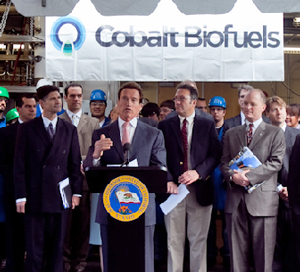
Biobutanol got a boost from California Governor Arnold Schwarzenegger Tuesday at the launching of a Cobalt Technologies pilot plant in his state,

Schwarzenegger said biobutanol will meet California’s Low Carbon Fuels Standard (LCFS), which was approved this week by the state’s Office of Administrative Law. “It is great companies like Cobalt that will help California meet our greenhouse gas reduction targets under AB 32 and our Low Carbon Fuel Standard,” said Governor Schwarzenegger, who used the occasion to promote his proposed sales tax exemption for clean tech companies. “Cobalt shows us that what is good for the environment can also be good for the economy. In fact, within the next few years, Cobalt has plans to build an even larger plant that will create 1,300 permanent jobs. I want that plant and those jobs right here in California.”

Biobutanol can be used as a standalone fuel or blended with gasoline, diesel or ethanol. It can also be converted into jet fuel or plastics, or sold as is for use in paints and coatings. It is similar to ethanol and can be produced from non-food feedstock, such as forest waste and mill residue. However, while the new state LCFS would virtually eliminate corn ethanol, the company says a 12 percent blend of Cobalt biobutanol with gasoline complies with the standard. The drawback is that biobutanol is not yet commercially available. The ethanol industry has filed suit in federal district court in Fresno, California, challenging the LCFS on the grounds it violates both the Supremacy and Commerce Clause of the U.S. Constitution.

biobutanol, biofuels, Ethanol

Nuffield Council on Bioethics Seeks Views on Biofuels

Joanna Schroeder

Ever thought about putting in your two sense on the growth of biofuels? Well, here’s your chance. The UK-based Nuffield Council on Bioethics is asking people to submit their views on the potential of biofuels.

Nuffield_Council_on_BioethicsIn recent months, first generation biofuels have been under fire from groups supporting the position that the net greenhouse gas emissions may not be much better than those of fossil fuels. In addition, environmental impact and food availability has also been questioned as has the role of sustainable biofuels development in developing countries.

“Research into new types of biofuels is looking more promising,” said Professor Joyce Tait, Chair of the Council’s Working Party on biofuels. “Rather than using food crops to produce biofuels, in the future we may be able to use algae, trees, the inedible ‘woody’ parts of plants, and agricultural waste. In addition, scientists are working to increase the yield of biofuel crops and improve the production process, in order to maximize the energy output of land and reduce net greenhouse gas emissions.”

However, the Council notes that before these types of biofuels are brought into wider use, their potential to meet energy needs, support economic development and reduce environmental impact should be considered. In addition, the council will study how government policies and international initiatives will affect biofuel production and research.

The ultimate goal of the council is to solicit peoples’ views on how to promote, provide incentives for and regulate new types of biofuels in ways that are both sustainable and ethical. These results, combined with the Council’s expertise, will be used to advise policy makers. The deadline for comments is March 15, 2010 with the results to be published this winter. Comments can be made by visiting the Council’s website.

biofuels, Miscellaneous