

Renewable fuels are the backbone of Iowa’s economy, according to a report released last week by the Iowa Renewable Fuels Association (IRFA).
According to the report, “Contribution of the Biofuels Industry to the Economy of Iowa,” ethanol and biodiesel producers are part of a manufacturing sector that adds substantial value to agricultural commodities produced in Iowa and makes a significant contribution to the state’s economy.
* Accounts for nearly $11.5 billion, or about 8 percent, to Iowa GDP
* Generates $2.3 billion of household income for Iowa households
* Supports more than 70,000 jobs through the entire Iowa economy
* Boosts state tax revenue by $532 million.
 “That is an awesome success story,” said IRFA Executive Director Monte Shaw in his address at the 4th Annual Iowa Renewable Summit. “At the same time, we must not rest on our laurels. Iowa and the nation must move quickly to realize the full promise renewable fuels represent.”
Shaw says that means approving ethanol blends up to 15 percent nationwide and for Iowa, urging the Iowa legislature to enact an E10 Fuel Quality Standard so that all gasoline in the state would contain at least 10 percent ethanol. “Why shouldn’t Iowa say that E0 poses too high a cost to our economy and our energy independence? Shouldn’t Iowa lead the way to make E10 the standard fuel with E15 available for those who choose it?” Shaw questioned.
Shaw also called on Congress to restore the federal blenders tax credit for biodiesel and for EPA to implement the federal RFS2 biodiesel usage requirement. “If we can couple those two federal actions with a B5 fuel quality standard here in Iowa, it will go a long way toward restarting Iowa’s 15 biodiesel plants,” he said.
 Leaders from
 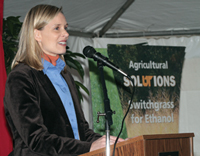 During the grand opening celebration, Kelly Tiller, CEO of Genera Energy and director of external operations for the UT Office of Bioenergy Programs, said, “The University of Tennessee Biofuels Initiative is the only fully integrated program that is working with farmers and agricultural industry to reliably supply the necessary feedstock so biorefineries can produce plentiful, affordable, renewable and sustainable fuels.” She said plans are for Tennessee farmers to place an additional 4,000 acres of switchgrass into production this spring, bringing the total production in the state to nearly 7,000 acres of the dedicated energy crop.






 The two companies have extended the initial 18-month joint development program
  According to the latest figures from the