

 The St. Louis-area Donald Danforth Plant Science Center will receive $44 million in stimulus bucks to conduct advanced biofuels research.
This press release from the center says the money from the U.S. Department of Energy will go to helping the center to serve as the lead organization in a consortium:
The National Alliance for Advanced Biofuels and Bioproducts (NAABB) led by the Donald Danforth Plant Science Center is one of two cross-functional groups that will seek to breakdown critical barriers to the commercialization of algae-based and other advanced biofuels such as green aviation fuels, diesel, and gasoline that can be transported and sold using today’s existing fueling infrastructure. Ten to 15 jobs in St. Louis will be immediately created as a result of the project. Biofuels generate more jobs than any other sector of sustainable energy. As the industry grows, there is potential for hundreds of thousands of new jobs nationally.
The NAABB will develop a systems approach for sustainable commercialization of algal biofuel (such as renewable gasoline, diesel, and jet fuel) and bioproducts. NAABB will integrate resources from companies, universities, and national laboratories to overcome the critical barriers of cost, resource use and efficiency, greenhouse gas emissions, and commercial viability. The consortium will develop and demonstrate the science and technology necessary to significantly increase production of algal biomass and lipids, efficiently harvest and extract algae and algal products, and establish valuable certified co-products that scale with renewable fuel production. Co-products include animal feed, industrial feedstocks, and additional energy generation. Multiple test sites will cover diverse environmental regions to facilitate broad deployment.
The release goes on to say that the award will help cements St. Louis as a center for the development of renewable energy from algae.


 A proposed ethanol pipeline could create nearly 80,000 jobs across the country, according to a new feasibility report.
 Ethanol producer
 “Pursuing this strategy runs counter to the stated goals of Governor Schwarzenegger and the State Assembly to reduce carbon emissions from motor vehicles,” said
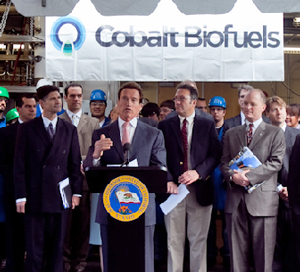 Schwarzenegger said biobutanol will meet California’s Low Carbon Fuels Standard (LCFS), which was approved this week by the state’s Office of Administrative Law. “It is great companies like Cobalt that will help California meet our greenhouse gas reduction targets under AB 32 and our Low Carbon Fuel Standard,” said Governor Schwarzenegger, who used the occasion to promote his proposed sales tax exemption for clean tech companies. “Cobalt shows us that what is good for the environment can also be good for the economy. In fact, within the next few years, Cobalt has plans to build an even larger plant that will create 1,300 permanent jobs. I want that plant and those jobs right here in California.”

 American manufacturing giant General Electric is striking some big deals in the alternative energy field, especially wind power.