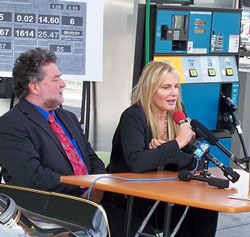
Growth Energy Offers Funding for Blender Pumps

Cindy Zimmerman

Growth Energy’s Market Development team is now offering funding to retailers to assist in ethanol blender pump infrastructure. Grants of $2,500 and $5,000 are now available on a first come, first serve basis to vendors who wish to install new or convert existing equipment for ethanol fueling. These grants are in addition to any Federal or state grants or incentives a retailer may be eligible.

“There are over 8 million flexible fuel vehicles across the country with more being produced in each model year. Unfortunately, of the 161,000 gasoline stations in the U.S. only 2,200 offer E85 where FFVs may fuel up with a high level blend of domestic, renewable fuel such at 85% ethanol……….another 132 offer mid-level blends,” said Growth Energy Market Development VP, Phil Lampert. “Growth Energy is pleased to offer this assistance to retailers across the nation and we hope that they avail themselves of this unique opportunity.”

Growth Energy can also offer pump imaging and technical assistance along with the grants. You can find the two page outline of the Infrastructure Development Program by clicking here. To apply for the funding, click here.

blends, Ethanol, Growth Energy

Ethanol Producer Plans to Cut Water Use

Cindy Zimmerman

poet plantThe world’s largest ethanol producer plans to decrease water use in the production of ethanol by 22 percent over the next five years, which would result in a savings of one billion gallons of water per year.

In a presentation to employees today, POET CEO Jeff Broin said the company is committed to producing ethanol as sustainably as possible and minimizing its impact on natural resources.

poetWater reduction is the first goal of Ingreenuity, POET’s new initiative to improve the environmental performance of ethanol. The reductions will come primarily through installing a proprietary process developed by POET engineers that recycles cooling water rather than discharging it. The process has recently been installed in three POET Biorefining locations which now average 2 to 2.5 gallons of water per gallon of ethanol.

To kick off the initiative, Broin announced that the POET Foundation has committed more than $420,000 to the non-profit Global Health Ministries (GHM) over the same five-year period as POET’s water reduction goal. A portion of the funds will help GHM repair, construct and maintain 90 wells in Nigeria that that will give more than 300,000 people access to pure water.

Ethanol, POET

Big Oil Exec Talks Natural Gas, Electric Cars, Biofuels

John Davis

The CEO of one of the world’s biggest petroleum companies says his company will soon produce more natural gas than oil and is investing more than ever in biofuels.

And this article from the Wall Street Journal says that Peter Voser of Royal Dutch Shell says he expects in the next 40 years, 40 percent of the world’s cars will be electric:

Mr. Voser sat down with The Wall Street Journal’s Alan Murray and Kimberley Strassel to talk about the future of climate-change legislation, the company’s push beyond oil, the prospects for electric vehicles and more…

MR. MURRAY: What percentage of your capital spending goes to renewable energy sources, roughly?

MR. VOSER: It is not the capital intensity that drives renewable energies and alternative energies. It’s what you spend in technologies and in innovation. Roughly 25% of our budget at this stage goes into what we call alternative energies from an R&D point of view.

MR. MURRAY: And of the 25% of your R&D budget that you spend on renewables, what in that portfolio do you personally think is the most promising?

MR. VOSER: We are focusing a lot on biofuels at this stage.Read More

biofuels, Electric Vehicles, Natural Gas, Oil

Imperium Re-Opens Washington State Biodiesel Plant

John Davis

They’re back up and running at Imperium Renewables’ Grays Harbor, Washington biodiesel plant.

This company press release says Imperium re-opened the facility after a glycerin tank rupture idled operations last December:

“We are thrilled to be producing again,” said John Plaza, founder and CEO of Imperium Renewables. “We have replaced the damaged equipment and re-designed the glycerin neutralization system to ensure such a rupture won’t happen again.”

The first of more than 40 rail cars containing millions of gallons of vegetable oil from canola grown in the Northwest arrived yesterday at the Imperium Grays Harbor facility. Imperium will convert the oil into biodiesel, which has been shown to reduce carbon emissions by 78 percent compared to petroleum fuel. The fuel will be distributed and consumed within the Pacific Northwest as well, embodying the preferred approach recently recommended by President Obama’s Biofuels Interagency Working Group.

The re-opening comes just in time as nearby British Columbia had a new biodiesel mandate go into effect at the beginning of this year, while in the U.S., biodiesel prospects have brightened in the wake of the U.S. Senate’s passage of the $1-a-gallon federal tax incentive and the EPA’s issuance of the new Renewable Fuel Standard, better known as RFS-2, which mandates the consumption of 1.15 billion gallons of biodiesel nationally in this year.

Biodiesel

Biodiesel Credit Clears Senate, On to House

John Davis

As expected, the federal $1-a-gallon biodiesel tax incentive has cleared the U.S. Senate on the back of the current jobs bill.

The 62-36 vote now moves the measure into a reconciliation phase with the House’s version of the bill.

I caught up with Michael Frohlich, the director of federal communications for the National Biodiesel Board’s office in Washington, D.C. earlier this evening. He says final passage of this important measure can’t come soon enough.

“It’s an immediate need for the industry at this point,” says Frohlich, pointing out that biodiesel has been without the credit since the beginning of the year. Fortunately, if the bill does pass and is signed into law, it will be retroactive back to January 1, 2010.

But Frohlich is worried that biodiesel will be back in the same boat next December 31st as it was last December 31st, because this version of the tax credit expires at the end of this year.

“Although it’s slightly a bit of a hollow victory in the sense that we’ll have to go back to the drawing table once this gets enacted to make sure that it continues to get enacted again next year, it is traditional that [Congress does] pass these extenders, and we haven’t seen any objection from any senator or House member.”

He says last year, the Senate got so caught up in the health care debate, lawmakers worked on Christmas Eve … and that never happens … and the incentive got left by the wayside. Frohlich doesn’t expect that the biodiesel credit will get left behind again, but it has reinforced that the NBB’s number one legislative priority is to get a multi-year tax credit into effect.

And hopefully, there won’t be a health care debate that stops all business.

You can hear all of my conversation with Michael below.

Audio, Biodiesel, Government, Legislation, NBB

Register Now For Process Optimization Seminar

Chuck Zimmerman

It may be a little late in the day for this reminder but you can still go online to register for a spot in the upcoming Process Optimization Seminar being hosted by Phibro Ethanol Performance Group, along with Fremont, Fermentis and Novozymes.

The Seminar is targeted to plant managers, operations managers, technical managers, lab managers and general managers. This interactive seminar is focused on helping ethanol plants increase their efficiency and profitability through learning about new technologies available for the fermentation process. This two half-day seminar is being held in Indianapolis, Indiana on March 30-31 and the early registration deadline is March 10 (uh, that’s today!).

Click here to get registered.

Domestic Fuel is happy to be the media partner for this event.

Education, Ethanol, Ethanol News

Wisconsin Team Turns Biomass into Jet Fuel

John Davis

A group of engineers at the University of Wisconsin-Madison has been able to turn biomass into the chemical equivalent of jet fuel, and they’ve been able to do it using a process that actually takes advantage of biomass sugars’ bad habit of degrading.

This press release from the school says a simple process developed by James Dumesic, Steenbock Professor of Chemical and Biological Engineering at UW-Madison, postdoctoral researchers Jesse Bond and David Martin Alonso, and graduate students Dong Wang and Ryan West preserves about 95 percent of the energy from the original biomass, requires little hydrogen input, and captures carbon dioxide under high pressure for future use:

Much of the Dumesic group’s previous research of using cellulosic biomass for biofuels has focused on processes that convert abundant plant-based sugars into transportation fuels. However, in previously studied conversion methods, sugar molecules frequently degrade to form levulinic acid and formic acid — two products the previous methods couldn’t readily transform into high-energy liquid fuels.

The team’s new method exploits sugar’s tendency to degrade. “Instead of trying to fight the degradation, we started with levulinic acid and formic acid and tried to see what we could do using that as a platform,” says Dumesic.

In the presence of metal catalysts, the two acids react to form gamma-valerolactone, or GVL, which now is manufactured in small quantities as an herbal food and perfume additive. Using laboratory-scale equipment and stable, inexpensive catalysts, Dumesic’s group converts aqueous solutions of GVL into jet fuel. “It really is very simple,” says Bond, of the two-step catalytic process. “We can pull off these two catalytic stages, as well as the requisite separation steps, in series, with basic equipment. With very minimal processing, we can produce a pure stream of jet-fuel-range alkenes and a fairly pure stream of carbon dioxide.”

The researchers say the fuel produced is high-energy density, making it better suited for the aviation industry than more conventional ethanol. Now, the team is working on making the process cost-effective.

biomass

Biodiesel Clears Senate Hurdle on the Back of Jobs Bill

John Davis

It looks like the $1-a-gallon federal biodiesel tax incentive could be close to renewal, as the jobs bill to which it was attached has cleared a key vote in the U.S. Senate.

The vote came Tuesday as eight Republicans sided with 58 Democrats to end debate on the $150 billion measure.

The cloture vote clears the way for final passage in the Senate. H.R. 4213, the American Workers, State and Business Relief Act includes retroactive extension of the biodiesel tax credit, and it will have to be reconciled with the US House’s version.

The American Soybean Association is urging lawmakers to work together to get a final bill done:

“Expiration of the biodiesel tax incentive has essentially caused the production and use of biodiesel in the U.S. to cease and has placed thousands of jobs currently supported by the domestic biodiesel industry in immediate jeopardy,” said ASA President Rob Joslin, a soybean producer from Sidney, Ohio. “Companies have already started laying-off employees, and this situation is certain to worsen the longer the tax incentive is allowed to lapse.”

An interesting note: I found out about this passage earlier on Tuesday when our friend Jessica Robinson from the National Biodiesel Board (@Biodiesel_Media) tweeted, or more accurately, re-tweeted @agripulse‘s tweet to my Twitter account (@jdavisreporter) when the vote happened. Didn’t take long for at story to travel around the social media! No wonder Chuck and Cindy (@AgriBlogger and @FarmPodcaster) have been such big advocates!

Biodiesel, Government, Legislation

Biofuels and Conservation Achievable with Biomass

John Davis

Getting energy from the land and practicing good conservation are not mutually exclusive. A federal ag deartment researcher says we can have both through using biomass.

USDA researcher Doug Karlen, who works at the Agricultural Research Service’s National Soil Tilth Lab in Ames, Iowa, told attendees of the recent USDA Outlook Forum that conservation and energy from biomass can be compatible if three things are considered.

“If we utilize multiple feedstock options, multiple conversion platforms and recognize that’s there’s no single solution.”

Karlen also told the group that you have to consider how land conditions vary. In addition, biomass cannot always be seen as just a waste waiting to be made useful. He points out that the trade-off for using biomass from fields for bioenergy is that there is no residue left over to renew the soil with nutrients, as well as losing the habitat for wildlife those crop leftovers provided. Karlen says that’s why it is so important to have a diversity of biomass products within a certain area.

biomass, Government, USDA

S4 Energy Solutions Announces Plasma Gasification Project

Joanna Schroeder

S4 Energy Solutions has recently announced plans to develop a plasma gasification facility at Waste Management’s Columbia Ridge Landfill in Arlington, Oregon. The facility will covert municipal solid waste into clean fuels and renewable energy. Construction is beginning in early summer and the plant will be online by the end of this year. During construction, 28 people will be employed with 16 being permanent once the facility is operational. S4 is a partnership between Waste Management and InEnTec, a deal that was solidified in May of 2009.

“Our goal is to extract as much value as possible from waste and this project will help us recover valuable resources to generate clean fuels, renewable energy and other beneficial products,” said Dean Kattler, area vice president for Waste Management Pacific Northwest. “This project strengthens our focus on renewable energy and new technologies that use waste as a resource. We are committed to growing our business in this region in innovative ways, bringing green jobs to communities where we already have operations and community relationships.”

Using S4’s PEM process, waste materials are prepared and fed into a phase gasification chamber that operates at nearly 1500 degrees Fahrenheit. Once this phase is complete, the waste materials flow into a second closed chamber where they are superheated using plasma, an electricity-conducting gas. Ultimately, the intense heat rearranges the molecular structure of the waste converting it into syngas. From here, the syngas can be converted into ethanol or diesel or into industrial products like hydrogen or methanol.

This site also features a landfill gas-to-energy (LFGTE) facility which captures methane gas created during decomposition and to use for electricity which powers 5,000 homes in Seattle. Sixty-seven windmills also generate 100 MW of electricity at the landfill and the power is sold to PacifiCorp.

Jeff Surma, president and chief executive officer of S4 Energy Solutions, concluded, “Plasma gasification has garnered a lot of attention recently, as we look for new ways to sustainably manage waste while recovering valuable resources. We believe the project will demonstrate commercial viability of the new S4 integrated system, so that we can implement this technology at many other locations for a wide variety of applications.”

Electricity, Energy, Ethanol, Hydrogen, Waste-to-Energy