An Iowa State University researcher has developed a new green, bio-based process for producing the fuel additive isobutene that could help ethanol production.
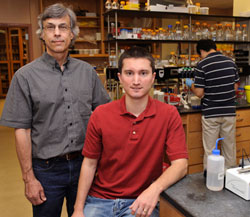 ISU biochemistry professor Thomas Bobik invented a process for manufacturing the much-used fuel additive and industrial chemical that is currently made from petroleum by identifying a new, natural enzyme that produces the fuel organically. Isobutene is a gas used to produce chemicals and also in the manufacturing of fuel additives, adhesives, plastics and synthetic rubber. It can be chemically converted to isooctane, which is a fuel that could be used to replace gasoline additive methyl tert-butyl ether (MBTE), which can be environmentally harmful. Isooctane is used in gasoline to stop engine knocking and other problems. Currently, isooctane is produced from petroleum products.
Bobik, along with doctoral student David Gogerty (both pictured), believe that once more research is completed, there could be huge benefits to the biofuels industry since currently one of the biggest expenses in producing ethanol now is the cost of separating the ethanol from the water where it’s made. “Isobutene is a gas, so we can imagine that it will be easy to remove the isobutene from the vessel in which it was made, and that should be a very cheap and efficient way to purify the biofuel,” said Bobik.
One of the drawbacks, Bobik warns, is the process currently takes too long because the activity of the enzyme is low. “It’s too low for commercial application. So we’re trying to use directed enzyme evolution to improve the activity of the enzyme so it can become commercially viable,” Bobik said. Directed enzyme evolution is the effort to engineer enzymes to perform certain functions. In this case, it is trying to find a way to get the enzyme to produce isobutene more quickly than in nature.
Bobik says progress is being made rapidly and perhaps, within 10 years, motorists may be using a bio-based, environmentally friendly ingredient in their gas tanks every time they fill up.
 Producers, consumers and distributors of bioenergy products can access crucial data through the
 On Wednesday, Rep. Stephanie Herseth Sandlin (D-SD) introduced the Consumer Vehicle Choice Act of 2010 (H.R. 5633) and the Consumer Fuels Choice Act of 2010 (H.R.5632). The first would mandate that auto manufacturers provide consumers with greater choice of flex fueled vehicles (FFVs). Under this legislation, 50 percent of cars and light duty trucks in model years 2011 and 2012 must be FFVs, and that percentage rises to 90 percent in model year 2013 and years after. The second bill would promote ethanol use through grants for the installation of blender pumps. The bills are co-sponsored by Rep. Adrian Smith (R-NE).
 “The data clearly show that crop acres in the United States continue to trend downward,” said Bob Dinneen, RFA president and CEO. “That’s because new technology and dramatically increasing yields are allowing farmers to produce more crops on less land. Today’s report reinforces the fact that the nation’s farmers simply don’t need to expand cropland to meet global demands for food, feed, fiber, and biofuels.”