A new study has looked at the “real” impacts of U.S. biofuels production both domestically and internationally and has concluded it is “negligible or nonexistent.” The research was coauthored by Dr. Seungdo Kim and Dr. Bruce E. Dale and was published in the July issue of Biomass and Bioenergy Journal under the title, “Indirect land use change for biofuels: Testing predictions and improving analytical methodologies.”
 “It is the first evidence-based evaluation of ILUC utilizing actual historic data, employing a ‘bottom-up’, data-driven, statistical approach based on individual world regions’ land use patterns and commodity grain imports,” stated Dr. Roger Conway, senior partner at Rosslyn Advisors LLC and former director of the United States Department of Agriculture’s Office of Energy Policy and New Uses.
The authors say that very few previous studies have attempted to find empirical evidence for or against indirect land use change from historical data, rather most studies rely on global economic simulations.
Dale said, “Unlike most other ILUC work this study relied on very few assumptions and did not attempt to quantify nor to predict ILUC effects. We searched for direct historical evidence for ILUC in relevant world areas rather than attempting to project or predict what course ILUC might take. Projecting forward can force scientists to make untestable assumptions.”
This study was unique in that is used data from 1990, when the U.S. biofuels industry was very small, as its baseline. It then measured crop changes against that as U.S. ethanol production has significantly grown during the past decade. Read More

 Agriculture Secretary Tom Vilsack, keynoting the Department of Energy
 The new advertising campaign quotes a


 A new study shows that biodiesel offers an amazing 5-to-1 return over fossil energy sources.
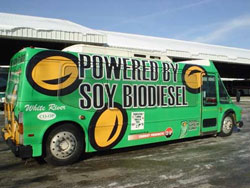
 When Medford, New Jersey’s 1998 International school bus retired at the end of June, it reached a milestone in the process. The bus was the first in New Jersey, and possibly the country, to be filled with B20.