The biodiesel tax incentive is helping to create jobs across the country, according to testimony submitted to the House Ways and Means Committee today by the National Biodiesel Board (NBB).
 “While we understand the pressures facing Congress, this is the wrong time to pull support from a growing American industry that is a rare bright spot in this economy,” said Anne Steckel, NBB vice president of federal affairs. “Our industry is having a record year of production, and the tax incentive is a key ingredient in that success. Stripping the incentive away this year would put thousands of jobs in jeopardy.”
Steckel’s written testimony was submitted to the committee for a hearing on energy tax policy and tax reform held today that focused on whether energy policy should be conducted through the tax code, and specifically on proposed tax credits for natural gas under the New Alternative Transportation to Give Americans Solutions (NAT GAS) Act of 2011.
While, the biodiesel industry was not called to testify at the hearing, Steckel’s submitted comments highlighted the biodiesel industry’s rebound this year after the biodiesel tax incentive was reinstated following a one-year lapse in 2010 which caused production to drop dramatically last year as dozens of plants shut down and thousands of people lost jobs.
Since its reinstatement this year, the industry had produced roughly 475 million gallons as of July compared with 315 million gallons in all of 2010. This year’s increased production of at least 800 million gallons will support more than 31,000 jobs while generating at least $3 billion in GDP and $628 million in federal, state and local tax revenues, according to a recent economic study conducted by Cardno-Entrix.
“We believe the U.S. biodiesel industry offers a clear and compelling case that strong domestic energy policy can boost this economy,” she said. “Our production turnaround this year is creating good-paying jobs in nearly every state in the country.”
 That claim was highlighted with the re-opening of a southern Minnesota biodiesel plant this week. Minnesota soybean farmer Jim Willers said reinstating the biodiesel tax incentive is one of the best jobs creation programs the government has done lately. “This plant’s put almost 25-30 people back to work, there’s usually 50 trucks that go through here and the spin off effect from this plant creates almost 2,000 jobs,” he said. “Between state and local and federal taxes, it’s way more than the tax credit so your return on investment for the government is just terrific with biodiesel.”


 The Renewable Energy Group (REG) just hated to see the 30 million gallon capacity biodiesel plant standing idle near Albert Lea, Minnesota for the past three years, so the company decided to do something about it.
  Iredell County Sheriff Phillip Redmond recently had 13 Ford Crown Victoria cruisers converted to run on propane autogas using money confiscated from illegal drug activity.
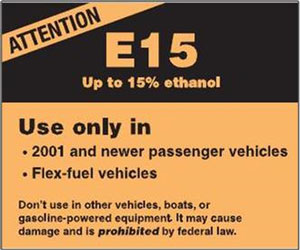 Groups representing small engine, automakers and marine manufacturers
  The
The  At the opening celebration of the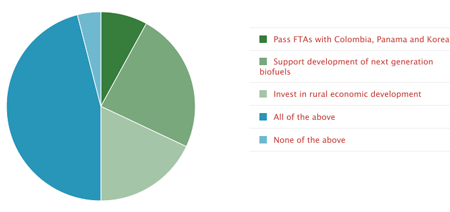

 Senators John Thune (R-SD) and Amy Klobuchar were recognized for their support of the ethanol industry today with the “Fueling Growth” award from
 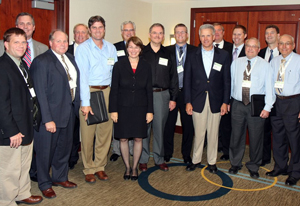 “We are grateful for the leadership and wisdom of these leaders,” said Growth Energy CEO Tom Buis. “This award serves as a reminder of our gratitude, and our continuing efforts to make this country’s national security and economic security stronger through a robust and viable alternative, renewable fuels industry. With their votes and actions in Congress, and their leadership within the administration, these individuals demonstrated loyalty and devotion to the cause of American energy independence.”
 In a letter to the co-chairs of the Joint Select Committee on Deficit Reduction, the so-called “super committee” assigned to find ways to cut the deficit, the
  Molecular biologist Zonglin Lewis Liu with ARS’ National Center for Agricultural Utilization Research in Peoria found a biorefinery yeast that successfully ferments plant sugars from cornstalks, wheat straw, and other rough, fibrous, harvest-time leftovers into cellulosic ethanol. According to Liu, the yeast overcomes some of the troublesome compounds in these materials that are created during dilute acid pre-treatment of the crop leftover. The compounds tend to damage yeast cell walls and membranes, disrupt yeast genetic material such as DNA and RNA, and interfere with yeast enzymes’ fermentation abilities, ultimately reducing potential cellulosic ethanol yields.