E85 sales in Iowa reached an all-time high in 2011 exceeding more than 10.7 million gallons, representing a 15 percent increase over 2010 sales, according to the Iowa Department of Revenue. The increase occurred despite third and fourth quarter sales being down compared to the year prior.
“E85 sales are up while overall gasoline sales are down – that shows progress,” said Monte Shaw, Executive Director of the Iowa Renewable Fuels Association. “Price is still an important factor. With ethanol prices closer to gasoline in the last half of 2011, we saw our growth streak curtailed somewhat. But today, wholesale ethanol prices are quite attractive and that translates into very enticing E85 prices. E85 is the best way for fuel consumers to boost the Iowa economy, reduce dependence on foreign oil and still save a few bucks.”
Iowa currently has 167 retail outlets offering E85. Check online for a list of all E85 stations. Iowa has 41 ethanol refineries capable of producing nearly 3.7 billion gallons annually. In addition, Iowa has 13 biodiesel facilities with the capacity to produce 320 million gallons annually.

 An
An 
 “PowerCane™ Miscanthus varieties are the first miscanthus products specifically developed for biomass production that can be planted as a seed,” said
 Mirshak says the feedstock for the plant will be corn stover and they have already been working with growers in the region on harvesting that product from their fields. “In 2011, we worked with about 50 growers within a 30 mile radius of the Nevada plant,” he said. “We harvested about 7500 acres. Our goal is to collect about two tons of stover per acre.” The stover will be baled in large rectangular bales and stored in various sites to be fed to the plant as needed.
 The
The 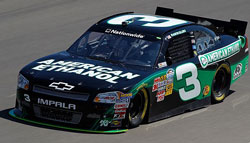 Las Vegas was the first race this season where No. 3 Chevrolet sported the black and green colors of American Ethanol and marked Dillon’s first Nationwide Series start at Las Vegas Motor Speedway. Dillon was so excited about the ethanol theme that his team even
  Among the highlights noted in the report is that the plan has resulted in a doubling of renewable energy generation from wind, solar, and geothermal sources since 2008. According to the report, “Since 2009, DOI has approved 29 onshore renewable energy projects—about 6,600 megawatts—including: 16 solar projects, 5 wind farms, and 8 geothermal facilities. These projects include the first solar projects ever permitted on public lands.”
 “This is an amazing difference from just five years ago,” said Purdue agricultural economist Dr. Chris Hurt. “The hog industry was largely set up with $2-2.50 corn going into 2006. After that we saw major increases in those corn prices.” Dr. Hurt spoke to swine veterinarians on the topic of “Global Feed Economics in a Biofuel World” during seminar in Denver on Friday.