

North Dakota State University has partnered up with a couple of private sector companies to develop energy beets for advanced ethanol production.
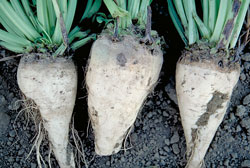 The partnership includes Green Vision Group (GVG) of Fargo and Heartland Renewable Energy of Iowa in the project that is fueled by a $1 million, two-year North Dakota Renewable Energy Council grant that includes matching funds from industry partners Betaseed and Syngenta.
In 2010, GVG and HRE formally came together to form BeetsAll Biofuel, a partnership that envisions developing at least 12 sustainable ethanol facilities across North Dakota, according to Maynard Helgaas, president of GVG. “Each plant will use energy beets grown within a 20-mile radius and support job creation in rural communities,” said Helgas. “This grant will help us make significant progress toward that vision and help develop North Dakota’s energy beet biofuel industry.” GVG is in the process of selecting the location for its first processing facility, which is expected to produce 20 million gallons of ethanol per year once complete.
Cole Gustafson, NDSU Department of Agribusiness and Applied Economics chair, says they believe ethanol produced from sugar beets can be sold at a premium, which will benefit both farmers and producers. “We expect that energy beet ethanol will produce 50 to 60 percent less greenhouse gas emissions than petroleum-based fuels, which will designate it as an advanced biofuel. We are working to finalize the life-cycle analysis of energy beets through a formal Environmental Protection Agency application. Securing EPA approval of energy beets as an advanced biofuel will mean a significant premium for producers and processors in the sugar-based ethanol market.”
The project seeks to establish a U.S. Department of Agriculture Risk Management Agency multiperil crop insurance program for energy beets; engineer and evaluate new front-end energy beet processing methods; expand regional energy beet research trials; scale up whole-energy beet and juice storage technology to enable year-round processing; and inform producers, community developers and the biofuel industry of the emerging opportunity.
 “As part of his blueprint for an American economy built to last, President Obama called for an all-out, all-of-the-above energy strategy that’s cleaner, safer, full of new jobs and develops every available source of American energy,” said Gage. “Extending the Advanced Energy Manufacturing Tax Credit will encourage further investment in clean energy manufacturing here in Nebraska and across the nation, ensuring new windmills, solar panels and biofuel products are produced and assembled by American workers.”
  The
The  NEC Connect provides access to the online social networking community designed specifically for the NEC, allowing attendees to design their own profile, link other social networking sites to their profile, communicate with other attendees via conversations and private messages, as well as see which attendees they have the most in common through categories and tags. NEC Connect also lets each attendee design their own session schedule and invite other attendees to private meetings.
  The
The  Agronomic benefits of residue removal include preventing stand establishment concerns in the following crop and avoiding nitrogen tie-up to reduce additional applications. Good residue management practices are crucial to overcoming some of the challenges associated with reduced-tillage systems.
 In September 2011, Aventine announced it was delaying work on the plant due to uncertainty surrounding its ability to secure critical third-party technical and engineering support. Since that time, the company has secured the support necessary to move the project forward and now anticipates resuming work in early March 2012 with production expected to start this summer.
 An Australian ethanol producer has received the first completed commercial certification from the
  A breakthrough by
  “The market for ethanol has grown exponentially over the past decade, thus utilizing an abundance of corn to meet the already-present need for a renewable, domestic biofuel,” said Chad Willis, a Minnesota corn grower who serves as chairman of the committee. “Now, we face a myriad of challenges and opportunities as those in the industry continue to innovate while some outside of it continue attempts to deny ethanol’s incredible value to our nation.”
 The committee of farmer leaders from around the Corn Belt also had the opportunity to meet the NCGA’s new Director of Biofuel Programs and Business Development Pam Keck, who is a scientist and educator with more than 20 years of experience in the agricultural and biofuels industry, academia and not-for-profit research.