ACE Conference 2026

Butamax Granted Patent for Iso-Butanol

butamax Butamax Advanced Biofuels LLC, has been granted patent number 8,129,162 for production of iso-butanol from biological resources.

This latest patent was issued from a series of applications covering modified KARI enzymes that optimize production of biobutanol by Butamax’s proprietary microorganisms. These microorganisms are engineered with the isobutanol biosynthetic pathway invented by Butamax that includes five enzymatic steps that convert sugar to isobutanol. The KARI enzyme performs the second step of the pathway which is fundamental to achieving high biobutanol yield. This latest invention is essential to best cost of manufacture position.

Since 2003, the Butamax team has pioneered new technology innovations in order to offer the most cost-effective production of biobutanol for the transportation fuels market. The company will continue its commitment to innovation in the areas of biocatalyst, engineering design and end-use applications to deliver maximum value to licensees.

“With these new KARI enzymes, we have achieved a significant improvement in performance, which is necessary for low-cost commercial production of biobutanol,” said Paul Beckwith, Butamax CEO. “We are pleased that our research team continues to be recognized for their innovation in biobutanol technology. Their work has led to the only cost-effective retrofit option that enables existing ethanol manufacturers to produce drop-in biofuels.”

biobutanol, biofuels, Company Announcement, isobutanol

Exhibit Showcases Biodiesel at MN Auto Show

Cindy Zimmerman

The “Biodiesel Green Room” exhibit will showcase the benefits of biodiesel at the Twin Cities Auto Show, March 10-18 at the Minneapolis Convention Center. The exhibit includes information on biodiesel, staff to answer questions, and new vehicles like the Audi A3 TDI, which gets an estimated 42 miles per gallon (highway) on B5 biodiesel.

Biodiesel is recognized as a “Clean Air Choice” fuel by the American Lung Association in Minnesota, which is helping to staff the exhibit. “The five percent biodiesel blend now powering diesel vehicles in Minnesota provides roughly the same clean air benefits as removing 55,000 vehicles from the road every year,” said Kelly Marczak, outdoor air program director for the American Lung Association in Minnesota. “The new diesel-powered vehicles are significantly cleaner and quieter than past models, and include advanced pollution control systems.”

Minnesota was the first state in the nation to require biodiesel blends at all diesel retail outlets. The state currently has an annual production capacity of 63 million gallons of biodiesel, made primarily from locally grown soybeans, but can also be produced from a wide variety of renewable sources, including corn, canola and recycled cooking oil. Biodiesel production uses only the oil portion of the soybean, leaving all of the protein available for animal and human consumption.

The exhibit is sponsored by the Minnesota Soybean Research & Promotion Council.

Biodiesel, Soybeans

Amendment Would Extend Domestic Energy Tax Credits

Cindy Zimmerman

Senator Debbie Stabenow (D-MI) introduced an amendment to the Transportation Bill (S.1813) Thursday that would extend tax incentives for domestically produced energy sources, including biodiesel, ethanol, cellulosic biofuels, electric vehicles, wind energy and solar.

The measure would re-instate and extend the $1 per gallon biodiesel tax incentive, which expired at the end of last year, and the Advanced Energy Manufacturing Tax Credit, which expired in 2010.

The amendment also includes extending tax credits for companies that install charging stations for electric vehicles and alternative fuel dispensers, like ethanol blender and E85 pumps. It would extend the $1.01/gallon production tax credit for cellulosic biofuel production through 2014, for grants in lieu of tax credits to eligible solar projects, and the Production Tax Credit for wind energy. “We cannot allow a tax increase on American businesses that are creating clean energy jobs in America,” said Senator Stabenow.

The amendment is one of 30 the Senate is considering before a vote on the final legislation takes place, possibly next week. Several of those were considered Thursday, most were rejected, and the remaining amendments are scheduled to be taken up on Tuesday.

Stabenow, who chairs the Senate Agriculture Committee, spoke to members of the agriculture community gathered in Washington DC Wednesday night for National Ag Day festivities. During a brief interview, she was asked if she thought maintaining the Renewable Fuel Standard was more important to agriculture than a new Farm Bill. “I think they’re both important. The farm bill covers everything from support for production agriculture, risk management, crop insurance, nutrition in schools,” she said. “Obviously energy is important to that as well. We need both.”

Listen to Senator Stabenow comment here: Senator Debbie Stabenow

2012 National Agriculture Day Activities Photo Album Знакомства

advanced biofuels, Audio, Biodiesel, biofuels, Cellulosic, Electric Vehicles, Ethanol, Ethanol News, Flex Fuel Vehicles, Solar, Wind

Ethanol Land Use Debate Continues

Cindy Zimmerman

The debate over ethanol, greenhouse gases and land use continues – and that was the topic of a panel discussion at the recent 17th annual National Ethanol Conference.

The panel, moderated by Renewable Fuels Association VP of Research and Analysis Geoff Cooper, consisted of Thomas Darlington with Air Improvement Resource, Inc.; Dr. David Zilberman with the University of California-Berkeley; and Dr. Wally Tyner with Purdue University. The three experts addressed the latest developments in GHG analysis, and the impact of regulations like the Renewable Fuel Standard and California’s Low Carbon Fuel Standard on the future of the ethanol industry.

“The new thing is that we now have real world data,” Dr. Tyner said. He presented actual data from the U.S. Department of Agriculture showing that in the last six years the world has added 105 million of crop land – mostly corn, soybeans, rice, rapeseed and wheat. “So, markets work – that’s basically the bottom line,” said Tyner.

The question is, how much of that can be attributed to biofuels? “Our estimate is that of that 105 million acres, 5.9 million is due to U.S. soybean and corn ethanol,” he said – or about 5.6%. “So, yes we’ve had a lot of land use change, and some of it’s been due to biofuels, but the lion’s share of it’s due to a lot of other things,” such as growing global population and increased income in countries such as India and China.

Tyner also presented some new estimates of carbon footprint, or land use versus biofuels production capacity for various feedstocks. “Our current estimate for corn is .18 hectares per thousand gallons of ethanol,” said Tyner. “That’s about a fifth of what the original Searchinger estimate was.” A hectare is approximately 2.5 acres.

The really good news Tyner’s research found was that using corn stover for cellulosic biofuels production showed zero land use change. “So in terms of greenhouse gasses, global warming, all of that, it’s golden,” he said, adding that miscanthus also shows great promise with .06 hectares per thousand gallons, but switchgrass did not show up much better than corn at .15.

Tyner is the first to admit that all of this can change and every economic is uncertain, so the debate over land use change could continue “forever.”

Listen to or download an interview with Dr. Tyner here: Dr. Wally Tyner

2012 National Ethanol Conference Photo Album

advanced biofuels, Audio, corn, Ethanol, Ethanol News, feedstocks, Indirect Land Use, National Ethanol Conference, RFA

Ethanol 2012: Emerging Issues Forum

Cindy Zimmerman

nebraska ethanolThe Nebraska Ethanol Board 2012 Emerging Issues Forum will be held next month in Omaha.

The forum will address current issues that are facing those involved in the ethanol industry at every level, including meeting the RFS2, RIN management and compliance, production diversity, commodities outlook and corn ethanol’s carbon footprint. Speakers on the topics are leaders in ethanol production, marketing, co-products, transportation, engineering, financing and environmental issues.

The two-day event will be held April 19-20 at the Magnolia Hotel in Omaha. Details and registration information are available on-line from the Nebraska Ethanol Board.

conferences, Ethanol, Ethanol News

Is Maintaining RFS More Important to Ag Than Farm Bill?

Chuck Zimmerman

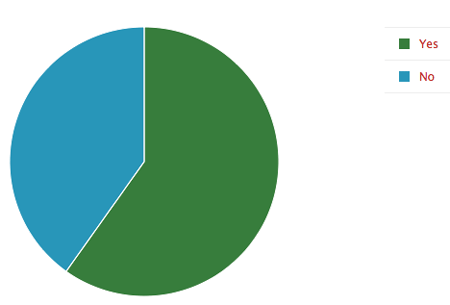
Our latest ZimmPoll asked the question, “Is our food system broken?” Not according to you with 63% saying no and only 37% saying yes. During the Bayer CropScience Ag Issues Forum held prior to the Commodity Classic, one of our speakers was Gawain Kripke, Oxfam America. He told us “our food system is broken.” I think the statement was made out of frustration that we produce more food than we can eat in this country and a huge amount goes to waste. Since we don’t have a system to get waste food to those who need it they seem to believe the food system is broken. I think it’s a provocative statement and would love your thoughts.

Our new ZimmPoll is now live and asks the question, “Is maintaining the Renewable Fuels Standard more important to agriculture than the farm bill?” The statement was made during a recent meeting I attended that the Renewable Fuels Standard was more important to agriculture than the Farm Bill. What do you think?

ZimmPoll is sponsored by Rhea+Kaiser, a full-service advertising/public relations agency.

ZimmPoll

Biodiesel Industry Leader to Present at Global Conference

Cindy Zimmerman

The chairman of the National Biodiesel Board will be presenting an update on the U.S. industry during a global biofuels conference next week.

Renewable Energy Group Vice President, Sales and Marketing, Gary Haer will present during the “Global Biodiesel Production and Trading” panel at the World Biofuels Markets Congress & Exhibition on Wednesday, March 14 in Rotterdam, Netherlands.

“The U.S. biodiesel industry experienced phenomenal growth in 2011 with the sound, stable federal policy in place,” explained Haer. “As the biodiesel industry prepares to grow our role as North America’s commercialized, domestically-produced Advanced Biofuel, it is critical to work with customers, vendors and potential partners on an international scale to expand sustainable biodiesel production and enhance trading and business opportunities.”

The conference is organized by Greenpower Conferences.

Biodiesel, conferences, International, NBB, REG

Cobalt Demonstrates Biomass Treatment Process

Cindy Zimmerman

Cobalt Technologies has announced a milestone in the commercial conversion of biomass to sugars with the successful demonstration of its biomass pretreatment process.

The company, which is developing next generation n-butanol, made the achievement in cooperation with ANDRITZ, a globally leading supplier of technologies, equipment and plants for the pulp and paper industry.

Cobalt conducted the testing in the ANDRITZ pulp and paper mill demonstration facility in Springfield, OH, which is specifically designed to validate new processes before commercial-scale implementation. Cobalt’s dilute acid hydrolysis pretreatment process, which extracts sugars from ligno-cellulosic biomass, was validated on woody biomass, bagasse and agricultural residues.

Cobalt tested its pre-treatment process on both a batch and continuous basis and reports that these runs, while processing up to 20 bone-dry tons of biomass per day, successfully extracted sugars from the biomass without the use of enzymes to produce the desired liquid hydrolysate – a liquid-based sugar that is then converted into n-butanol.

“The hydrolysates produced at ANDRITZ’s demonstration facility have been fermented successfully at our facility in Mountain View, California without the need of any conditioning to remove inhibitory compounds,” Bob Mayer, CEO of Cobalt Technologies. “By proving we can meet, and in some areas, exceed our commercial targets and cost metrics at this scale, we are now well positioned to leverage this critical milestone to support our on-going commercialization efforts.”

This milestone also marks the first phase of Cobalt’s partnership with specialty chemical company, Rhodia in Brazil to develop bio n-butanol refineries throughout Latin America utilizing bagasse as a feedstock.

advanced biofuels, biobutanol, biofuels, Ethanol, Ethanol News

President Calls for Alternative Fueling Stations

Cindy Zimmerman

During a speech at a truck manufacturing plant in Mount Holly, North Carolina this week, President Obama outlined specifics for an energy plan that includes alternative-fueled vehicles and fueling stations.

“We’ve got to develop every source of American energy — not just oil and gas, but wind power and solar power, nuclear power, biofuels,” Obama said, noting that he has directed “every department, every agency in the federal government, to make sure that by 2015, 100 percent of the vehicles we buy run on alternative fuels — 100 percent.”

But at the end of the day, it doesn’t matter how much natural gas, or flex-fuel or electric vehicles you have if there’s no place to charge them up or fill them up. So that’s why I’m announcing today a program that will put our communities on the cutting edge of what clean energy can do.

To cities and towns all across the country, what we’re going to say is, if you make a commitment to buy more advanced vehicles for your community — whether they run on electricity or biofuels or natural gas — we’ll help you cut through the red tape and build fueling stations nearby. And we’ll offer tax breaks to families that buy these cars, companies that buy alternative fuel trucks like the ones that are made right here at Mount Holly. So we’re going to give communities across the country more of an incentive to make the shift to more energy-efficient cars.

Growth EnergyGrowth Energy CEO Tom Buis says ethanol producers embrace the president’s “all of the above” energy policy that focuses on giving consumers greater choice for motor fuel. “With ethanol trading at a buck a gallon less than gasoline, it only makes sense to speed more biofuels like ethanol to the marketplace to help reduce prices at the pump,” said Buis. “We know that there are a lot of developing alternative fuels out there that can help replace foreign oil – someday. But today, ethanol is the only commercially-viable alternative to foreign oil that we have, and we ought to be embracing policies that give consumers greater access, not less.”

Electric Vehicles, Ethanol, Ethanol News, Flex Fuel Vehicles, Government, Growth Energy, Natural Gas, Solar, Wind

Ethanol Can Help Meet Higher Octane Needs

Cindy Zimmerman

Automakers will need higher octane fuels to meet the coming increases in fuel economy and reductions in emissions called for by 2025 and ethanol is positioned to help fill that need.

According to a new study by auto engineering firm Ricardo, Inc., the increase in average fleet fuel economy to 54.5 mile per by 2025 will have to be met in large part by engines and vehicles popular today, which is about double the average of 2010. Ricardo notes, “[t]he vast majority of vehicles sold through 2025 in the United States will use gasoline-fueled, spark-ignited internal combustion engines as the primary form of propulsion.”

Specifically, Ricardo reports that nearly 3 out of every 4 vehicles will require a gasoline-type, higher octane fuel to operate a growing list of engine technology options. “Future powertrain solutions will have a natural thirst for higher octane fuels,” Ricardo concludes. Octane is the standard measure of the anti-knock properties (i.e., engine performance) of a motor fuel. Most fuels today, including E10 ethanol blends, have an octane rating of at least 87.

Speaking at the 17th annual National Ethanol Conference, Ricardo project director Rod Beazley said the meeting should be called the “National Octane Conference” because “ethanol has sort of a bad rap with the autos and it might need to re-market itself.”

Beaszley says he doesn’t agree with the timing of the Renewable Fuel Standard (RFS). “If I was king for the day, you’d be getting the 36 billion gallons by 2017,” he said. “That would be the challenge – how to accelerate it by five years.”

He called for an alliance with auto makers who have a tremendous challenge ahead of them to increase fuel economy. “I think there’s a huge opportunity for the renewable fuels industry to grow and to have a very strong partnership with the autos,” he said. “There’s never been a better time for the industry than now.”

Listen to or download Beazley from NEC here: Ricardo Inc. Project Manager Ron Beazley

2012 National Ethanol Conference Photo Album

Audio, Car Makers, Ethanol, Ethanol News, National Ethanol Conference, RFA