Renewable Energy in House Farm Bill

John Davis

The U.S. House Agriculture Committee has passed its version of the Farm Bill… better known as the Federal Agriculture Reform and Risk Management Act or FARRM Act… but the measure doesn’t seem to give much love to renewable energy… and by love, we mean FUNDING!

Because of the lack of funding, most proposed amendments were withdrawn. One that did pass that required no specific funding was Arkansas Republican Rep. Rick Crawford’s measure for the Biomass Crop Assistance Program (BCAP). Rep. Kristi Noem (R-SD) introduced the measure in the committee on Crawford’s behalf that would protect funding already invested. “The worst thing we could do to a project that has benefited and been a part of the BCAP program is pull the funding from it before it has had a chance to establish itself,” she told the committee. Noem added that if existing projects have their funding pulled before coming to fruition, it would send the wrong message to the farming community about biomass fuels. Despite some misgivings about the overall program from Ranking Member Rep. Collin Peterson (D-MN), the amendment passed and is headed to the House floor with about 40 other amendments.

Listen to the debate on the BCAP amendment here: BCAP amendment debate in House Ag CommitteeRead More

Audio, biomass, Government, Legislation

RFA Reiterates Safety of Ethanol By Rail

John Davis

While the fiery derailment and crash of a train carrying 90,000 gallons ethanol in Columbus, Ohio makes for some spectacular pictures and video, the folks at the Renewable Fuels Association point out that this is the exception and not the rule as 99.99 percent of all hazardous materials are delivered by rail without any issues:

“Billions of gallons of ethanol safely travel American railways without incident each year. Unfortunately, some accidents do occur which are out of our control. For whatever reason, some trains derail. In order to help ensure the safety of the public near these railways, the Renewable Fuels Association has been partnering with the federal government, rail carriers, railroad operators, and other stakeholders to conduct safety seminars for first responders all across the country. Since beginning the program in 2010, the RFA has conducted more than three dozen trainings for more than 1,500 first responders nationwide. These fire departments and other essential safety organizations now have the proper understanding and tools to respond in the unlikely event of a train accident involving ethanol.”

The RFA also has founded the Emergency Response Coalition (ethanolresponse.com), designed to educate responders on what to do in such an incident.

Check out the video from ABC News below. While I can’t agree about some of the characterizations of the green fuel, the video of the actual explosion is pretty amazing.
video platformvideo managementvideo solutionsvideo player

Ethanol, Ethanol News, RFA, Video

Latest Soil Research Supports Biomass Harvesting

Good news is emerging from the most recent soil data of the Project LIBERTY biomass harvesting research in northwest Iowa. Harvesting crop residue can be a responsible part of good farm management.

Project LIBERTY is a commercial-scale, cellulosic ethanol plant that is scheduled to begin operations in Emmetsburg, Iowa in late 2013. The plant will use corncobs, leaves, husk, and some stalk and is expected to produce 20 million gallons of ethanol growing to approximately 25 million gallons per year. It is the first project of the POET-DSM Advanced Biofuels Joint Venture.

For the last four years, Project LIBERTY has commissioned soil sustainability work from researchers with Iowa State University and the USDA. They have studied six different harvest methods in an effort to provide area farmers with data to help them make decisions about biomass harvesting.

“Basically, at the removal level that POET-DSM recommends, there is no reduction in yield, and removal rates are well within the sustainability limits,” said Dr. Stuart Birrell with Iowa State University.

Birrell and Dr. Douglas Karlen of USDA-ARS led the research.

The most recent data is consistent with previous years. Birrell said nutrient replacement is minimal, with no evidence of a need to replace nitrogen. Based on the research, POET-DSM recommends to farmers the addition of 10-15 pounds of potash when soil tests indicate it is needed. The effects of biomass harvesting on soil carbon have also proven to be minimal according to measurements of soil organic carbon, Birrell said, more an effect of yield and tillage intensity than biomass removal.

POET-DSM contracts for about 1 ton of biomass per acre with participating farmers. That’s less than 25 percent of the available above-ground biomass. They are contracting for 85,000 tons this year, and once operational, Project LIBERTY will require about 285,000 tons per year.

biomass, corn, Ethanol, POET

Fill Up on Biodiesel & Meet NASCAR Truck Driver Today

Fill up on biodiesel and meet a NASCAR Camping World Truck Series driver today in Newton, Iowa at 4 p.m. at Love’s Travel Stop, 4400 S 22nd Ave. East, (I-80/East 44th St. South).

Meet driver Todd Peck of Peck Motorsports. Peck, a NASCAR racing team from Pennsylvania, is committed to going green. The Peck race hauler has been outfitted with solar panels on the roof which power the newly installed LED lights and equipment, and the goal is to drive to and from races using biodiesel blends. The hauler runs on up to B50, 50 percent biodiesel.

Today, Peck will fill up the race hauler with 15 percent blend biodiesel and sign autographs for local fans. The team makes its NASCAR Camping World Truck Series debut at the Iowa Speedway on July 14.

Biodiesel, NASCAR, Racing

Biofuel Groups File Petition in Oil Lawsuit

Cindy Zimmerman

Six biofuel industry organizations have jointly petitioned the U.S. Court of Appeals for the District of Columbia Circuit to intervene in a lawsuit filed by the American Fuel & Petrochemical Manufacturers (AFPM) and the Western States Petroleum Association (WSPA) against the U.S. Environmental Protection Agency. The biofuel organizations include the Advanced Biofuels Association, Advanced Ethanol Council, American Coalition for Ethanol, Biotechnology Industry Organization, Growth Energy and the Renewable Fuels Association.

The organizations are asking to join the AFPM et al v. EPA suit to support the EPA’s denial of a waiver of the 2011 Cellulosic Renewable Volume Obligation under the Renewable Fuel Standard (RFS). The lawsuit was filed in June 2012, the same month that the first Renewable Identification Numbers reportedly were assigned to cellulosic biofuel produced in the United States.

ACE, advanced biofuels, AEC, Ethanol, Ethanol News, Growth Energy, RFA

Fungus Could Be Key for Corn Stover Ethanol

John Davis

Trying to get more ethanol out of every part of the corn is the goal for many alternative fuel producers. With demand for the actual grain of corn for food, scientists are looking at the rest of the plant to try to extract ethanol. This article from the American Chemical Society’s journal Industrial & Engineering Chemistry Research says researchers have found that white rot fungus is showing promise in unlocking 50 percent more sugar from the stock and cobs, corn stover, that can be converted into ethanol:

Yebo Li and colleagues explain that corn ethanol supplies are facing a crunch because corn is critical for animal feed and food. They note that the need for new sources of ethanol has shifted attention to using stover, which is the most abundant agricultural residue in the U.S., estimated at 170-256 million tons per year. The challenge is to find a way to break down tough cellulose material in cobs, stalks and leaves – so that sugars inside can be fermented to ethanol. Previous studies indicated that the microbe Ceriporiopsis subvermispora, known as a white rot fungus, showed promise for breaking down the tough plant material prior to treatment with enzymes to release the sugars. To advance that knowledge, they evaluated how well the fungus broke down the different parts of corn stover and improved the sugar yield.

While the researchers are able to extract a significant amount of sugar for ethanol from the leaves as well, it’s less than the stalks and cobs. Since the leaves are good for the soil, they point out those leaves can be left in the field to recharge the soil.

corn, Ethanol, Ethanol News, Research

Adding Value To Ethanol Byproducts

John Davis

Researchers are looking for ways to get more value out of the byproducts of ethanol production, and thus, making the production of the green fuel more efficient and cost effective. During the recent Corn Utilization Technology Conference, USDA’s Kurt Spokas presented his ideas of getting more value out of those ethanol byproducts. He’s been working with the Minnesota Corn Growers on a project that converts distillers grains into various bio byproducts that are of higher value than the grains themselves.

“With the microwave-assisted pyrolysis, [we] convert very wet biomass over to an actual higher value product in both a bio-oil materials that have the building blocks for other uses, as well as a biochar, which we hope to actually utilize for sustaining our agricultural production,” he said. In the second year of this project, Spokas said it is going very well and is hoping to have field plots to see what larger scale impacts could be.

Spokas wants farmers to see all the different ways corn can be used… and what the future holds. “We thought we had a good picture of all the various products that were possible, but now we’re beginning to see that was only the beginning or the tip of the iceberg.”

Listen to an interview with Kurt here: Interview with Kurt Spokas

Audio, corn, CUTC, Ethanol, Ethanol News, Government, Research

Ethanol Report on First E15 Sales

Cindy Zimmerman

The nation’s first E15 gallons under the EPA waiver were finally pumped this week at the Zarco 66 “Oasis” station in Lawrence, Kansas at a price two cents a gallon less than E10.

This edition of “The Ethanol Report” features comments from Jere White, Executive Director of the Kansas Corn Commission, who bought the first gallon of E15 at the station; Zarco 66 owner Scott Zaremba, who is a big supporter of alternative fuels; and Renewable Fuels Association president and CEO Bob Dinneen.

Listen to or download the Ethanol Report here: Ethanol Report on First E15 Sales

Subscribe to the Ethanol Report here.

Audio, corn, Ethanol, Ethanol News, Ethanol Report, RFA

USDA Cuts Corn Yields and Ethanol Use

Cindy Zimmerman

As expected, the USDA World Agricultural Supply and Demand Estimate report out this morning did lower corn yields as a result of the hot and dry conditions throughout much of the growing region this summer.

The projected U.S. corn yield was lowered 20 bushels per acre to 146 bushels reflecting the rapid decline in crop conditions since early June and based on that and reduced harvested area based on the June 29 Acreage report, WASDE reduced corn production prospects by 1.8 billion bushels from last month. “Persistent and extreme June dryness across the central and eastern Corn Belt and extreme late June and early July heat from the central Plains to the Ohio River Valley have substantially lowered yield prospects across most of the major growing regions,” the report says.

Reduced supplies and higher prices are expected to sharply lower 2012/13 corn usage with the biggest reduction for feed and residual disappearance, projected down 650 million bushels. Food, seed, and industrial use is also projected lower, down 105 million bushels, mostly reflecting a 100-million-bushel reduction in corn used to produce ethanol. Exports are projected 300 million bushels lower as tight supplies, higher prices, and strong competition from South American exporters limit U.S. shipments. A 52-million-bushel increase in beginning stocks and a 15-million-bushel increase in imports offset only a small portion of the expected reduction in this year’s crop. Ending stocks for 2012/13 are projected at 1.2 billion bushels, down 698 million from last month’s projection. The season average 2012/13 farm price for corn is projected at $5.40 to $6.40 per bushel, up sharply from $4.20 to $5.00 per bushel in June.

corn, Ethanol, Ethanol News, USDA

Will Corn Crops Make it Through the Summer?

Melissa Sandfort

Our latest ZimmPoll asked the question, ” How will Obamacare affect you and your business?”

Our poll results: Sixty percent said negatively; thirty percent said positively; five percent said not at all and the remaining five percent didn’t know.

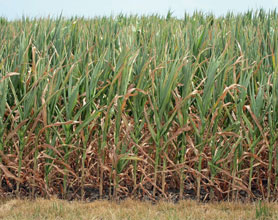
Our new ZimmPoll is now live and asks the question, ” How worried are you about the weather impact on crops this summer?” The worst U.S. drought since Ronald Reagan was president is withering the Midwest’s corn crop. The condition on July 1 was the worst since the drought of 1988. What do you think – will the rest of the summer bring relief or are the crops in trouble?

ZimmPoll is sponsored by Rhea+Kaiser, a full-service advertising/public relations agency.

ZimmPoll