

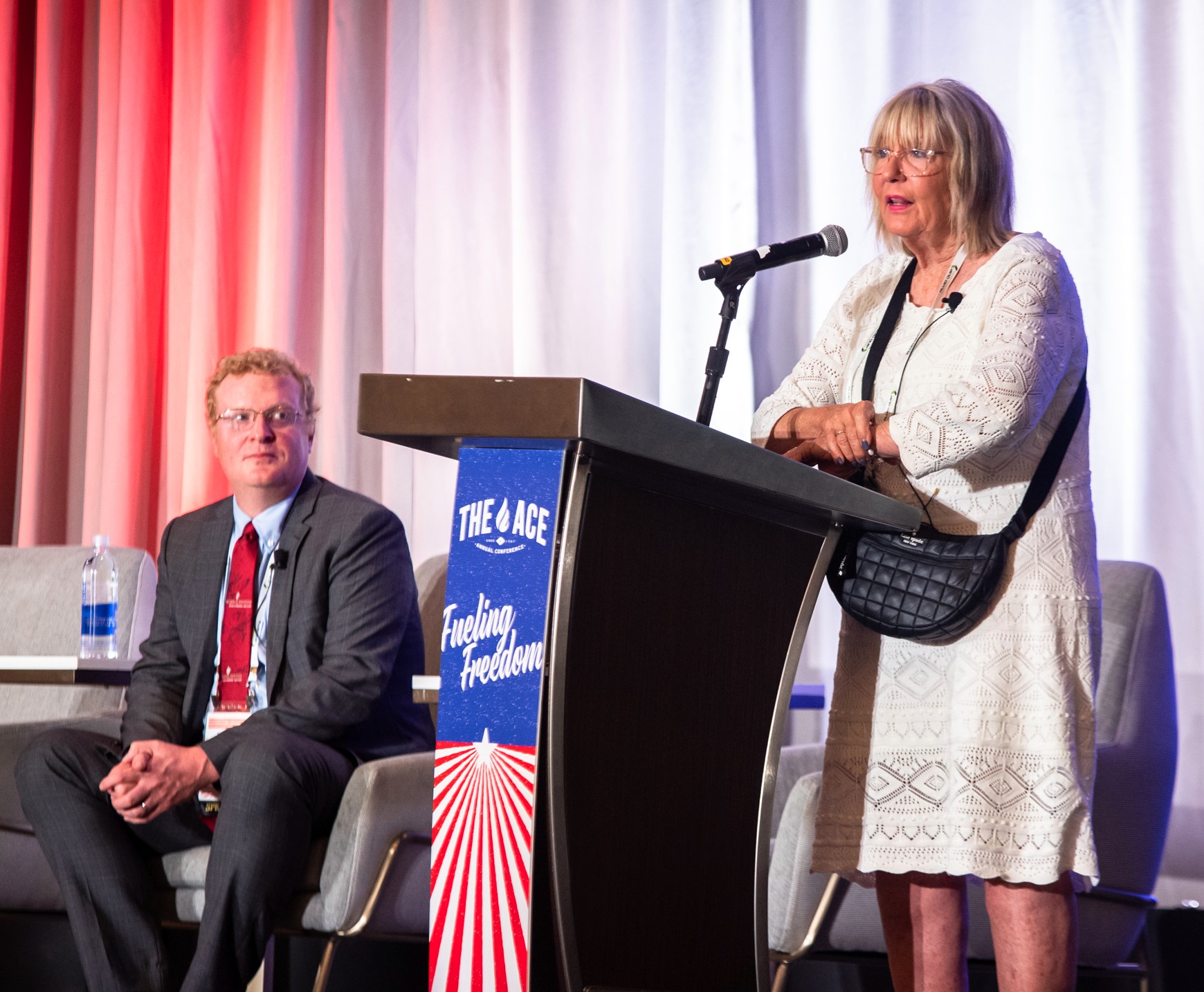
Gail Dennison speaks as Dr. Luke Hoeppner looks on at the ACE Conference
At the recent American Coalition for Ethanol (ACE) annual conference in Minneapolis, Gail Dennison and Dr. Luke Hoeppner of the University of Minnesota’s Hormel Institute outlined the latest research linking fossil-fuel BTEX compounds (benzene, toluene, ethylbenzene and xylenes) to higher cancer risk and other disease, and the potential health advantage of replacing them with ethanol.
Dennison described how the project began after industry leaders asked whether ethanol could serve as a less carcinogenic alternative in fuels. Early work, she said, showed BTEX mixtures to be more hazardous than anticipated. Exposure has been tied not only to lung, breast and prostate cancers but also to generational breast-cancer risk after prenatal exposure and to neurodegenerative conditions, including Alzheimer’s, through disruption of the gut microbiome. “We’re on the quest now of completing and taking the research to the next stages,” said Dennison. “We know you need published data. And so that is our number one goal.”
Hoeppner, a cancer researcher who joined the institute from Mayo Clinic, presented laboratory and animal data on lung cancer. In custom inhalation chambers built at the University of Minnesota, mice that breathed BTEX developed more and larger lung tumors in both carcinogen-induced and genetically driven models. A zebrafish assay further indicated that BTEX accelerates a key step in metastasis: cancer cells leaving the bloodstream. Parallel mouse metastasis studies are under way. “And we’re currently performing studies and optimizing a technique that we can deliver ethanol to the mice as a control to show that ethanol is likely not having these effects, whereas the BTEX is,” said Hoeppner.
The institute has co-funded the work and multiple papers are in preparation. Dennison noted growing interest from officials in California and Mexico City, where ethanol use remains low. A planned next phase will use mice carrying random mutations to identify which genes make individuals most susceptible to BTEX-driven lung cancer.
Learn more in their presentation at The ACE.
Gail Dennison, The Hormel Institute, Director of Development & External Relations
Luke Hoeppner, The Hormel Institute, University of Minnesota, Associate Professor
Hormel Institute Panel 22:13