

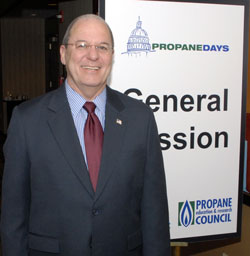
 This morning I met with the President/CEO of the Propane Education & Research Council, Roy Willis. He was on hand at the sessions taking place for the 3rd Annual Propane Days here in Washington, DC. Roy says PERC’s goal here is to help educate policy makers so that they make good decisions based on sound science and research.
I asked him to highlight some of their projects that he is especially proud of in the area of agriculture. They include what he calls thermal cultivation which is using heat/steam/flame to control pests in a variety of farm applications. He says this has a special interest to anyone growing organically since it reduces or eliminates the need for chemicals. Irrigation done with propane powered engines is another area that he mentioned as well as safety programs geared to agricultural audiences. He also mentioned that discussions are underway to see how propane can be used in tractors and combines.
One of the things I aske him about was where this fuel comes from. I think a lot of people wonder that. You see that’s it’s widely available but where do we get propane? To start with it’s a naturally occurring hydrocarbon that we mainly get as a by-product of the natural gas or oil refining processes. He says that over 90 percent of our propane comes from these sources which are domestic. Another area that holds promise includes bio-propane which would be made from a biomass production process. PERC is actively involved in this work with a project in Japan. One thing he wants people to know is that propane represents a very sustainable supply of fuel now and in the future.
You can listen to my interview with Roy here: [audio:http://www.zimmcomm.biz/propane/propane-days-07-willis.mp3]
Roy ended our discussion by saying that the slogan, “Exceptional Energy,” is taken by PERC as a promise to their customers and a challenge to the staff to deliver a superior, safe product.
 As I promo’d last week, I’m here in Washington, DC at Propane Days. The
  A Michigan utility has inked a 20-year deal to buy renewable energy from
 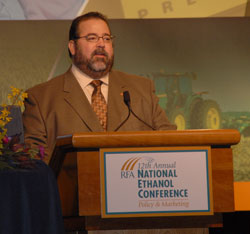 “Record-high gas prices, continued unrest in oil-producing regions of the world and the fragility of America’s oil refining complex underscore the necessity of developing renewable alternatives to fossil fuel,” said Renewable Fuels Association President Bob Dinneen.
 In fact, NCGA President Ken McCauley tells
  NearBio, the innovator of technology that sends to your computer, cell phone, or mobile device info on where the nearest alternative fuel station is, has established a new web site:
 According to
  “We are pleased to see that the Udall Foundation and the federal agencies and equipment manufacturers who are sponsoring the tour recognize biodiesel’s valuable contribution to the environment,” said NBB Chief Executive Officer Joe Jobe. “It is only fitting that the bus tour will feature many National Parks since the Park Service’s fleets were among the first in the nation to use biodiesel. Today, hundreds of fleets, including government, commercial and school buses, use biodiesel to benefit America’s environment, energy security and economy.”
 “Making these funds available represents this Administration’s ongoing commitment to promoting clean energy technologies to help diversify our nation’s energy mix in an environmentally sensitive way,” Energy Secretary Samuel Bodman said. “I am hopeful that these projects will play a critical role in furthering our knowledge of how we can cost effectively produce more homegrown, bio-based products to help reduce our reliance on imported sources of energy.”
 “These grants are one of many steps we are taking to meet the President’s goals of reducing petroleum dependency,” Agriculture Secretary Mike Johanns said from South Dakota, where he was addressing the Western Governor’s Association. “They will fund essential research that not only will lead to the creation of new, sustainable energy sources, but also will create new uses and markets for agricultural products.”