
 Florida Power & Light Company (FPL) has announced the launch of its new, high-tech Power Delivery Diagnostic Center, which is designed to leverage advanced smart grid technology to better manage the electric system and deliver reliable service that ranks among the best in the nation. FPL is investing in smart grid technology and using predictive analytics to deliver real-time data to engineers in its diagnostic center. Engineers, in turn, analyze the data to measure and improve the performance of the electric grid.
- Republic Services, Inc. has announced today that its Sand Valley Landfill Gas-to-Energy (LFGTE) project in Collinsville, Alabama. has been named Electricity Project of the Year by the U.S. Environmental Protection Agency (EPA.) The EPA’s Landfill Methane Outreach Program recognized the Sand Valley renewable energy project with the award at a workshop held yesterday in conjunction with the Solid Waste Association of North America’s 38th Annual Landfill Gas & Biogas Symposium.
- China Ming Yang Wind Power Group Limited takes 8th in world’s top 10 wind turbine original equipment manufacturers (“OEMs”) ranking in 2014, raised from 9th last year, according to the report of Global Wind Turbine OEM Market Share Study released by MAKE Consulting. The same source reveals that the market share of Ming Yang hit 9.9% in total in 2014, with an 11.1% increase of the whole market growth. Ming Yang was also one of the only two Chinese companies that retained its position compared to 2013.The report also shows that 8 out of the 15 world’s top OEMs in 2014 were from China. “China’s unparalleled growth dominates the industry,” cited the report, which says the Chinese wind market grew 23.6GW in 2014, reaching 114.9GW in total.
- Geothermal Energy Association will be holding its fifth annual National Geothermal Summit on June 3-4 at the Grand Sierra Resort and Casino in Reno, NV. The National Geothermal Summit is the leading forum for western state policy discussions, bringing together the geothermal industry for a dialogue with state and federal policy makers.The 2015 Summit theme is “Geothermal Policies as Stimulus For Economic Growth and Environmental Quality”.

Another Successful ACE Fly-in
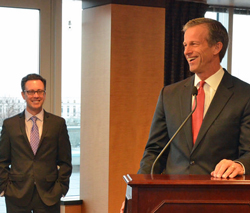
ACE executive VP Brian Jennings smiles as Sen. John Thune (R-SD) speaks at fly-in reception.
“We do this because we know lawmakers and their staff want to meet with people with a little dirt or grease under their fingernails who are doing things out in the country that really matter,” said Jennings. The group of 70-plus ethanol supporters who attended the event included students, producers, farmers, accountants, bankers, seed and technology companies, and advanced biofuels supporters.
“We’ve always received good feedback from members of Congress,” Jennings added, noting that their main message was to keep the Renewable Fuel Standard (RFS) on track, “This program is working despite what detractors might say,” he said. “I think members of Congress are starting to see that.”
Interview with Brian Jennings, American Coalition for EthanolCountry Star Launches College Tour on Biodiesel
 Country music star Lee Brice is launching an environmentally friendly tour of college campuses, fueled by biodiesel. This article from The Boot says the tour is in partnership with REVERB, a non-profit organization that unites artists and colleges to bring about environmental and social change.
As an avid outdoorsman, the singer-songwriter hopes to focus his attention on outdoor preservation and water conservation.
“We’re hoping to offset the environmental impact of the tour by supporting clean energy projects and using buses and trucks fueled with locally produced biodiesel,” Brice says. “I have two sons, and I look at this as investing in their future and that of kids around the world.”
The tour begins April 8 at Campbell University in North Carolina. The singer’s tour announcement comes as his latest single, “Drinking Class,” was just certified gold.
Ethanol Supporters Counter Funding Request
 Ethanol and agriculture industry groups sent their own letter to House Appropriations leadership in response to a group of lawmakers calling for the elimination of funding for blender pumps or corn ethanol export promotion.
The letter signed by the Renewable Fuels Association, American Coalition for Ethanol, National Farmers Union, National Corn Growers Association, and Growth Energy calls on the subcommittee to “vehemently oppose and reject any efforts to include such limiting language” in FY 2016 appropriations for USDA.
It is important to note at the outset that there already exists a prohibition on the US Department of Agriculture using grant funds for the installation of blender pumps, which was included in the recently passed Farm Bill. Now, in a blatant effort to shelter the oil and gas industry from any further competition from ethanol, Representatives Goodlatte, et al. are seeking to place limitations on the U.S. Department of Agriculture’s efforts to help promote the consumption of American made ethanol at home and abroad; something that agency has been successfully doing with other agriculture and livestock products for decades.
Reps. Bob Goodlatte (R-VA), Peter Welch (D-VT), and Jim Costa (R-CA), claim in their letter that the government has created an “artificial market” for ethanol that is “negatively impacting American consumers, livestock farmers, food producers, retailers, air and water quality, and the ability to feed our nation’s hungry.” The ag and ethanol groups responded that “corn prices today are below the prices witnessed in 2007 when the Renewable Fuel Standard was expanded and livestock feed costs are at their lowest levels in more than five years…Meanwhile, consumer food prices have advanced more slowly since passage of the RFS than in the 25 years prior to its enactment.”
California Firm Buys Connecticut Biomass Plant
 A California firm has bought a biomass plant in Connecticut. This article from the Sacramento Business Journal says Greenleaf Power has agreed to buy the 37.5-megawatt Plainfield Renewable Energy plant.
Greenleaf did not disclose a value for the transaction, which is expected to close later this year. But the Washington Post reported the sale price was $30 million in cash and $80 million in secured notes. The seller was Leidos Holdings Inc. of Reston, Va.
Plainfield becomes Greenleaf’s sixth plant, along with facilities in Mecca, Tracy, Humboldt County, Susanville and Quebec City. The acquisition brings Greenleaf’s total renewable energy capacity to more than 180 megawatts.
The plant in Connecticut opened at the end of 2013 and burns waste wood. The plan is to sell the electricity to Connecticut Light and Power under a long-term agreement.
Presidential Hopefuls and Agriculture
 Our latest ZimmPoll asked the question, “Which potential presidential candidate would be best for ag?”
Of the 12 potential presidential candidates included in our poll, only one has officially declared. But two hopefuls have risen to the top of our poll. It seems many believe Hillary Clinton and Scott Walker might have the best interest of agriculture in mind, if elected.
Here are the poll results:
- Joe Biden – 3%
- Jeb Bush – 11%
- Ben Carson – 5%
- Chris Christie – 1%
- Hillary Clinton – 22%
- Ted Cruz – 7%
- Mike Huckabee – 13%
- Rand Paul – 4%
- Rick Perry – 2%
- Marco Rubio – 3%
- Scott Walker – 19%
- Elizabeth Warren – 10%
Our new ZimmPoll is now live and asks the question, What is best for GMO labeling?
Agricultural organizations are voicing support for the bi-partisan Safe and Accurate Food Labeling Act introduced in the U.S. House recently. What do you think is best when it comes to the labeling of GMO’s? Should it be mandatory or voluntary? Should it include all foods? Should states decide? Let us know your opinion.
NASDAQ Trading SolarEdge Technologies Shares
 SolarEdge Technologies is now trading on NASDAQ. The solar company announced its pricing for its initial public offering of 7 million shares of common stock at a public price of $18 per share. All shares are being sold by SolarEdge. As part of the offering, the underwriters have been granted a 30-day option to purchase up to 1,050,000 additional shares. The shares began trading today on the NASDAQ Global Select Market under the ticker symbol “SEDG”. The closing of the offering is expected to occur on March 31, 2015, subject to the satisfaction of customary closing conditions.
Goldman, Sachs & Co. and Deutsche Bank Securities Inc. are acting as joint book-running managers for the offering. Needham & Company, Canaccord Genuity Inc. and Roth Capital Partners are acting as co-managers. A registration statement relating to these securities was declared effective by the Securities and Exchange Commission on March 25, 2015. The offering will be made only by means of a prospectus.
Retailer Takes Ethanol Story to Hill
 Fuel retailers who have had to fight battles with big oil companies to offer higher ethanol blends were among those joining the American Coalition for Ethanol (ACE) Fly-in on Capitol Hill this week.
Charlie Good has been in the fuel retailing business for 35 years as a convenience store operator and auto mechanic and he started offering higher ethanol blends at his Good and Quick store in Nevada, Iowa about 18 months ago. “And it’s just been a big boom for me, it’s added new gallons, it’s increased my customer base,” said Good.
The Renewable Fuel Standard (RFS) was the main topic of ethanol supporter meetings with lawmakers and their staff this week and Good says even those they met with who have actively opposed the RFS are unlikely to vote for repeal. “The three of the five that we met with that were against it came out and said we’re not actually going to vote to repeal it…they’re just going to remain low key,” said Good.
Interview with Charlie Good, ethanol retailerMonopoly Utilities Expose Solarcism
State-sponsored monopoly utilities, as coined by the Gulf States Renewable Energy Industry Association (GSREIA) have exposed their ‘solarcism’ in recent weeks. GSREIA has accused them of being “ignorant” and “misleading” when it comes to solar energy. The nonprofit wants to keep the utilities honest and is publicly clarifying some misconceptions. At issue is the frequency that monopoly utility supporters confuse Louisiana’s low electricity rates with customer electricity bills.
“It’s embarrassing that groups funded by large utilities could be so confused on the basic facts on electricity,” said Jeff Cantin, president of GSREIA. “If low rates meant low bills, Louisiana’s utilities would never have to explain to the media and regulators why customers suffer from high bills every summer and every winter.”
 A good example, says Cantin, that explains how monopoly mouthpieces get it so wrong is to compare the automobile gasoline price-per-gallon vs. a driver’s total bill at the pump.
Cantin offers an example. Assume gasoline costs $2 a gallon. If a Prius owner fills up that car’s 11-gallon gasoline tank, the gasoline bill will be $22. If a Suburban owner fills up that SUV’s 31-gallon gasoline tank, the gasoline bill will be $62. Obviously the Suburban owner’s bill is going to be much higher. And clearly, the low price of gas per gallon doesn’t mean the bill will be cheap. The same principle applies to electric bills.
While Louisiana’s residential rates are relatively cheap at about 9.4 cents per kWh, actual bills depend on how many kWh customers actually use. According to the latest information from the Energy Information Administration, Louisiana’s average residential electric bill was $119.98 in 2013. Residents in 36 states paid lower average bills, meaning Louisiana had the 14th most expensive average utility bills in the nation.
Although every Louisiana utility customer’s bill clearly explains that the number of kWh used defines the size of the monthly bill, GSREIA hopes the state-sponsored monopoly mouthpieces are making honest mistakes instead of purposefully misleading the public.
Motor Club Rep: No Ethanol-Related Claims
 While AAA may be an outspoken critic of ethanol blended gasoline and E15 in particular, some other motor clubs think differently, and one of them was on Capitol Hill this week with the American Coalition for Ethanol to tell his story to lawmakers.
Gene Hammond with Association Motor Club Marketing and Travelers Motor Club, which represent 50 years in the business and over 20 million members, says they studied their claims over the past several years to see if there were any related to ethanol. “And what we discovered is that we have not had one ethanol-related claim where we’ve had to go out and tow,” said Hammond. “In fact, the opposite is true.”
Hammond explains that claims related to gasoline freeze used to be common in the northern part of the country, “but that’s gone away, we don’t have that anymore with ethanol.”
Hammond was pleased to join ethanol supporters in Washington this week for the ACE Fly-in to tell members of Congress and their staff his experiences with ethanol from an automotive standpoint. Interview with Gene Hammond, AMCM and Travelers Motor Club