#Ag Industry Split on Final #RFS Rules

Joanna Schroeder

The #Ag industry is split on the final #RFS (Renewable Fuel Standard) rules that were released yesterday by the Environmental Protection Agency (EPA). While the RVOs (renewable volume obligations) were an improvement over the proposed rules released in May of this year, the #Ag industry is calling on the EPA to further strengthen the legislation and increase the amount of corn ethanol blended into America’s fuel.

USDA logoAgriculture Secretary Tom Vilsack called the final rules for 2014, 2015 and 2016 a move in the right direction. “This unprecedented commitment is part of the reason why, even in recent years when there has been some uncertainty with RFS, we have seen continued growth in biofuels production and consumption,” said Vilsack in a statement.

National Corn Growers Association (NCGA) President Chip Bowling reacted to the news with mixed feelings. “While we are pleased to see the EPA take a step forward and revise NCGA-Logo-3its original proposal, the fact remains that any reduction in the statutory amount will have a negative impact on our economy, our energy security, and the environment.”

Despite the volumes increasing over 2014 numbers, none of the four renewable fuel categories are at statutory levels. As a result, Bowling said NCGA and other organizations are evaluating their options to protect farmers and consumers and hold the EPA accountable to meet statutory requirements.

National Farmers Union logoNational Farmers Union (NFU) President Roger Johnson sharply criticized the EPA for issuing final volume targets well below their statutory level. “The administration’s decision to issue RFS volume obligations below their statutory requirements exacerbates the serious damage already done to the renewable fuels industry and America’s family farmers,” said Johnson. “Clearly the administration has accepted Big Oil’s talking points and paved the way for a weaker RFS to the detriment of economic prosperity in rural America and the administration’s own climate change goals.”

AFBF-logoThat sentiment was shared by American Farm Bureau Federation President Bob Stallman. “We need more biofuels, not less, and Farm Bureau called on EPA earlier this year to protect the RFS,” said Stallman. “We are disappointed to see the agency move forward with a decision that will stall growth and progress in renewable fuels as well as the broader agricultural economy.”

Agribusiness, Biodiesel, biofuels, EPA, Ethanol, RFS

BioEnergy Bytes

Joanna Schroeder

  • BioEnergyBytesDF1Renovate America, the leading provider of residential Property Assessed Clean Energy (PACE) financing in the U.S., has announced the nation’s first-ever “green bonds” securitizing PACE bonds. This is Renovate America’s fifth securitization of PACE bonds in the U.S., issuing $201,532,000 in Class A Notes rated AA (sf) by Kroll and AA (sf) by DBRS, and represents 8,939 home improvements made that reduce energy or water consumption or produce renewable energy.
  • The Cleantech Open has announced Vartega Carbon Fiber Recycling LLC as the recipient of the National Emerging Technology Award at its 2015 Global Forum at Herbst Theatre on November 19th.
  • A startup company in the New York University Tandon School of Engineering clean-tech incubator called NYC ACRE recently launched a design and technology race to build the first beautiful solar panels. In the latest step toward reality, the U.S. Department of Energy (DOE) announced it will help take Sistine Solar’s technology the last mile, to production, by means of a $1 million grant. The grant is part of DOE’s SunShot Initiative.
  • The U.S. Department of Energy (DOE) and Israel’s Ministry of National Infrastructure, Energy and Water Resources (MIEW) have selected six projects to receive $5.1 million under the 2015 Binational Industrial Research and Development (BIRD) Energy program. Each project is conducted by a U.S. and an Israeli partner. Selected projects address energy challenges and opportunities of interest to both countries, while focusing on commercializing clean energy technologies that improve economic competitiveness, create jobs, and support innovative companies.
Bioenergy Bytes

McD’s Cooking Oil Biodiesel Runs to Mars and Back

John Davis

UAEflagBiodiesel made from McDonald’s used cooking oil in the United Arab Emirates hit an impressive milestone: running the equivalent of the distance to Mars and back. This article in the UAE’s The National says McDonald’s UAE fleet completed 5 million kilometres this month fueled entirely by biodiesel. The green fuel is possible thanks to a four-year partnership between Mickey D’s and Dubai-based biodiesel producer Neutral Fuels.

Sixteen vehicles collect cooking oil from McDonald’s 135 outlets up to twice a day, which is then converted into a renewable fuel, or biodiesel.

It is the first quick service restaurant in the Mena region recycling all of its “waste cooking oil for refuelling the company’s logistics fleet to transport its goods throughout the emirates”, said Rafic Fakih, managing director and partner at McDonald’s UAE.

Each litre of cooking oil can make about one litre of biodiesel, according to Karl Feilder, chairman of Neutral Fuels. And the price matches what customers would pay at the pump, although the company declined to comment on wholesale prices and discounts for providing the feedstock.

McDonald’s is not the only company using the alternative fuel. Neutral Fuels says there has been an increase in biodiesel purchased in the UAE, doubling sales each year for the past three years.

This month, the company produced and sold 400,000 litres of biodiesel to hotels, restaurants, transport companies, schools and for power generators.

Neutral Fuels’ one biodiesel refinery in the UAE produces about 120,000 gallons per month.

Biodiesel, International

Researchers Sequence Algae Genome for Biodiesel

John Davis

chrysochromulinaResearchers at the University of Washington have sequenced the genome for a type of algae and found important information for biodiesel production. This news release from the school says the scientists sequenced the complete genetic makeup of the important and plentiful algae, known as haptophytes.

“Haptophytes are really important in carbon dioxide management and they form a critical link in the aquatic foodchain,” said senior author and UW biology professor Rose Ann Cattolico. “This new genome shows us so much about this group.”

The haptophyte Cattolico and her team studied is Chrysochromulina tobin, and it thrives in oceans across the globe. The researchers spent years on a series of experiments to sequence all of Chrysochromulina‘s genes and understand how this creature turns different genes on and off throughout the day. In the process, they discovered that Chrysochromulina would make an ideal subject for investigating how algae make fat, a process important for nutrition, ecology and biofuel production.

“It turns out that their fat content gets high during the day and goes down during the night,” said Cattolico. “A very simple pattern, and ideal for follow-up.”

She believes that that these extreme changes in fat content — even within the span of a single day — may help ecologists understand when microscopic animals in the water column choose to feast upon these algae. But knowledge of how the algal species regulates its fat stores could also help humans.

“Algae recently became more familiar to the general populace because of biofuel production,” said Cattolico. “We needed a simple alga for looking at fat production and fat regulation.”

The research was published Sept. 23 in the online, open-access journal PLOS Genetics.

algae, Biodiesel

Growth Energy Reacts Positively to #RFS Final Rules

Joanna Schroeder

Growth Energy reacted positively today after the Environmental Protection Agency (EPA) released the final Renewable Volume Obligations (RVOs) under the 2014, 2015 and 2015 Renewable Fuel Standard (#RFS). While the volumes were higher than in the proposed rules, on behalf of its members, Tom Buis, co-chairman, said that their members are pleased to see the #EPA moving the renewable fuels industry past the so-called ‘blend wall’.

growth-energy-logo1However, Buis said during a press call today that the EPA is still relying on flawed methodology that sets RVOs below the levels set by the legislation, “It is an important improvement from the proposed rule, and moves us closer to getting America’s most effective climate policy back on track and providing certainty for biofuels in the marketplace.”

“This final rule makes it possible to drive the growth of higher ethanol blends through the so-called blend wall, giving consumers choices at the pump, such as low-cost E15. Additionally, the numbers for 2016 represent a final rule closer to the statutory levels established by Congress, avoid the “reset” and indicate a more certain future for renewable fuels.

Buis continued, “However, we remain concerned that the final rule continues to rely on the “distribution waiver” that redefines supply as demand and was rejected by Congress when the RFS was enacted into law. Of particular concern is that by using such a waiver, the oil industry is being rewarded for its unwillingness to follow the law and invest in infrastructure to move toward cleaner, renewable fuel, which sets a dangerous precedent for the future of the program. The uncertainty this waiver will create risks sending investment in the next generation of renewable fuel overseas just as this new, homegrown industry is taking off.”

Jeff Broin, co-chairman of Growth Energy added during the press call, “In the future, we need to see a stronger and more consistent commitment to renewable fuel from Washington if we are ever going to realize the true potential of renewable fuels, including the development of cellulosic ethanol.”

Listen to the press call here: Growth Energy #RFS RVO Reaction Presser

Audio, biofuels, EPA, Ethanol, Growth Energy, RFS

Final #RFS Numbers Disappoint @EthanolRFA

Cindy Zimmerman

rfalogo1The Environmental Protection Agency’s final rule for volume obligations under the Renewable Fuel Standard (RFS) “puts the future of biofuels and climate policy in the hands of the oil industry,” according to Renewable Fuels Association (RFA) president and CEO Bob Dinneen.

“Let’s give EPA props, I guess, for recognizing that gasoline demand is increasing and that they needed to increase those numbers accordingly,” said Dinneen. “But they didn’t change anything with respect to the methodology … they still reduced the numbers from the statutory levels and embraced the notion of the blend wall … they are effectively turning the nation’s renewable energy program over to the oil companies.”

Dinneen says the ethanol industry will be evaluating its options when it comes to taking EPA to court over the final rule. “What EPA has done here is a dramatic departure from a program that was working,” he said. “I believe when we finish our review of the final rule that we will want to stand up for the program, stand up for consumers, stand up for carbon reduction, stand up for rural America and put this program back where it belongs.”

With President Obama in Paris this week for the COP21 climate change summit, Dinneen considers today’s announcement ironic. “How in the world can the president speak with any credibility on climate change when he is ripping the guts out of a climate change program in his own backyard?” Dinneen asked.

Listen to interview here: Interview with RFA CEO Bob Dinneen on final RFS rule

Audio, EPA, Ethanol, Ethanol News, Government, RFA, RFS

Biodiesel Industry Welcomes #RFS RVO Numbers

Joanna Schroeder

The Environmental Protection Agency (EPA) announced the final renewable volume obligations (RVOs) for the Renewable Fuel Standard (RFS) for years 2014, 2015 and 2016 as well as the volumes for the biomass-based diesel category for 2014-2017 that includes biodiesel volumes. The volumes were raised since the proposal in May 2015 and the National Biodiesel Board (NBB) welcomed the improved #RFS rules; yet stressed that the EPA still needs to improve the amount of renewable fuels such as #biodiesel in years to come. Biodiesel is designated as an Advanced Biofuel under the RFS.

nBB“This decision means we will displace billions of gallons of petroleum diesel in the coming years with clean-burning biodiesel. That means less pollution, more American jobs, and more competition that is sorely lacking in the fuels market,” said NBB CEO Joe Jobe. “It is a good rule. It may not be all we had hoped for but it will go a long way toward getting the U.S. biodiesel industry growing again and reducing our dangerous dependence on fossil fuels.”

According to the EPA, biodiesel reduces greenhouse gas emissions (GHGs) by 57 percent to 86 percent as compared with petroleum diesel depending on the fuel’s production pathway. Under the now final RFS rule, Biomass-based Diesel volumes would grow to 1.9 billion gallons in 2016 and 2 billion gallons in 2017. The Biomass-based Diesel category also includes renewable diesel, another diesel alternative made from the same feedstocks using a different technology.

Jobe says the new standards reflect modest but meaningful growth over recent years when the U.S. market has hovered around 1.8 billion gallons annually. “We certainly think the biodiesel and overall Advanced Biofuel standards could and should have been higher,” he added. “The production capacity is there, and we have surplus fats and oils that can be put to good use.”

ASA logoAmerican Soybean Association (ASA) President Wade Cowan seconded NBB’s promise that the biodiesel industry can do much more. “As an industry we have always advocated for RFS volumes that are modest and achievable and the biodiesel industry has met or exceeded the targets each and every year that the program has been in place,” said Cowan. “The Administration wants to address climate change and reduce greenhouse gas emissions and biodiesel can contribute more to that effort.”

Accounting for approximately half of the feedstock used, soybean oil remains the largest source of oil for biodiesel production.

advanced biofuels, Biodiesel, EPA, NBB, RFS, Soybeans

Final #RFS RVO Numbers from @EPA

Cindy Zimmerman

epa-150The Environmental Protection Agency (EPA) announced final volume requirements under the Renewable Fuel Standard (RFS) program Monday for the years 2014, 2015 and 2016, and final volume requirements for biomass-based diesel for 2014 to 2017.

The rule finalizes higher volumes of renewable fuel than the levels EPA proposed in June, according to Janet McCabe, the acting assistant administrator for EPA’s Office of Air and Radiation.

“The biofuel industry is an incredible American success story, and the RFS program has been an important driver of that success—cutting carbon pollution, reducing our dependence on foreign oil, and sparking rural economic development,” said McCabe during a press call with reporters. “With today’s final rule, and as Congress intended, EPA is establishing volumes that go beyond historic levels and grow the amount of biofuel in the market over time. Our standards provide for ambitious, achievable growth.”

The final 2016 standard for cellulosic biofuel — the fuel with the lowest carbon emissions — is nearly 200 million gallons, or 7 times more, than the market produced in 2014. The final 2016 standard for advanced biofuel is nearly 1 billion gallons, or 35 percent, higher than the actual 2014 volumes; the total renewable standard requires growth from 2014 to 2016 of more than 1.8 billion gallons of biofuel, which is 11 percent higher than 2014 actual volumes. Biodiesel standards grow steadily over the next several years, increasing every year to reach 2 billion gallons by 2017.

The RFS, established by Congress, requires EPA to set annual volume requirements for four categories of biofuels. The final rule considered more than 670,000 public comments, and relied on the latest, most accurate data available. EPA finalized 2014 and 2015 standards at levels that reflect the actual amount of domestic biofuel used in those years, and standards for 2016 (and 2017 for biodiesel) that represent significant growth over historical levels.

The final numbers were required to be released on November 30 under court order.

Listen to the EPA call here: EPA announces final RVO numbers

advanced biofuels, Audio, Biodiesel, biofuels, EPA, Ethanol, Ethanol News, RFS

Study: Affordable Technology Can Reduce U.S. GHGs

Joanna Schroeder

A new study from the Deep Decarbonization Pathways Project (DDPP) details how the U.S. can reduce greenhouse gases (GHGs) in line with the goal of limiting any additional temperature increases due to climate change by 2 degrees Celsius. The two-volume report finds that reductions are technologically feasible and economically affordable.

Pathways to Deep Decarb Volume 1Volume One, “Pathways to Deep Decarbonization in the United States,” an update from last year, reviews technology requirements and costs of different options for reducing GHGs by 80 percent below 1990 levels by the year 2050. The analysis, that looks at every piece of energy infrastructure from power plants to water heaters, was conducted by the San Francisco-based consulting firm Energy and Environmental Economics, Inc. (E3), in collaboration with researchers at Lawrence Berkeley National Laboratory and Pacific Northwest National Laboratory.

“This is by far the most rigorous and detailed study of what it will take to achieve a transition to clean energy in the United States,” said Dr. Dan Lashof, chief operating officer of NextGen Climate America, one of the sponsors of the research. “It demonstrates that a climate-friendly transformation of our energy system is not only achievable, it would increase our prosperity, protect our environment, and strengthen our national security.”

Policy Implications of Deep Decarb Volume 2The second volume, “Policy Implications of Deep Decarbonization in the United States,” provides a guide for what policy makers at the national, state, and local levels must do to enable a low carbon transition. It describes how businesses and whole regions could benefit in an energy economy where the dominant mode shifts from purchasing fossil fuel, with historically volatile prices, to investment in efficient, low carbon hardware, with very predictable costs.

“I think our work throws down a gauntlet to those who claim that decarbonization of the US energy system is impractical and out of reach,” said report lead author Dr. Jim Williams, chief scientist at E3 and director of the DDPP. “The more deeply you look at the energy system, the more optimistic you feel. Arguments that the US can’t achieve this technologically or economically don’t hold water – they are political arguments dressed in technical clothing.”

The reports are a part of a series by the DDPP, an international collaboration of research teams from the world’s 16 highest-emitting countries. This year it has issued country-specific strategies for deep decarbonization in Australia, Brazil, Canada, China, France, Germany, India, Indonesia, Italy, Japan, Mexico, Russia, South Africa, South Korea, the United Kingdom, and the United States.

Alternative energy, Clean Energy, Climate Change

Study Raises Doubts About Dev of New Fossil Fuels

Joanna Schroeder

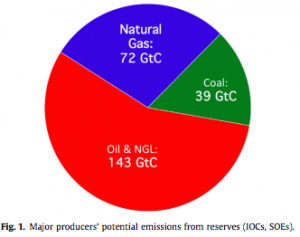
A new study is raising doubts about future development of new fossil fuel resources. Published in Global Environmental Change and authored by Richard Heede and Naomi Oreskes, the report looks closely at the potential of global warming emissions that could be unleashed from carbon reserves held by the globe’s largest fossil fuel producers.

Screen Shot 2015-11-30 at 12.04.41 PMSome key findings of the study include:

  • Burning the reserves of the world’s largest fossil fuel producers will result in emissions of 440 gigatons of carbon—far in excess of the 275 gigatons of carbon scientists say can be emitted this century if global mean temperature increases are to stay at or below 2 degrees Celsius.
  • The future emissions from the proven reserves of the largest 28 state-owned entities, including the National Iranian Oil Company, Saudi Aramco and Russia’s Gazprom, collectively make up more than three quarters (76 percent) of the world’s remaining carbon budget.
  • The future emissions from the proven reserves of the largest 42 investor-owned companies collectively make up 16 percent of the world’s remaining carbon budget.

Funded in part by the Union of Concerned Scientists (UCS) also found that “profound risk” to the climate exists from the prospect of development of these reserves.

“This study shows just how important it is that the world reaches a strong international climate agreement in Paris next month,” said Alden Meyer, the director of strategy and policy at UCS who has been involved in the climate negotiations for 25 years. “The fact is, Russia, Iran, Saudi Arabia and other oil producing counties are continuing to ramp up production, despite the threat climate change poses to communities around the world.”

The study shows the reserves of most of the 42 investor-owned companies will be exhausted in 15 years or less. But oil and gas companies are investing hundreds of billions of dollars to explore for and develop new reserves to extend production in the decades to come. Heede says the threat of exceeding the 2 degree Celsius target comes primarily from the investor-owned companies tapping new reserves and he states the study’s findings can help inform shareholder action.

“The threat of exceeding the 2 degree Celsius target comes primarily from the investor-owned companies tapping new reserves, less so from their relatively small existing reserves,” said Heede, the principal of Climate Mitigation Services.

Oreskes, a Harvard history of science professor and former exploration geologist, added, “The bottom line is that if we’re to have any hope of avoiding a 2 degree temperature increase, the largest state-owned companies cannot fully tap all of their proven reserves and the big investor-owned companies need to decrease rapidly, and ultimately eliminate, their capital expenditures for exploration and development of new reserves.”

bioenergy, Carbon, Oil, Research