Lawmakers Frustrated with E15 Hold Up

Cindy Zimmerman

Harmon Wilts and Doug Schliep meet with Rep. Michelle Fischbach

American Coalition for Ethanol members meeting on Capitol Hill with lawmakers this week found them to be just as frustrated as the ethanol industry about getting E15 legislation in Congress.

“We visited about seven different House Representatives and Senators, and the main theme is they’re frustrated too,” said Harmon Wilts with Chippewa Valley Ethanol Company (CVEC) in Minnesota. “Two different times it was in the legislation, it should have been passed, and it was pulled at the last minute by just a handful of folks that were able to do that. A lot of it centers around the SREs, the RVOs, and the small refineries. So I think that’s kind of been the biggest thing. But most folks are like, hey, this is fairly simple.”

Ben Rhodes, Zac Griess and Scott McPheeters meet with Rep. Eric Sorensen

Scott McPheeters with KAAPA Ethanol in Nebraska heard the same thing during his visits with ethanol-friendly legislators. “I think they’re pretty frustrated that the E15 thing has been so long and there’s actually really nothing negative about it. It doesn’t cost the government anything. It saves consumers money. It puts money in farmers pockets,” said McPheeters. “But it’s also hard because some of our lawmakers have gotten battle fatigue, you might call it, where they have said, we’ve been at this so long and we just need to move on and we can’t move on… It’s just what we need.”

While the chances of getting any E15 legislation this year seem to be dwindling, Reuters reports today that the Trump administration is contemplating a temporary suspension of the federal restrictions requiring summer-blend gasoline, which would lower prices at the pump while also allowing continued sales of E15 in the summer months.

Listen to interviews with Wilts and McPheeters below:
Harmon Wilts, CVEC (9:49)
Scott McPheeters, KAAPA Ethanol (7:00)

2026 ACE Fly-in Photo Album

ACE, Audio, E15, Ethanol, Ethanol News

Strong Start for 2026 Ethanol and DDGS Exports

Cindy Zimmerman

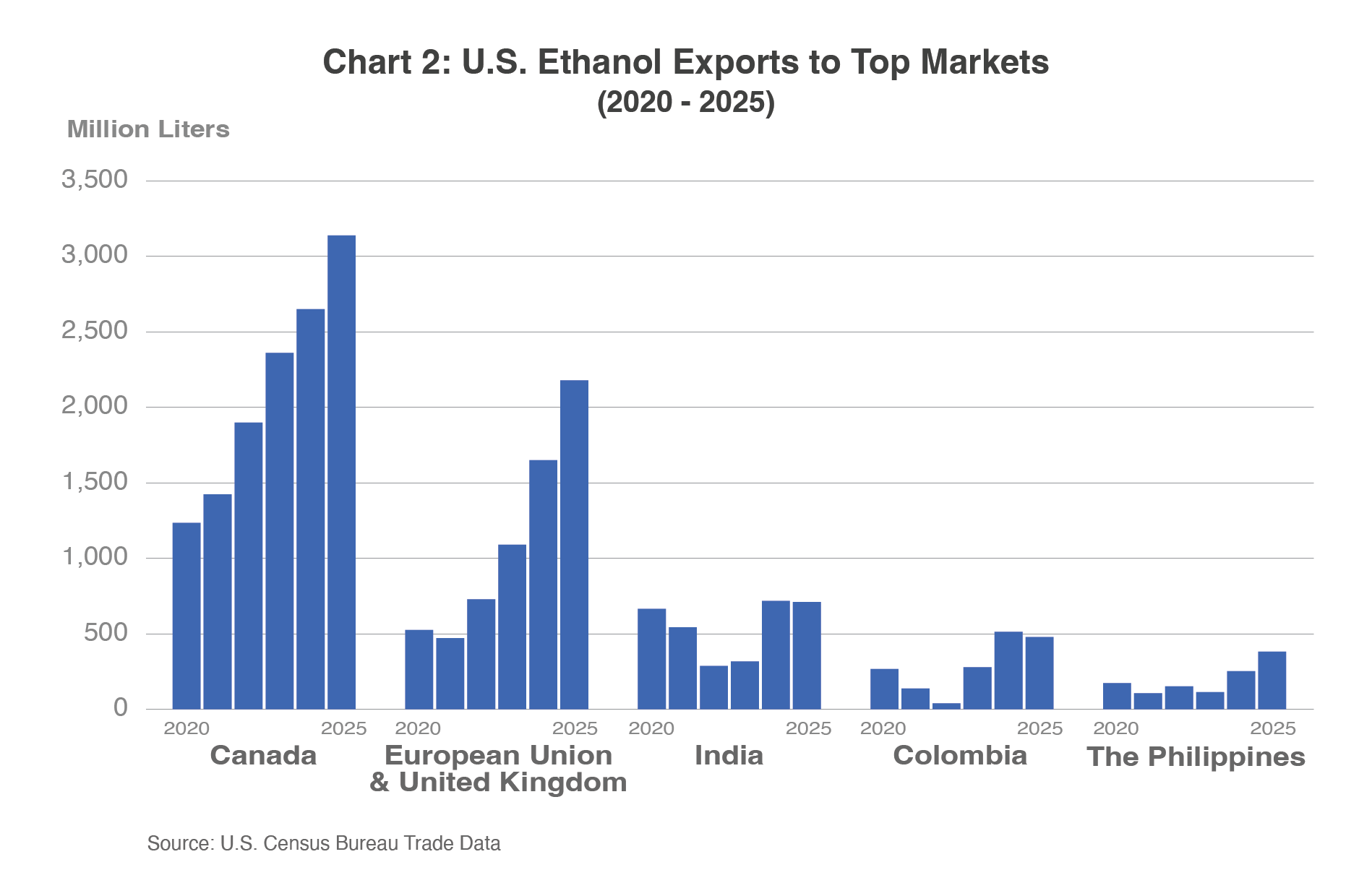
U.S. ethanol exports kicked off 2026 at 212.1 million gallons (mg), according to the latest Renewable Fuels Association Trade Monitor for January 2026. Despite slipping 4% from December, it is 8 percent more than January 2025.

Canada retained its position as the top destination with a 5% increase to 70.0 mg, with denatured fuel ethanol accounting for 90% of the total and representing two-thirds of all denatured fuel ethanol exports in January. Brazil tripled its imports of U.S. ethanol to 36.4 mg, marking the largest monthly purchase in nearly six years. Exports to the European Union declined 18% to a six-month low of 35.1 mg, with the Netherlands serving as the primary recipient. Exports to India decreased 19% to 12.2 mg, while Colombia jumped 25% to 12.1 mg and the Philippines scaled back 29% to 11.4 mg. Direct shipments to the United Kingdom rose 6% to 8.0 mg. Other key markets included South Korea (7.0 mg, -20%), Vietnam (4.9 mg, up from zero for a 14-month high), and Mexico (4.1 mg, -35%).

In addition U.S. exports of dried distillers grains (DDGS) jumped 13% in January to a three-month high of 1.01 million metric tons (mt) amid large swings among major markets. Mexico remained the largest destination with 226,324 mt, up 38% to a 10-month high. South Korea increased 9% to 120,911 mt. Colombia quadrupled to a record high of 104,959 mt. Indonesia decreased 19% to 91,660 mt, while Vietnam declined 12% to an 11-month low of 71,166 mt.

Distillers Grains, Ethanol, Ethanol News, Exports, Renewable Fuels Association, RFA

Verity and CIBO Partner to Help Biofuel Producers With 45Z

Cindy Zimmerman

Gevo subsidiary Verity Holdings and CIBO Technologies, a leading data and analytics platform for agriculture, have announced a strategic partnership to deliver an end-to-end data and verification solution connecting farm-level practices to fuel production. The collaboration is designed to enable biofuel producers to generate verified carbon intensity (“CI”) scores and audit-ready documentation that is required to capture value under Section 45Z, known as the Clean Fuel Production Credit.

As clean fuel markets evolve, biofuel producers must increasingly demonstrate traceable, auditable connections from feedstock sourcing through fuel production to be able to utilize credits such as the 45Z tax credit. Because of the value of the 45Z credit scales with verified reductions in CI, producers need systems capable of linking real-world agricultural practices with fuel production data and regulatory reporting.

Biofuels typically participate in multiple markets and credit programs, each with different compliance and reporting requirements. These include the Section 45Z credit, Canada’s Clean Fuel Regulations, California and other state Low Carbon Fuel Standards, and emerging voluntary carbon market registries.

Together, Verity and CIBO aim to help the renewable fuel production supply chain (including ethanol producers, grain elevators, processors, and farmers) collect and convert verified farm-level and operational data into traceable environmental attributes that support participation in these markets.

aviation biofuels, Ethanol, Ethanol News, SAF

RFA Report on Who’s Talking About E15

Cindy Zimmerman

Everyone is talking about E15 and yet there is still no bill to show for it.

The Renewable Fuels Association just released a comprehensive report on “What They’re Saying” about E15, featuring dozens of statements from members of Congress, President Trump, administration officials, Governors, and industry leaders on the urgent need to pass year-round E15 legislation immediately.

“As this report shows, there is broad bipartisan support—and growing urgency—for legislation that would finally allow year-round, nationwide sales of lower-cost E15,” said RFA President and CEO Geoff Cooper. “There is widespread agreement that the time to act on E15 legislation is right now. This can’t wait any longer. For the sake of America’s farmers and consumers facing higher prices at the pump, Congress must act immediately to allow unfettered access to E15. As gas prices continue to rise and as farmers are facing the worst economic crisis in nearly 50 years, we are again urging Congress to act as quickly as possible. Opening the marketplace to E15 would reduce pump prices, while providing a badly needed demand boost for our nation’s farmers.”

On January 27 in Iowa, President Trump called on leaders in the House and Senate to adopt legislation allowing year-round, nationwide E15 as quickly as possible. “I will sign it without delay,” he said. Nearly two months later, no legislation has been forthcoming from the Congressional council assigned to the task.

Still, members of Congress continue to talk about the need. At a Senate Agriculture Hearing last week, E15 was a constant refrain coming from witnesses and Senators. The National Corn Growers Association even made a reel highlighting the comments.

E15, Ethanol, Ethanol News, NCGA, Renewable Fuels Association, RFA, Video

Clean Fuels Celebrates Biodiesel Day Urging Final RFS

Cindy Zimmerman

Clean Fuels Alliance America is celebrating National Biodiesel Day today and looking ahead to new opportunities for growth.

“Biodiesel helped chart the course for today’s clean fuels market in heavy-duty transportation and opened the doors to applications in rail, marine, Bioheat® fuel and aviation,” said Clean Fuels CEO Donnell Rehagen. “We have built that progress on a proud legacy of clean, homegrown fuel led by our nation’s soybean farms.”

National Biodiesel Day commemorates the birthday of Rudolf Diesel, who invented the diesel engine and predicted the importance of biodiesel more than a century ago. “The use of vegetable oils for engine fuels may seem insignificant today, but such oils may become, in the course of time, as important as petroleum and the coal tar products of the present time,” he said in a speech in 1912.

This week, Clean Fuels joined five other trade associations in a letter to President Trump urging him to unleash U.S. biodiesel and renewable diesel production to bolster America’s energy security during the conflict with Iran.

The disruption in the global oil market is constraining diesel fuel supplies, which threatens to raise the cost of all U.S. consumer goods and further harm the U.S. agriculture sector as farmers start this season’s planting. Immediately finalizing the 2026 and 2027 Renewable Fuel Standards would encourage the U.S. clean fuel industry to quickly ramp up enough production capacity to meet 3% of the nation’s demand for diesel, the groups write.

The letter to President Trump is signed by Clean Fuels Alliance America, the American Soybean Association, National Energy & Fuels Institute (NEFI), National Oilseed Processors Association (NOPA), North American Renderers Association (NARA), and U.S. Canola Association, representing the full biomass-based diesel value chain – farmers, feedstock providers, clean fuel producers, and customers.

“The biodiesel, renewable diesel and SAF industry is ready to meet the challenge of providing crucial supplies of diesel fuel free from overseas threats,” the groups write. “The RFS rule should be finalized as quickly as possible. Continued delays in finalizing and publishing the RFS rule would extend market uncertainty for farmers and stakeholders across our value chain as well as exacerbate the recent spike in diesel fuel prices.”

Biodiesel, canola, Clean Fuels Alliance, renewable diesel, RFS, Soybeans

ACE 2026 DC Fly-In Marks 15 Years

Cindy Zimmerman

ACE members meet with Senate Ag Chair John Boozman Tuesday

The American Coalition for Ethanol (ACE) is marking 15 years of grassroots ethanol advocacy on Capitol Hill this week at its 2026 DC Fly-In. Since launching the first event in 2009, more than 300 individuals from over 30 states have participated in ACE Fly-Ins, bringing firsthand perspectives from rural America to the policymakers and regulators responsible for shaping the nation’s biofuel policies.

ACE members spent Tuesday afternoon meeting with members of Congress and their staff, and Wednesday will hear from Aaron Szabo, Assistant Administrator for EPA’s Office of Air and Radiation, and Kate Zook, Acting Administrator of USDA’s Office of Energy & Environmental Policy. Key priorities are securing permanent, year-round market access for E15, advocating for strong Renewable Fuel Standard (RFS) blending targets, and ensuring swift and clear guidance on the 45Z Clean Fuel Production Tax Credit—including clarity on how ethanol producers can benefit from low-carbon farming practices.

“This fly-in is impactful,” said Troy Knecht, ACE President. “It took us a few years to educate people. We had to come out and educate. And every office you go to now, they know our issue. They know why we’re there….ACE has impacted really the way these congressional offices look at our product, our end product, ethanol,” Knecht said.

Knecht, a South Dakota farmer representing Redfield Energy, has been involved with ACE for over a decade. “Since I’ve been on this board, we’ve talked about E15 and it’s constant and we were close and now we aren’t as close, but I think there are some things in motion that would lead me to believe that maybe in the next year or two here we can get the job done.”

Listen to an interview with Knecht here and find other interviews in the ACE Fly-in virtual newsroom.
Troy Knecht, Redfield Energy (4:33)

2026 ACE Fly-in Photo Album

ACE, Audio, E15, Ethanol

ACE DC Fly-in Brings Ethanol Voices to Capitol Hill

Cindy Zimmerman

Despite blizzards, wildfires and a tornado watch that threatened travel, a determined delegation from the American Coalition for Ethanol (ACE) is on Capitol Hill today for the group’s annual DC Fly-In and Government Affairs Summit, ready to conduct roughly 100 meetings with lawmakers and staff.

ACE VP of Government Affairs Katie Muckenhirn says they did have several people who were unable to attend due to travel issues, but the ones who did make it were able to get to all of the scheduled meetings. “The group was eager to get out there because we have some high-priority issues to hit,” she said. “It’s prime time to get some of these issues over the finish line.”

The top issue of course is year-round E15 sales and members are sporting and handing out “E15 Now” buttons today while pressing Congress for a legislative fix to allow E15 access year-round.

The delegation is also closely watching implementation of the 45Z clean-fuel production credit. Treasury recently released its rules, and ACE attendees will hear directly from USDA on its renewable-fuel calculator and from EPA’s Aaron Szabo on pending RFS updates. The White House may announce updates next week at an event reportedly expected to include farmers and biofuel interests and coinciding with National Ag Day celebrations.

Muckenhirn said the timing could not be better for unlocking new ethanol markets and growing demand. “We’ve got a great group out here and we’re excited to keep pushing our ethanol priorities,” she added.

Katie Muckenhirn - Fly-in kick off (3:12)

2026 ACE Fly-in Photo Album

ACE, Audio, E15, Ethanol

Industry Looking for 45Z Answers

Cindy Zimmerman

With planting season coming soon in many parts of the country, farmers and ethanol producers are looking for clear answers to take full advantage of the 45Z clean fuel production tax credit.

Republican lawmakers sent a letter this week to the Secretaries of Treasury Scott Bessent, Energy Chris Wright, and Agriculture Brooke Rollins urging final rules that recognize on-farm conservation practices like no-till, cover crops, and optimized fertilizer use, providing flexibility without bundling or excessive bureaucracy. The lawmakers, led by Sen. Joni Ernst (R-IA) and Rep. Mariannette Miller Meeks (R-IA), call for swift integration of the 45ZCF FD-CIC calculator into the GREET model, distinct emission pathways for manure-derived RNG, and a “Book and Claim” framework to broaden farmer participation. Emphasizing urgency ahead of planting season, they seek clarity to boost markets for U.S. producers and reward agricultural innovation under the extended credit through 2029.

The tax credit was the topic of a panel at the recent National Ethanol Conference, moderated by Renewable Fuels Association Policy Counsel and Director, Government Affairs, Jared Mullendore.

With tax filing season coming up, Mullendore says we have to accept the lack of final guidance that answers every possible question that could come up. “Because you’re going to operate with a certain degree of uncertainty in the first few years of a tax credit…You know, we’re going to have to embrace that uncertainty.”

Joining Mullendore on the panel were Rebecca Johnson, Christianson PLLP; Faith Larson, Mickelson & Company; and Marc Nickel with Aon, a British-American professional services firm that offers risk-mitigation products and consulting. Nickel says the proposed rulemaking released by Treasury on February 4 was very helpful. “We’re in a way better place than we were a month ago. We just got some very excellent proposed regs, which cleared up a lot of the issues,” said Nickel. “And those two really biggest issues were, were sales going to be deemed qualified if they were going to blenders, which most ethanol sales do. Very big issue for this industry. And whether the modeling of carbon intensity was also going to be respected. The proposed regs definitively cleared up the qualified sale issue, and now it is off to the races with that. And it gave us some very, very good directional guidance on carbon intensity.”

Listen to interviews with Mullendore and Nickel, as well as the full panel below to learn more about the status of 45Z going into tax time and planting season.

NEC26 interview - Jared Mullendore, RFA Policy Counsel (3:48)

NEC26 interview - Marc Nickel, Aon (3:50)

NEC26 45Z Panel (59:15)

Audio, aviation biofuels, biofuels, Carbon, carbon capture, corn, Ethanol, Ethanol News, Farming, National Ethanol Conference, Renewable Fuels Association, RFA

AI and the Ethanol Industry at NEC

Cindy Zimmerman

At the recent National Ethanol Conference, Cornell University Professor Sarah Kreps, an expert in AI, national security, and geopolitics, addressed how artificial intelligence intersects with energy security and global competition.

While admitting she’s “not an ethanol insider,” Kreps drew from her upbringing in Lancaster County, Pennsylvania to connect AI’s challenges to the ethanol sector.

Kreps emphasized that AI’s rapid growth is bottlenecked by energy infrastructure and politics, positioning the ethanol industry within a “much bigger and very complex system of energy security, industrial policy, and infrastructure.” She compared ethanol production’s need for proximity to corn supplies with AI’s reliance on critical materials and minerals for compute power. “You can’t sustain this large-scale compute without the supply chains,” she noted, underscoring parallels in geographic and resource dependencies.

Discussing AI adoption, Kreps shared insights from conversations with attendees. “AI in your industry seems to be a lot of like individual use, but it’s not universal. And there’s a kind of lag effect within certain parts of the industry.” She notes this mirrors broader AI trends where geographic advantages determine deployment speed.

Kreps predicted AI’s electricity demand will surge, becoming a “material factor” in power systems, potentially doubling or tripling in key regions by the early 2030s. This shift could elevate ethanol’s role in sustainable energy solutions, especially amid data center expansions straining grids.

“Your industry is very well placed to be doing what it’s doing and trying to kind of leverage the opportunities and hedge against the risk,” said Kreps, as she urged ethanol stakeholders to view AI not just as a tool, but as a catalyst for navigating energy geopolitics and innovation.

NEC26 AI, Energy Security (37:04)

AI, Audio, Ethanol, Ethanol News, National Ethanol Conference, Renewable Fuels Association, RFA

Hearing Highlights E15 to Boost Demand for Farm Products

Cindy Zimmerman

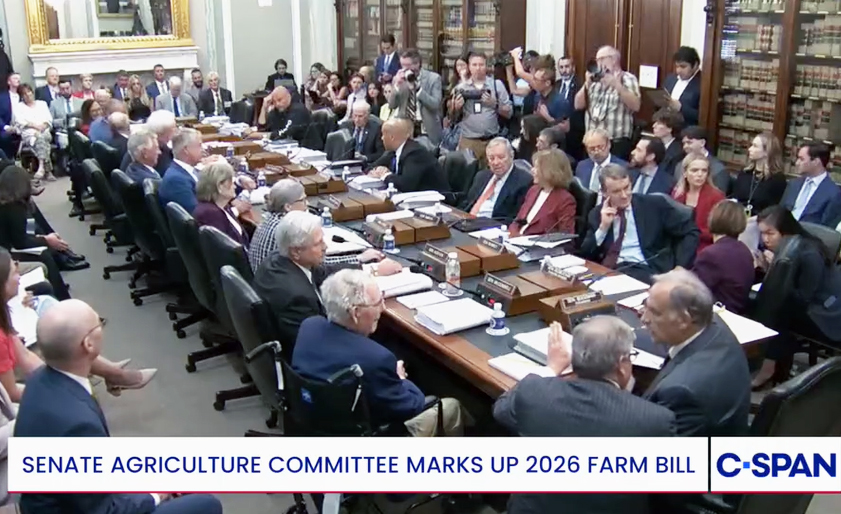
The Senate Committee on Agriculture, Nutrition, and Forestry on Tuesday held the first in a series of hearings to gather recommendations from agriculture industry leaders on policy improvements to help boost consumption of American-grown agricultural products, and year-round E15 was highlighted from start to finish by both lawmakers and witnesses.

Ranking Member Senator Amy Klobuchar (D-MN) drove the point home in her opening remarks, pushing to have E15 included in the Senate version of a farm bill. “There is bi-partisan support for this…we need to get it done. A bipartisan farm bill seems to me a vehicle where we can get it done but there may be others as well,” said Klobuchar. “It’s an obvious solution to what we are facing now, which is higher gas prices, which we weren’t facing a few months ago.”

National Corn Growers Association President Jed Bower zeroed in on expanding consumer access to fuels with 15% ethanol blends in his opening remarks. “Year-round access to E15 is critical,” Bower told the committee. “Aside from the economic boost it would provide to farmers, year-round E15 would lead to significant savings for American consumers and strengthen U.S. energy dominance at a time when geopolitics are increasingly complicating markets and supply chains.”

Bower says putting the E15 issue to rest at last would definitely help farmers who have been suffering for four years. “For every one percent we increase that blend wall, that’s 490 million bushels of grind,” said Bower. “We’re looking at maybe 35 cents a bushel…any relief right now is tremendous for growers.”

Sen. Chuck Grassley (R-IA) used the hearing to vent his frustrations over getting nationwide, year-round E15 legislation done. “One of the frustrations I have is dealing with these refineries and the RINS, that are holding up getting E15 by legislation,” said Grassley. “There’s some good talk that we’re getting close but we were there in February until some refineries wanted to get their hand in the cookie jar.” He noted that even if the House does manage to pass a stand alone bill for E15, it will have to be attached to some other legislation in the Senate.

Listen to some of the hearing below:
Senate Ag Hearing comments Klobuchar and Bower (12:03)

Senate Ag Hearing comments Grassley (5:24)

Audio, E15, Ethanol, Ethanol News