
Check out this January 11 post on the EV World blog – Bio-Energy Economy Picking Up Steam. This blog, from what I can tell, mainly focuses on electric vehicles and hybrids but recent developments in the biofuels department really caught the blogger’s attention. He writes: My read is that the idea of a biomass economy is beginning to catch on not only in Colorado and California and New York, where Governor Pataki just announced his own initiative to spur biofuel production and sales, but globally. Where millions of dollars in public funds continue to be poured into hydrogen research, the real investment dollars are going into biofuel production from ethanol plants here in Nebraska (where we already have two cellulosic ethanol projects in the works) to palm oil plantations in Asia. He even posts a map from the National Ethanol Vehicle Coalition showing E85 fueling stations.
The author of EVWorld is Bill Moore of Papillion, NE.

Airing Both Sides
 Wilson College in Chambersburg, PA is hosting an ethanol forum January 30 to “address concerns on both sides of the ethanol debate.” The college, located in south-central Pennsylvania, is billing the event as an educational forum being co-sponsored by Citizens for a Quality Environment and Penn-Mar Ethanol LLC.
In this corner …. representing the ethanol industry …. Dr. David Morris, vice president of the Institute for Local Self-Reliance in Minneapolis, will discuss the benefits that ethanol can provide as an alternative fuel. I have never heard of him or this organization, so I don’t really know – but because of that I would think there might be others better qualified to talk on the benefits of ethanol.
The opposing view will be presented by Dr. Tadeusz Patzek from the University of California, Berkeley – best known for his ethanol-bashing, oil-industry sponsored, short-on-facts report that got some media traction last summer.
From what I can gather from other stories on the web, the Citizens for a Quality Environment group says ethanol plants are bad for the environment and has been actively opposing Penn-Mar’s plans for developing ethanol plants in the area (Pennsylvania and Maryland). Basically, we’re talking about environmental wackos here. I have no patience for people like that who just like to oppose stuff and offer no alternatives. I really don’t understand why any “environmental” group can oppose efforts to develop renewable fuel sources here in the United States that would lessen our dependence on petroleum. Makes absolutely no sense to me.
Here is a link to the press release from the college with all the details.
Investing in the Future
Biodiesel and ethanol plants are getting lots of interest from investors, especially in the midwest.
According to an article in yesterday’s Des Moines Register, organizers of a biodiesel plant in Newton, IA raised $7 million in two days last week, with at least one investor driving over 200 miles across the state to put in his $25,000. According to the article, another group of organizers recently raised $20 million in a little more than a week to build a 30 million-gallon-a-year biodiesel plant in Wall Lake, IA.
Is the industry growing too big too fast? One person quoted in the article thinks so. Leland Tong of MARC-IV Consulting, which tracks the biodiesel market, warns against thinking of the industry as “the next big cash cow.”
But, Iowa State University economist Roger Ginder, a specialist in agribusiness management, disagrees – saying there is sufficient demand for biodiesel fuel and sufficient feedstocks like soybeans and animal fats to support the industry’s growth.
Good article by veteran agricultural journalist Jerry Perkins.
Fuel of the Future
 This is an interesting story from the Land Down Under I found today while Googling around.
Take a bunch of old buggers, a 1925 Austin ragtop, a thousand litres of pure ethanol and what have you got? Queensland’s only entry in the 2005 Panasonic World Solar Challenge! This event, which has been running every two years since 1987, now attracts teams from all over Australia and around the world. It runs in late September, from Darwin to Adelaide, over about six days.
Team Ethanol, from Mackay, was entered in the Greenfleet Class, a recent innovation to showcase alternative fuel solutions, other than solar. It was one of 11 teams, which included electric, hybrid, bio-diesel, smart petrol and smart diesel cars and was the only ethanol powered entrant.
It’s a long story and worth reading – so here is the link to the whole thing.
The picture is the 1925 Austin ragtop from the story. Kinda reminds you of the Model T Ford – which Henry Ford originally built to run on what he called the “fuel of the future” … ethanol. I guess the future is finally here!
Check out Wikipedia’s entry about Ford and the Model T – some very interesting stuff there. For instance – in 1913, Ford attempted to enter a reworked Model T in the Indianapolis 500, but was told rules required the addition of another 1,000 pounds (450 kg) to the car before it could qualify. Ford dropped out of the race, and soon thereafter dropped out of racing permanently, citing dissatisfaction with the sport’s rules and the demands on his time by the now-booming production of the Model Ts.
Interestingly, this year all cars in the Indy 500 will run on 10 percent ethanol for the first time – and switch to 100 percent next year! And … there is a Team Ethanol car in the IRL, sponsored by our friends at EPIC. Last year was the first year the car was in the race – and you can expect to hear much more about it this year!
Show-Me the Ethanol
 The Governor of Missouri is calling for a 10 percent ethanol mandate in the Show-Me state. Encouraging the use of domestic fuels is one of Gov. Matt Blunt’s priorities outlined in his state of the state address this week.
“Through the ethanol and bio-diesel incentive programs we are encouraging a vital expansion of the economy by producing renewable fuels and reducing America’s and Missouri’s dependence on the Middle East while providing ready markets for the farmers of the Midwest. My budget calls for full funding of Missouri’s bio-diesel and ethanol incentive funds.
I also call upon this General Assembly to pass an “Energy and Green Power Initiative,” to reach beyond full funding for bio-diesel and ethanol incentives. I ask that we give Missouri’s heartland economy a major and lasting boost by requiring that motor fuel sold in Missouri for passenger cars and trucks contain 10 percent ethanol.
This standard will spur even greater economic development in rural Missouri. For all of us, it will provide cleaner air, lower prices and greater independence from Middle East oil supplies. Please stand with me against special interests and for our farmers, consumers, the environment and new energy supplies made right here in Missouri.”
The picture is of Gov. Blunt at the grand-opening ceremony for Mid-Missouri Energy in June 2005.
WICHITA RESIDENTS EMBRACE ETHANOL

 The Ethanol Promotion and Information Council – or EPIC – is pleased with the success of it’s ethanol awareness campaign conducted last fall in Wichita, KS. (see previous post) EPIC Executive Director Tom Sluneka calls the results of the campaign “outstanding.” “Our partner in Wichita-Hutchinson market was Kwik Shop, and their stores branded ethanol with our E-logo. At that point in time they saw a 42.8 percent increase of sales to branded ethanol over regular fuel. This is a dramatic increase and our partners there were very excited to see those types of results at their stores.” Conversely, ethanol-enriched fuel sales at Kansas Kwik Shops located outside the promotion area accounted for just 22 percent of the total during the same period. This marks nearly a 100 percent increase in ethanol sales between the two sets of stores. Prior to the EPIC promotion efforts, sales of ethanol-enriched fuel inside and outside the promotion area were nearly identical. (full release)
One of the ways EPIC promoted ethanol at the Kwik Shops was to give away their E-logo magnets to motorists who filled up with an ethanol-blend – as you can see in the picture.
KENTUCKY LOVES ETHANOL

 February has been declared Ethanol Awareness Month in Hopkinsville and all of Christian County, KY. The mayor of Hopkinsville and the judge-executive of the county made that proclamation this week. According to a news release, as part of Ethanol Awareness Month, MaxFuel Express of Max Arnold & Sons, LLC, in partnership with the Commonwealth Agri-Energy, LLC, will donate a portion of the proceeds from the sales of ethanol-enriched gasoline to the Jennie Stuart Medical Center. Funds donated will be used to send five children to the American Lung Association of Kentucky asthma camp. “We know that offering consumers the option to use ethanol is the right thing to do because it helps reduce air pollution which helps everyone breathe easier,” says Phillip Russo, vice president of Max Arnold & Sons, LLC, based in Hopkinsville, Ky. Forty-four MaxFuel Express stores in the Christian county area sell one or more grades of gasoline with a 10 percent ethanol-enriched fuel.
Somebody’s Doing Something Right
 Here’s some good news out of Detroit on consumer awareness and acceptance of ethanol and flex-fuel vehicles. An on-line survey by research firm Phoenix Marketing International found that 60 percent are extremely or very familiar with the grain-based fuel. When presented with ethanol’s strengths and weaknesses, more than 90 percent of drivers said they would prefer a flex-fuel vehicle (running on both bio- and fossil-fuels) over a strictly gasoline or diesel version.
Consumers also seem to be getting the message about the benefits of ethanol, according to the survey. Consumers perceive renewable resource (42 percent), clean fuel (24 percent) and produced in America (19 percent) as the most important benefits of ethanol-powered vehicles.
Bill Saunders, president of Phoenix Automotive, says that ethanol could ultimately help increase sales for American auto manufacturers.
“Last year’s fuel price run-up and Middle East crises may have not only hurt American drivers’ pocketbooks but also caused them to feel guilty about operating large, gas-only vehicles,” said Saunders. “Ethanol power not only allows owners to enjoy large vehicles, but it can also let them feel good about the domestic agricultural economy, American energy independence and the environment.”
The survey also questioned which auto manufacturers were seen as extremely or very environmentally sensitive. Sixty percent or more put Honda and Toyota in that category, but 18 percent or less felt the same way about Ford, General Motors and DaimlerChrysler.
The study of more than 2,000 vehicle owners was conducted just last week on-line. Here is the link to the full release.
How Much Do You Think Gas Should Cost
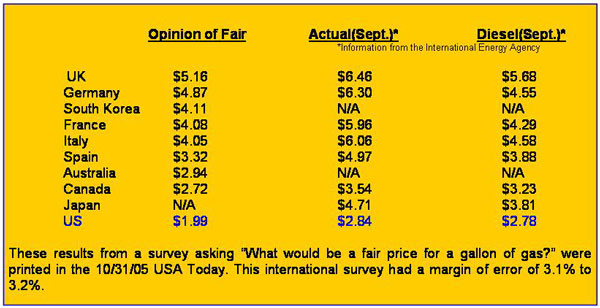
I had not seen this USA Today survey until yesterday when John Kleiboeker with the Missouri Soybean Association did a nice presentation on biodiesel production at the Missouri Ag Leaders luncheon in Jefferson City, MO. I thought the disparity between different countries on what people thought was a fair price for gas was fascinating. John also pointed out that the actual base price for gas was the same everywhere – the difference is all taxes!
Ethanol May Replace Citrus As Florida Cash Crop
 I have been a farm reporter all of my professional broadcasting career, half of that time in Florida and half in the midwest. For the past four years I have been reporting farm news for Florida FROM the Midwest – thanks to the magic of the internet and computers – on the Southeast Agnet radio network. One of the stories I did today was about a meeting that Florida Commissioner of Agriculture Charles Bronson will be holding Thursday afternoon on the state’s potential to create bio-fuels from farm crops. Part of the reason for the meeting is the fact that, in the wake of five major hurricanes hitting the citrus belt in the last two years, the state has decided it is no longer feasible to eradicate citrus canker. The disease is harmless to humans, but causes blemishes on fruit and production declines – which will likely lead to an end to the fresh citrus business in Florida. While most of Florida’s citrus is made into juice, there is a significant amount of fresh fruit grown – and there’s just no market for ugly citrus. SOOOO – there’s alot of talk now about converting those citrus groves into energy crops, and some domestic fuel companies are already jumping on the bandwagon (see previous post).
Here is a link to my Southeast Agnet report with Commissioner Bronson, and stay tuned for more about the industry developing in the Sunshine State.