 Making ethanol from wood could help prevent forest fires.
The Wisconsin State Journal did an interview with Chris Risbrudt, director of the U.S. Forest Products Laboratory in Madison, about that potential. Risbrudt says ethanol is a possible solution to thinning the smaller trees that lead to forest fires.
Q: So U.S. forests need to be thinned?
A: Yes. That’s one reason we spent $1.3 billion fighting forest fires (last) year in the Forest Service; because nature is trying to remove that biomass and get back to the amount it should have. If we thin it to prevent or reduce the impacts of wild fire, it costs us $1,000 per acre because we’re not making many products out of that stuff. We’re trying to figure out how to make products out of that so we can reduce the cost of thinning national forests down to zero.
Q: What products are you working on that would come from that surplus biomass?
A: Ethanol is the big one we’re working on right now. It’s got huge potential. But trees are made up of three major components: lignan, which is the glue, hemicellulose and cellulose. And they’re just sugar molecules strung together.
But (with) the way the tree puts them together, it’s very hard to take it back apart efficiently, so we’re working on that. In fact, the Department of Energy is also working on it, funding projects. They call it the recalcitrant cellulose problem. It just doesn’t want to break down back into sugar very easily.
Q: How close are you to a solution?
A: We’ve patented a strain of yeast called pichia stipitis and licensed it to a company called Xethanol Corp. and they’re building plants right now to make cellulosic ethanol.
Risbrudt says it’s not commerically profitable yet, but they are working on it.


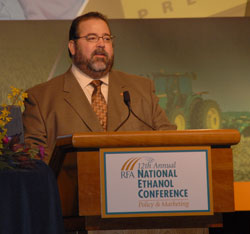 The Reverend of Renewable Fuels and the President/CEO of the Renewable Fuels Association, Bob Dinneen, gave his annual State of the Ethanol Industry speech this morning here at the National Ethanol Conference.
 Bob Dinneen State of the Industry Speech (25 min MP3)
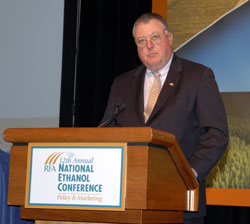 The opening general session is in progress here at the National Ethanol Conference. Welcoming everyone was Ron Miller, Chairman of the Renewable Fuels Association.
 Recently, a school district in Indiana had to start school late. Normally, that’s not news for Indiana in the wintertime. But the weather was not to blame this time. Officials with the Maconaquah School Corporation in Bunker Hill, IN say some of their buses would not start earlier this month because of a sludge that was clogging the fuel filters.
  “Microbial fungus problems will happen in ANY diesel fuel, especially with ultra-low sulfur diesel” Ge says. “Sulfur actually inhibits [the growth of microbial fungi].” Ge says it is usually the presence of water that really gets the “bugs” growing.
 Two ethanol plants backed by Sir Richard Branson’s
  Aventine will market all of the ethanol produced by Indiana Bio-Energy of Bluffton, Indiana and
 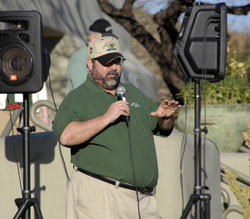 The National Ethanol Conference is underway in Tucson, AZ. Today is golf tournament day and RFA President and CEO, Bob Dinneen, welcomed everyone before they headed out on the course.
 In this edition of “Fill Up, Feel Good” we explore an explorer’s efforts to educate people about global climate change and how ethanol is helping.