

A University of Delaware researcher is looking at turning seashore mallow plants into biodiesel and ethanol.
 Dr. John Gallagher, professor of Marine Biosciences and co-director of the Halophyte Biotechnology Center at UD’s College of Marine and Earth Studies says the seeds from the plant has oil traits similar to soybeans and cottonseed. And, as this AP story in the DelMarVa Daily Times explains, it grows in an area inhospitable to most other biodiesel sources:
“You don’t have to divert land that is presently used for producing food and feed to the process of making biodiesel,” said Gallagher, who runs UD’s Halophyte Biotechnology Center with his wife and fellow researcher, Denise Seliskar.
With the threat of sea water encroaching on farmland and coastal aquifers in response to global warming, Gallagher believes the seashore mallow could help preserve the economic value of arable land transitioning to marsh land.
The leftover mallow seed meal make a good livestock feed, and the plant body can then be turned into cellulosic ethanol. Meanwhile, the roots are made into an industrial gum.
“It’s almost like the pig of the vegetable world; you can use everything but the squeal,” Gallagher said, noting that the roots are efficient at sequestering carbon pulled from the atmosphere, making the plant a “carbon-neutral” source of energy.
Funding the research can be an issue, and Gallagher says he’s looking for help from the federal government and private industry.

 You may have heard of a Tequila Sunrise – well, this is an Ethanol Sunrise.
 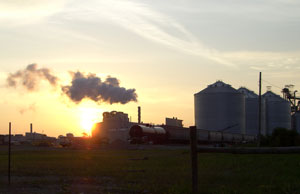 POET Biorefining – Laddonia was formed by East Central Ag Products, North East Missouri Grain and POET. POET Biorefining – Laddonia is proud to enhance the local economy with improved corn prices, value-added markets for farmers, good-paying jobs, and increased local tax revenue.
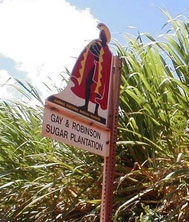 Gay & Robinson Inc. and Pacific West Energy LLC have formed a partnership to develop the first fuel ethanol plant in America to create renewable power and clean-burning ethanol fuel from sugarcane. The new 12-million-gallon-per-annum plant will use sugar juice and molasses as feedstock.
 The Minnesota Governor’s Ethanol Challenge is happening this week at four Wissota dirt tracks– July 10 in Alexandria, July 11 in Madison, July 12 in Willmar and July 13 in Montevideo.
 San Francisco-based Cleantech America, LLC says it will build a solar power farm possibly a square mile in size… making it seven times bigger than the world’s largest and 17 times bigger than anything else of its kind in America.
 Federal Agriculture Department officials are warning that the rising demand for biodiesel is pushing up the demand, and the price, for the feedstocks that go into biodiesel… and that is cutting into already thin margins biodiesel are working under.
 “As we look out over the coming year, we still think we’re going to have adequate supplies of soybeans, but the price for soybean meal and soybean oil is going up, and biodiesel, made from soybean oil has already been on a very thin margin over the past year.”
 Tonight’s Major League Baseball All-Star Game will be seen by millions of fans across the country… thanks, in part, to biodiesel. And it’s just the start for the green fuel’s part on America’s sports stage.
 Fox Sports will be powering all of its generators, satellite trucks, and other diesel equipment at its television compound in San Francisco with 20 percent biodiesel, B20.
  According to a
 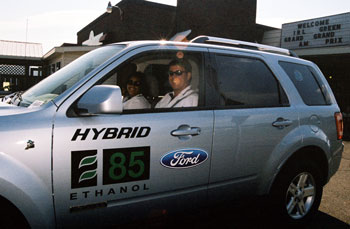 Hybrid and alternative fueled vehicles were in the spotlight July 6 at the