

 The Grain & Feed Association of Illinois (GFAI) is hosting two seminars to outline the impact ethanol is having on grain elevators.
According to the GFAI web site, the seminars will happen on August 13th at the Thelma Keller Convention Center in Effingham and August 14th at the Mendota Civic Center in Mendota:
University of Illinois professors Darrel Good and Bob Hauser will team up to provide the background information, analysis and possible implications of various corn production trends for a robust time of discussion.
Topics to be covered include:
• Examination of corn prices and food prices
• Impact on transportation and storage
• Long-run price projections and new price equilibrium
• Cropping patterns locally and internationally
• Implications of disruption in production
• Analysis of international trade
Registration begins at 1 p.m. on both days, and the seminar will last through the afternoon until about 5 p.m.
Check the GFAI web site for more information.
 United Kingdom-based ITM Power Ltd. has converted a Ford Focus that can run on gasoline or pure hydrogen.
 ITM Power’s CEO Jim Heathcote said: ‘Both these developments represent a seismic advance in our efforts to cut ourselves free from the dependence on oil and other fossil fuels. The bi-fuel car and refuelling system clearly demonstrate a simple, convenient and low-cost transportation solution that can significantly reduce greenhouse gases and help mitigate climate change. We believe combining electrolysers with an internal combustion-engined vehicle brings affordable hydrogen transportation forward by many years.’
 Oregon Governor Ted Kulongoski has signed into law two mandates for biofuel blending in his state.
  “We are delighted that private industry, and Blue Diamond in particular, is very active in searching for alternative sources of energy,” said Dr. Gerald Riskowski, professor and department head of the Department of Biological and Agricultural Engineering. “Texas A&M University wants to develop collaborative efforts to help utilize bioenergy for the benefit of society.”
 “We will be producing a product in accordance with international fuel standards, and this requires having the best minds and most efficient technology to achieve our goals,” said Blue Diamond Chief Executive Officer John Quincey Moaning. “We are delighted to have one of the country’s leading biofuels institutions as a partner.”
 New ideas have found support through venture capital firms such as Mohr Davidow Ventures in Menlo Park, Calif. MDV licensed the biodiesel technology of ISU professor Victor Lin and created Catalin, a company that will build its pilot plant at the university’s Biomass Energy Conversion Facility in Nevada.
 DuPont is dropping $58 million into a joint venture with British Petroleum (BP) and British Sugar to produce the biofuels, biobutanol and ethanol. Biobutanol is a renewable energy source similar to ethanol in that its is obtained by fermenting some of the same feedstocks, but biobutanol is closer to unleaded gasoline in energy content. It is also more compatible with existing pertoleum-based fuels pipeline systems.
 To celebrate independence from foreign oil on Independence Day, MFA Oil Company – which currently sells E85 at more than 40 locations in Arkansas, Iowa and Missouri – will be giving away a Ford F-150 FFV for the second year in a row.
  “Our goal is to help educate consumers so that E85 becomes their fuel of choice,” said Jerry Taylor, president of MFA Oil Company. “In doing so, we continue to demonstrate MFA Oil’s commitment to strengthening rural economies through support of the biofuel industry and by decreasing our dependence on foreign oil.”
  Roughly half of the cattle and hog operations in a 12-state region either fed ethanol co-products or considered feeding them to their livestock last year, according to a
  According to Dan Kerestes, chief of the USDA NASS Livestock Branch, USDA contacted some 94-hundred dairy cattle, cattle on feed, beef cattle and hog operations in 12 states. Kerestes says USDA didn’t have too many expectations going into the report – but he says the percentage of operations already feeding co-products was a surprise.
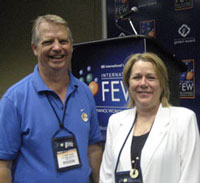 Great thing about going to meetings is getting to meet people you only know by email. I got to meet a couple of fellow bloggers at the Fuel Ethanol Workshop in St. Louis.
 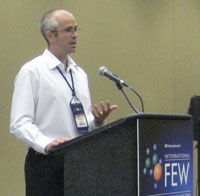 I also met Nathan Schock with
  Thanks to the