

 On May 25th, 2008, an F5 tornado ripped through the town of Parkersburg, Iowa… killing six people and practically wiping out the small town in Northeast Iowa. Now, with some help from biodiesel, the town is rebuilding.
This story from Biodiesel Magazine says the Iowa Renewable Fuels Association and the Ames, Iowa-based Renewable Energy Group Inc. have announced a $10,000 donation toward the purchase of biodiesel to aid the recovery effort. And that has turned into a statewide money-raising effort:
“The idea was to round the price of diesel up to $5 a gallon and ask people if they would like to donate just a gallon,” an REG representative told Biodiesel Magazine. “We have been overwhelmed by the participation in this fundraising activity.”
KCPS Radio in West Burlington, Iowa, donated $1,000 accumulated from listeners, and although the deadline for helping to purchase biodiesel has passed, persistence to help continues. “My sidekick and I raised the money from our listeners in just one week,” said Chip Giannettino, KCPS station owner and morning show host. “In fact, we’ll exceed $1,000 as donations are still drifting in.”
Western Dubuque Biodiesel in Farley, Iowa; and Central Iowa Energy in Newton, Iowa joined REG and the IRFA in making addiitonal $500 donations. GATX Rail and the Iowa Biodiesel Board were also noted donators among dozens of others.
 Due to the current market volatility,
 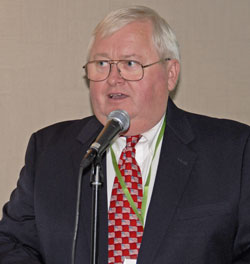 To wrap things up here at the Farm Foundation Transition To A Bio Economy conference I spoke with board member, Cornelius Gallagher. He says the conference brought together world class leaders who were able to listen to some fantastic presentations. I’ve posted interviews with almost all of them so please scroll back through them.
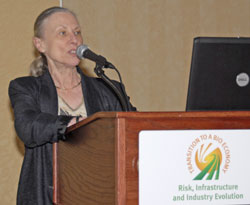 What we know and what we need to know was Peggy Caswell’s, USDA-ERS, topic here at the Farm Foundation Transition To A Bio Economy conference. She says we need to know things about how farmers or the providers of biofuels and feed stocks are going to have to change the way they do business. She used the example of having to look at different types of contracts and financing.
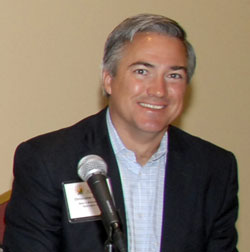 The issue of investment and financing for ethanol plants and bio refineries in general was addressed today by Chris Groobey, Baker & McKenzie, LLP. He works on project financing with investors and lenders and mostly in renewable fuels. He painted a pretty bleak picture.
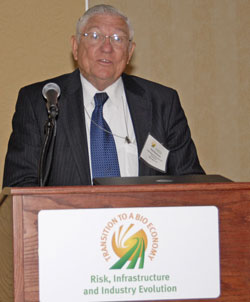 Our USDA Under Secretary for Research, Education and Economics is Gale Buchanan. He was here at the Transition To A Bio Economy conference to talk about the need for research in a growing bio economy. In fact, he sees a need for a tremendous amount of research to address the opportunities presented by the whole energy picture.
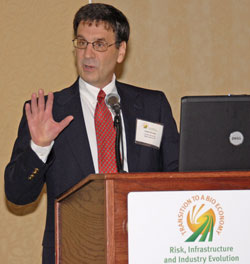 When it comes to infrastructure needs for a bio economy our rural road system is a key component. To speak about it here at the Transition To A Bio Economy conference we heard from Frank Dooley, Purdue University. He sees a big increase in grain production, primarily in the midwest. With that comes a growing demand for transportation. He thinks we should be concerned because most of the corn will be moved by truck and that’s going to impact rural roads. He also sees an increase in rail transportation but not significantly.
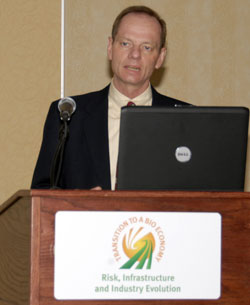 During our discussion on the infrastructure needs of a Transition To A Bio Economy, we heard from Paul Hammes, Union Pacific Railroad. Of course his focus was on rail infrastructure and as it relates to biofuels. Specifically, he spoke to the different pieces of that supply chain like rail cars, the rail network and unload/load capacity.
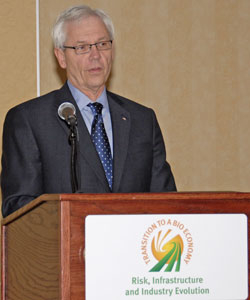 The opening speaker for day two of Farm Foundation’s Transition To A Bio Economy conference is our USDA Under Secretary for Rural Development, Thomas Dorr. He talked about rural policy and we visited for a while before the session got started.