ICM Designs Cassava Ethanol Plant in Mozambique

Cindy Zimmerman

Ethanol plant design company ICM, Inc. of Colwich, Kansas has designed and constructed equipment for a “one gallon per minute ethanol plant” currently under construction in Mozambique that will use locally grown cassava as a feedstock.

cleanstarThe project is part of CleanStar Mozambique, a company founded by Novozymes and CleanStar Ventures to protect forests, produce food, deliver energy, reduce air pollution and enrich lives. The vision of CleanStar Mozambique is to implement sustainable farming practices for smallholder farmers, and to integrate a food and energy production facility that will result in improved health and economic benefits for the people of Mozambique.

ICM“We’re thrilled to collaborate with Novozymes and CleanStar Ventures in this project,” said Dave Vander Griend, president and CEO of ICM. “Our employees put a tremendous amount of thought into the design in order to determine what equipment will work best for a location that has limited capabilities for overnight delivery. We are very proud to support CleanStar Mozambique in reducing exposure to breathing charcoal smoke through enhanced cooking practices, and improving the health and livelihood for millions of people living in the developing world.”

ICM’s Manufacturing division produced the shop-fabricated and specialty equipment components for the ethanol plant, which is designed to convert 18 pounds of locally grown cassava chips into a gallon of 185+ proof ethanol. Company officials say the reason the plant capacity is given in a “one gallon per minute” figure instead of the customary annual production number is that unlike plants in the United States, the Mozambicans do not have the ability to run the ethanol plant continuously, so the plant was specifically designed with the capability to start up in the morning, cease in the evening, and start up again the next morning. ICM has sized the cassava milling and cook process to operate 10-12 hours a day, and the small plant will include three fermenters and a beer-well. The distillation is sized to operate continuously, but the plant can begin and cease operations as needed.

ICM is providing a graphic control panel that contains the essential basics for motor control and flow control and during the start-up phase, ICM personnel will train the new plant operators in Mozambique.

Energy, Ethanol, Ethanol News, International

USDA Predicts Smaller Corn Crop But Larger Inventory

Cindy Zimmerman

USDAThe U.S. Department of Agriculture has shaved another 64 million bushels off projections for this year’s corn crop, but added 208 million bushels to beginning corn stocks for 2011/12.

Corn production is now forecast at 12.4 billion bushels, down 1 percent from the September forecast and down slightly from the 2010 production estimate, but still expected to be the fourth largest production total on record. Yields are expected to average 148.1 bushels per acre, the same as expected last month, which would be the lowest average yield since 2005.

Beginning stocks for 2011/12 are raised 208 million bushels from the previous projection based on the September 1 stocks estimate. USDA projected U.S. corn stockpiles at the end of the 2011-12 marketing year Aug. 31 at 866 million bushels, up 29 percent from a previous forecast but still the lowest since 1996. Corn supplies for 2011/12 are forecast 144 million bushels
higher.

The estimate of corn use for ethanol and by-products remained the same in the WASDE report at 5 billion bushels.

corn, Ethanol, Ethanol News, USDA

Coalition for E85 Urges Retention of Ethanol Tax Credit

Cindy Zimmerman

A coalition of retailers, producers, equipment manufacturers have formed the Coalition for E85 with the stated purpose of protecting consumer access to 85% ethanol blends.
According to the coalition, if the current tax credit for ethanol expires at the end of the year and is not renewed, Flex Fuel vehicle (FFV) drivers could end up paying up to 38 cents more per gallon for E85. This increase they say will force many small businesses that have invested more than $100 million in E85 infrastructure to close their pumps.

“E85 is not only an alternative fuel, it is our nation’s most widely adopted alternative fuel,” said Matt Horton, CEO of Propel Fuels, one of the lead members of the Coalition for E85. “If we are to make a meaningful dent in our dependency on foreign oil, we must expand E85 infrastructure and ensure this fuel has fair tax treatment.”

The coalition wants the Internal Revenue Service to recognize that E85, is not an additive, but a true alternative fuel like natural gas or propane. They note that E85 also provides a platform for advanced biofuels and can be made from non-food sources such as farming byproducts, algae biomass and household waste. Currently other alternative fuels such as compressed natural gas, propane and hydrogen receive a $0.50 per gallon tax credit as part of the Alternative Fuel Credit. The Coalition believes E85 should be included in this group.

Coalition member Todd Garner, CEO of Protec Fuels, says if the current tax credit for ethanol goes away permanently, the impacts on the price and availability of E85 will be dramatic. “We must not abandon E85 this close to self-sustainability,” he said. “We hope retailers, producers, auto makers, and others concerned about the future of E85 will stand up and fight with us.”

The Coalition for E85 currently includes Propel Fuels, Protec, Clean Fuels Development Coalition, ethanol industry associations, pump and tank companies, and individual E85 retailers.

advanced biofuels, E85, Ethanol, Ethanol News

Corn Stocks Concerns

Chuck Zimmerman

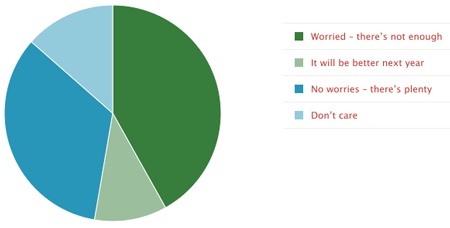
Our latest ZimmPoll asked the question, “How do you feel about the corn supply/demand status?” Sounds like there’s a little worry out there according to the results. 42% answered, Worried – there’s not enough; 34% said No worries – there’s plenty; 13% said, Don’t care and 11% said It will be better next year. If you’re worried, why?

Our new ZimmPoll is now live. We’re asking the question, “Should the Renewable Fuels Standard (RFS2) be changed?” What do you think? Take our poll and feel free to comment. Thank you.

ZimmPoll is sponsored by Rhea+Kaiser, a full-service advertising/public relations agency.

ZimmPoll

GROWMARK Sees Propane Use Growing

Cindy Zimmerman

In the home, on the farm, for businesses or for school buses, the Energy Division of GROWMARK is seeing the use of propane growing as a domestically produced, environmentally friendly fuel.

Marion Ertmer, GROWMARK Propane Marketing Manager, says some people may still think of propane as an import from the Middle East, but that’s no longer true. “Today, with the emerging sources of propane in North America, we’re actually not importing propane as a fuel, we actually have an exporting trend on propane,” he said, adding that it is a very clean fuel, similar to natural gas. “The net carbon footprint is actually much less than electricity,” said Ertmer.

Ertmer says home use of propane is also more economical than electricity. “Propane is actually about half the cost of electricity,” he said. He notes that with a propane heat and a propane-powered generator, you can be warm and have light even if the electricity goes out. “You’re never out of power with propane,” he said.

Of course, farmers are big users of propane, especially during harvest season for drying their grain, but Ertmer says the use of propane as a fuel for vehicles is an increasing new use. “Particularly school systems are looking at this for their buses,” he said, both for environmental and economic reasons. “There’s a tremendous savings on a per mile cost with propane and that’s a way for school districts to save money on their school bus fleets.”

GROWMARK sells about 300 million gallons of propane a year mainly in Illinois, Wisconsin and Iowa and is also involved in marketing wholesale propane in other parts of the country.

Listen to an interview with Marion Ertmer here: GROWMARK Propane Marketing Manager Marion Ertmer

Audio, GROWMARK, Propane

October 16 is National Plug In Day

Cindy Zimmerman

Hundreds of electric vehicle drivers in more than 20 cities from coast to coast will promote the benefits of plug-in vehicles on the first National Plug In Day on Sunday, October 16.

The event, sponsored by Plug In America, the Sierra Club, and the Electric Auto Association, will take place at simultaneous venues from Honolulu to New York. EV owners and enthusiasts will participate in electric car parades, “tailpipe-free” tailgate parties, lectures, a ceremonial plugging-in and other grassroots events.

The flagship event will be a parade of plug-in vehicles in Orange County, California where Chris Paine, director of the films “Who Killed the Electric Car?” and “Revenge of the Electric Car,” will be among the speakers. New plug-in vehicles by Nissan, GM, Mitsubishi, Toyota, SMART, Tesla, Ford, Coda and others will be available for ride-and-drives, and EV chargers and other products will be on display.

Cities where Plug In Day events will be taking place also include Washington D.C., Detroit, Phoenix, Denver, Knoxville, Seattle, Atlanta, Austin, Portland, Indianapolis, Concord, San Francisco, San Diego, Tucson, Kissimmee and Addison, Texas.

Electric Vehicles

PSM Most Cited Ethanol Plant Hazard

Joanna Schroeder

In 2010, process safety management (PSM) was the most common cited hazard at ethanol plants by OSHA (Occupational Safety and Health Administration). The data was published by Albert Patin with South Dakota State University. This year PSM citations are appearing to be on the same course as OSHA has been arriving unexpectedly at ethanol plants across the country assessing fines. More visits are expected. This is why Improving Process Safety Management is the feature of Part 4 of the Biorefinery Safety Series.

So what exactly is process safety management in the context of a biorefinery? It provides guidance on the control and use of highly hazardous chemicals (See Part 1: How to Properly Handle Chemicals in a Biorefinery), according to Nate Vander Griend with ERI, a company that has its roots with ICM dating back to 2003 and in 2006 became a stand-alone company. Vander Griend said that risk management planning is generally part of an environmental program, which ERI now provides.

“On the safety side, managing your risk is quite a bit different,” said Vander Griend. “You must get a safety program in place that not only meets OSHA requirements but exceeds them, and encompasses all the ethanol industry best practices.” He continued by explaining that there have also been property safety issues that have been a recent concern as it relates to process safety management. This encompasses how the plant is built, operated and the type of testing that happens to prevent catastrophic events such as the release of hazardous materials.

Listen to my interview with Nate Vander Griend here: Ethanol Safety Series Part IV: PSM Most Cited Ethanol Plant HazardRead More

Audio, Biodiesel, biofuels, Ethanol, safety

International Groups Urge Ending Fossil Fuel Subsidies

Cindy Zimmerman

Two international organizations are recommending reform of fossil-fuel subsidies to improve the economy and the environment.

IEAAn analysis by the International Energy Agency (IED) and the Organisation for Economic Co-operation and Development (OECD) found that governments and taxpayers spent about half a trillion dollars last year supporting the production and consumption of fossil fuels and that removing such subsidies would raise national revenues and reduce greenhouse-gas emissions.

oecdOECD and IEA say fossil fuel subsidies “create wasteful use of energy, contribute to price volatility by blurring market signals, encourage fuel smuggling and lower competitiveness of renewables and energy efficient technologies.”

The G20 leaders in 2009 agreed to phase out subsidies that “encourage wasteful consumption, reduce our energy security, impede investment in clean energy sources and undermine efforts to deal with the threat of climate change”. According to the IEA, since that agreement subsidies for fossil fuel globally have increased by $110 billion to $409 billion in 2010 and could reach $660 billion by 2020 despite the G20 countries commitment.

Global RFA“As we strive to develop alternatives to oil we must recognize that alternative fuels are not competing on a level playing field,” said Bliss Baker, spokesperson for the Global Renewable Fuels Alliance. “These massive multi-billion dollar crude oil subsidies completely outweigh current biofuel incentives and are a serious obstacle to the development of cleaner greener alternatives. Oil has a huge competitive advantage financed by global taxpayers.”
Baker notes that the G20 will meet in France next month and the issue of oil subsidies is on the agenda. “It is time for the G20 to show leadership and reverse this practice of never-ending subsidies to big oil,” Baker said. “It is time to move beyond crude oil and into a world with sustainable alternatives such as biofuels and other renewable forms of energy.”

biofuels, Ethanol News, International, Oil

Proposed Farm Bill Includes Advanced Biofuels

Cindy Zimmerman

Senator Dick Lugar (R-IN) and Rep. Marlin Stutzman (R, IN-3rd) have introduced a farm bill that they say would save $40 billion and includes provisions that support the development of advanced biofuels.

“We offer our bill as a thoughtful option for consideration by the House and Senate Agriculture Committees, as well as the Congressional Deficit Reduction ‘Super’ Committee charged with making real federal spending cuts by the end of the year,” Lugar said of the bill they have entitled “The Rural Economic Farm and Ranch Sustainability and Hunger Act” or REFRESH.

In the energy section, the legislation would “extend the current loan guarantee authority to help demonstrate new technologies, processes, and techniques for production of advanced biofuels and co-products.” It would also reform the Biomass Crop Assistance Program (BCAP) to focus on “demonstrating opportunities for farmers to diversify their income through rearing bioenergy crops and improving techniques and equipment for collecting biomass from the land for delivery to advanced biofuel production.”

The bill would would also reform farm programs, update conservation programs and close nutrition program eligibility loopholes. It also proposes to repeal the mandatory federal sugar program, allowing for market pricing of sugar.

advanced biofuels, biofuels, biomass, Ethanol, Ethanol News, Farming

Next Generation Scientists for Biodiesel Hosts Fall Webinar

Cindy Zimmerman

The National Biodiesel Board is offering students and others interested in the future of advanced biofuels the opportunity to take their renewable fuels education up a notch with the Next Generation Scientists for Biodiesel (NGSB) Fall Webinar on Oct. 18.

The webinar will feature the very latest on biodiesel research from two university students who will present their biodiesel research, and USDA’s Dr. Michael Haas, who will provide an overview of his work with low value feedstocks and in new process development.

Meredith Dorneker, a graduate student in geography at the University of Missouri – Columbia will present her research entitled “Federal Laws, Regulations, and Programs: application to biofuel production and the Roundtable on Sustainable Biofuels (RSB) Principles.” Chemical engineering undergrad at the University of Rhode Island Daniel Mallin will present his study on “The Glycerol Prewash and its Effectiveness for Removing Moisture and Free Fatty Acids from Waste Vegetable Oil for Biodiesel Production.”

The webinar will be held on October 18 at 4:00 pm central time and registration is free.

advanced biofuels, Biodiesel, NBB, Research