USDA Funds Algae Fuel Project in New Mexico

Cindy Zimmerman

USDA has issued a loan guarantee that will allow a biofuels firm to construct a facility in New Mexico to produce “green crude” oil from algae which can be refined into transportation fuel.

The loan is going to Sapphire Energy, which intends to design, build and operate a $135 million integrated algal biorefinery (IABR) in Columbus, N.M., for the production of advanced biofuel that is a “drop-in” replacement for petroleum derived diesel and jet fuel. The IABR will be capable of producing 100 barrels of refined algal oil per day, equivalent to at least one million gallons per year. The oil will be shipped to the United States Gulf Coast to be refined by Sapphire’s refinery partner, Dynamic Fuels, located in Geismar, La.

The funding is provided through USDA’s Biorefinery Assistance Program. On December 3, 2009, USDA issued a conditional commitment for an 80 percent guarantee on a $54.5 million loan. The loan closing and issuance of the Loan Note Guarantee for this project took place on October 21, 2011.

algae, Biodiesel, biofuels, biojet fuel, USDA

IEA Warns of Insecure Fossil Fuels Future

Cindy Zimmerman

The world is heading for an insecure and inefficient energy future unless there is a “bold change of policy direction” soon, warns a new report from the International Energy Agency (IEA).

The 2011 edition of the World Energy Outlook (WEO), released by IEA last week in London, said there is still time to act, but the window of opportunity is closing. “Growth, prosperity and rising population will inevitably push up energy needs over the coming decades. But we cannot continue to rely on insecure and environmentally unsustainable uses of energy,” said IEA Executive Director Maria van der Hoeven. “Governments need to introduce stronger measures to drive investment in efficient and low-carbon technologies.”

According the report, oil demand will rise 14% between 2010 and 2035, from 87 million barrels per day in 2010 to 99 million in 2035. All net increases in oil demand will come entirely from the transportation sector in emerging economies as economic growth pushes up demand for personal mobility and freight goods.

Global RFA“This is a deeply disturbing picture that the IEA has painted for the world,” said Bliss Baker, spokesperson for the Global Renewable Fuels Alliance. “Such increases are unsustainable making it imperative that all countries quickly bring real crude oil alternatives to market.”

Baker says that according to the report, an amount equivalent to twice the current total oil production of all OPEC countries in the Middle East must be discovered and brought to market by 2035.
“This is a wakeup call to the world that we need to further promote biofuels to meet this ever growing energy demand,” he said.

The IEA also highlighted the potential for supply disruptions in the Middle East and North African countries as a potential threat to world oil supplies saying that “If, between 2011 and 2015, investment in the MENA region runs one-third lower than the $100 billion per year required…consumers could face a substantial near-term rise in the oil price to $150/barrel.”

biofuels, Energy, Ethanol, Ethanol News, International, Oil

Iowa RFA Questions Rick Perry on Oil Subsidies

Cindy Zimmerman

Iowa RFAAs presidential candidate Rick Perry returned to Iowa today, the Iowa Renewable Fuels Association (IRFA) took the opportunity to question the Texas governor’s plan for energy tax incentives.

After the IRFA pointed out that Perry’s energy plan would end ethanol tax credits in less than two months, but allow oil tax subsidies to continue indefinitely, a Perry spokeswoman told Bloomberg News that Perry would “work with Congress to phase” out oil subsidies “over the next 20 years.”

Iowa RFA“How in the world does Governor Perry justify 20 more years of tax subsidies for oil companies?” asked IRFA President Walt Wendland. “The renewable tax credits cease at the end of this year. But despite that some of the oil subsidies go back 100 years, now we’re told that Perry wants to give oil companies another 20 years of subsidies. Given this extreme position, Perry’s talk about not picking winners and losers and having a level playing field is simply hollow rhetoric.”

IRFA notes that, in addition to favoring tax benefits for oil, Gov. Perry opposes the federal renewable fuels standard (RFS) but his energy plan would leave intact the “federal petroleum mandate” – mandating that over 95 percent of vehicles on the road be filled with a fuel that is a minimum of 85 percent petroleum. Perry has proposed 18 specific policy recommendations in his energy plan to promote the production and use of oil and natural gas, “but not a single policy recommendation to promote the production and use of renewable fuels.”

“The Perry energy plan is not good for Iowa’s economy or America’s security,” says Wendland.

Governor Perry is in eastern Iowa tonight and then plans a major policy roll-out on government reform Tuesday morning.

Ethanol, Ethanol News, Oil, politics

Ethanol Report from NAFB

Cindy Zimmerman

Once again this year, the Renewable Fuels Association (RFA) took part in the National Association of Farm Broadcasting’s annual Trade Talk. This unique event allows over 100 agricultural companies and organizations to have access to the nation’s farm broadcast professionals all at the same time. It is what you can truly call a “win-win” situation as the exhibitors can get their message out to farmers and ranchers nationwide and the farm broadcasters can collect lots of content for the upcoming holiday season!

RFA president and CEO Bob Dinneen spoke with a number of broadcasters about important topics facing the ethanol industry, including the expiration of the VEETC at the end of this year and the ability of U.S. farmers to produce enough corn for food, feed and fuel. In our Domestic Fuel Ethanol Report from NAFB, we also talked with Dinneen about European ethanol producers charging the U.S. with unfair imports and Brazil’s increasing imports of ethanol from the U.S.

Listen to the Ethanol Report from NAFB with Bob Dinneen here: RFA CEO Bob Dinneen

Audio, Ethanol, Ethanol News, Ethanol Report, RFA

Alaska Airlines Goes Green on Biofuels

Cindy Zimmerman

Alaska Airlines has gone green with commercial flights on biofuels.

Starting this week, Alaska Airlines began 75 commercial passenger flights in the United States powered by biofuel made from used cooking oil.

Two maiden biofuel-powered flights left Seattle November 9 bound for Washington, D.C., and Portland, Ore. Alaska Airlines and its sister carrier, Horizon Air, will continue to operate select flights between Seattle and the two cities over the next few weeks using a 20 percent blend of sustainable biofuel.

“This is a historic week for U.S. aviation. The 75 flights that Alaska Airlines and Horizon Air will fly over the next few weeks reflect our longstanding commitment to environmental responsibility and our belief that sustainable biofuels are key to aviation’s future,” Alaska Air Group Chairman and CEO Bill Ayer said. “Commercial airplanes are equipped and ready for biofuels. They will enable us to fly cleaner, foster job growth in a new industry, and can insulate airlines from the volatile price swings of conventional fuel to help make air travel more economical. What we need is an adequate, affordable and sustainable supply. To the biofuels industry, we say: If you build it, we will buy it.”

Alaska Air Group estimates the 20 percent certified biofuel blend it is using for the 75 flights will reduce greenhouse gas emissions by an estimated 10 percent, or 134 metric tons, the equivalent of taking 26 cars off the road for a year. If the company powered all of its flights with a 20 percent biofuel blend for one year, the annual emissions savings would represent the equivalent of taking nearly 64,000 cars off the road or providing electricity to 28,000 homes.

biofuels, biojet fuel

Farmers Harvest Biomass for Cellulosic Ethanol

Cindy Zimmerman

Farmers in north central Iowa have harvested 61,000 tons of corn crop residue to produce cellulosic ethanol, but delivery to POET’s Project LIBERTY plant in Emmetsburg is contingent on funding of a federal program that provides incentives for biomass production.

Some 100 farmers are waiting for word on the status of the Biomass Crop Assistance Program (BCAP) in the 2012 federal budget before delivering the bales to POET’s 22-acre biomass storage site in Emmetsburg, where the commercial cellulosic ethanol biorefinery is being constructed.

The biomass harvest is 5,000 tons more than last year and represents an additional 15 contracts with area farmers. POET has a target of 285,000 tons of biomass per year for Project LIBERTY to produce 25 million gallons of cellulosic ethanol per year starting in 2013.

“Biomass harvesting is moving along as planned, and I’m confident we’ll have a large and consistent supply of corn cobs and light stover once Project LIBERTY is running,” POET founder and CEO Jeff Broin said. “Both the farmers and POET Biomass personnel have learned a lot in the last few years about best practices in biomass harvesting, and that experience will pay dividends.”

The goal of these early harvests is to streamline the process for harvest, storage and delivery of biomass to Project LIBERTY. Approximately 300-400 bales will be part of ongoing biomass storage research, and up to 1,500 bales could be used for additional research.

Cellulosic, corn, Ethanol, POET

Nebraska Ethanol Coalition to Promote FFV Awareness

Cindy Zimmerman

A new grant awarded by the U.S. Department of Agriculture will be used to promote flex fuel vehicles, flex fuel pumps, and driver education in Nebraska, one of six states that will be working with the FlexFuel Vehicle Awareness Campaign.

NE EthanolThe Nebraska Ethanol Industry Coalition (NEIC) will be heading up the statewide project with partners including the Nebraska Ethanol Board, the Nebraska Corn Board, the Clean Fuels Foundation, ICM, Poet Ethanol Products, Monsanto, Green Plains Renewable Energy, and Phibro Ethanol Performance Group.

While the FFV Awareness Campaign is an ongoing national effort, this project will concentrate on six states: Nebraska, Iowa, Kansas, Maryland, Georgia and Florida. Key elements of the project include working with state motor vehicle departments to inform drivers that they may already have a flex fuel vehicle and how FFV drivers can easily find fueling sites offering high-level ethanol blends. The campaign will also provide an opportunity to educate all drivers on ethanol with respect to performance, emissions, and advantages it provides over gasoline and imported oil.

Todd Sneller, Chairman of the Clean Fuels Development Coalition and Administrator of the Nebraska Ethanol Board, said the project reflects a unique “virtual pipeline” that targets production states like Nebraska, Iowa and Kansas and links them with key markets like Maryland, Georgia, and Florida. “Clearly we are near the saturation point in terms of ethanol blends in conventional vehicles,” said Sneller. “To maintain the renewable fuel standard and move to the next level we need to take advantage of the 9 million FFVs on the road today that can use high level ethanol blends, ranging up to E85. For that to happen drivers need to know their vehicles have this capability and where to find the fuel,” he said.

E85, Ethanol, Ethanol News, Flex Fuel Vehicles, USDA

Your Favorite Republican Candidate?

Chuck Zimmerman

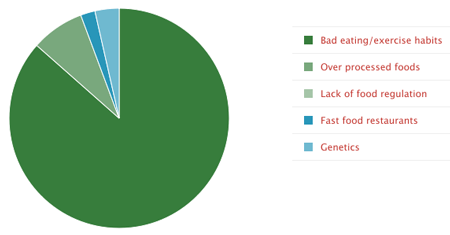
Our latest ZimmPoll seems to have hit a nerve judging by the number of responses. We asked, “What is the cause of obesity?” Eighty six percent said Bad eating/exercise habits! Only 8% said Over processed food, 4% said Genetics, 2% said Fast food restaurants and no one chose Lack of food regulation. Eating really is a personal choice as well as a necessity. Seems like personal responsibility trumps all else here. What do you think?

Our new ZimmPoll is now live. We’re asking the question, “Which Republican Candidate for President is best for Ag?” There are a lot of them and we’ve listed the main contenders of the moment. Which one would be best for renewable energy? What do you think? Feel free to add a comment here.

ZimmPoll is sponsored by Rhea+Kaiser, a full-service advertising/public relations agency.

ZimmPoll

Soybean Checkoff Promotes Biodiesel and Bioheat

Cindy Zimmerman

For the fourth year, the United Soybean Board (USB) through the soybean checkoff is joining with U.S. Department of Energy-affiliated Clean Cities to build demand for soy biodiesel and Bioheat® in major urban areas by providing some reimbursement incentive.

The Clean Cities program is a government-industry partnership sponsored by DOE that has more than 90 local chapters across the United States working to reduce petroleum consumption. The checkoff has opened the biodiesel reimbursement application process and encourages Clean Cities chapters to partner with Qualified State Soybean Boards for this project. “Hopefully we’ll see more applications for programs that reach out to potential biofuel users in the commercial area, such as heavy trucks and contractor fleets,” says Mike Beard, USB director and soybean farmer from Frankfort, Ind. “We also want to continue to reach those who make decisions in municipal governments.”

The application period will close November 14. Participating chapters will be selected by USB farmer-leaders. USB has provided up to $150,000 to use toward the funding of these soy biodiesel and Bioheat® communications programs. Selected participants in this reimbursement program will be announced in mid-December.

In addition, USB has a second reimbursement program opened for Clean Cities. This will focus on creating demand for soy-based products, many developed with the help of the soybean checkoff. This program will award three reimbursements for up to $10,000 and four reimbursements for up to $5,000.

Biodiesel, Soybeans

Cellulosic Ethanol Still Needs to Get Cheaper

Cindy Zimmerman

A cost comparison study between corn based and cellulosic ethanol has found that corn is still the cheapest way to make the alternative fuel.

The study, published in the international journal Biofuels, Bioproducts & Biorefining, concludes that “the production of ethanol from lignocellulose-rich materials such as wood residues, waste paper, used cardboard and straw cannot yet be achieved at the same efficiency and cost as from corn starch” and that it will be 2020 at the earliest before it can become competitive. The study did identify many opportunities for reducing costs and improving income within the lignocellulose-to-ethanol process, and provides insight into the priority areas that must be addressed in coming years.

Reasons for the higher cost of cellulosic ethanol include that the cost of building large scale ethanol-producing facilities will likely be higher for second generation ethanol compared to first generation technologies due to the need for significant and costly pre-treatment, according to the study’s lead author Jamie Stephen, who works in the Department of Wood Science at the University of British Columbia in Vancouver, Canada.

“Researchers and companies are going to have to concentrate on reducing the cost of pretreatment and increasing the output of the digester in order to reduce the costs of the lignocellulose-to-ethanol process,” says Stephen. Another reason costs are higher is that lignocellulose is made of multiple kinds of sugar, while corn starch consists of pure glucose. Corn starch can be reduced to glucose with low-cost amylase enzymes, while pre-treated lignocellulose requires a cocktail of cellulase enzymes. Providing these enzymes is one of the major costs of the whole process, but you currently need 12 times more cellulase than amylase protein to generate the same amount of ethanol from woody biomass.

Finally, while the input to sugarcane- and corn starch-based systems is fairly constant, the feedstocks that go into lignocellulose systems are much more variable. Different species of tree produce wood that has different properties, and waste paper and agricultural wastes will have many different types of material in them. To get maximum efficiency, each type of biomass needs to be processed under different conditions, which introduces another challenge for anyone wanting to make ethanol from these materials.

Read the study here.

advanced biofuels, Cellulosic, Ethanol, Ethanol News